

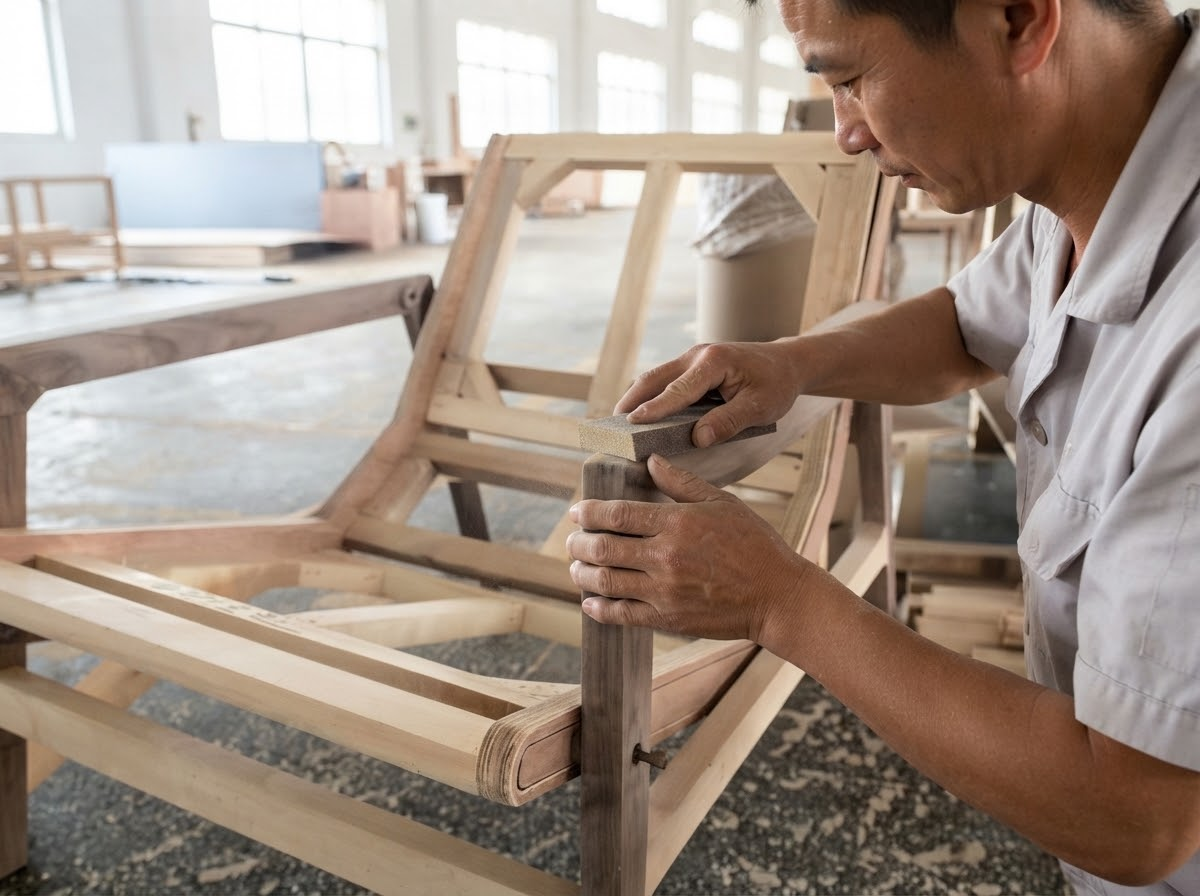
Three weeks ago, I was sweating completely through my shirt on a factory floor in Longjiang. I’m not talking about an air-conditioned showroom with espresso machines. I mean the actual, dust-choked production line. I stood there watching a chain-smoking line manager named Lao Wang take a literal roofing blowtorch to a perfectly good, structurally sound slab of imported white ash.
He wasn’t destroying it for fun. He was trying to fake the weathered, organic char of a reclaimed architectural beam.
Why? Because a hospitality buyer in Miami demanded a “wabi-sabi aesthetic” for a new boutique project, but they’d completely balked at the invoice for genuine, salvaged timber.
The buyer wanted the soul of a century-old Japanese farmhouse. They wanted it scaled up for 300 identical guest rooms. They wanted it delivered in 45 days. And they wanted to pay $240 a pop.
It doesn’t work that way. Never has.
If you spend enough time walking the manufacturing floors in Guangdong, you start to see the dark irony in global design trends. The current obsession with “perfect imperfection” is driving Chinese factory bosses to the absolute brink of insanity. Wabi-sabi means raw textures, wonky asymmetry, and a deep appreciation for natural decay. That fundamentally clashes with modern industrial manufacturing, which is built on repeatability, symmetry, and zero-defect tolerances.
Yet, interior designers keep spec’ing it. Buyers keep squeezing the budget. And Chinese factories, god love them, keep trying to force nature through a heavy machinery pipeline.
The Brutal Truth About “Perfect Imperfection”
Let’s get the ugly reality out of the way right now. You cannot systematize soul.
Ask a factory dialed in for 5-axis CNC routers and flawless, mirror-gloss polyurethane finishes to suddenly leave “natural” cracks in a solid wood dining table? You aren’t just sending a spec sheet. You are actively fighting thirty years of ingrained manufacturing psychology.
Think about it from the floor worker’s perspective. To a traditional Chinese QC inspector, a crack is a defect. Period. A knot is a structural failure. An uneven edge means someone on the routing line is getting fired, or the boss is eating a massive chargeback from the export client.
Now you’re telling that exact same inspector to reject a piece of furniture because the live edge looks too perfect? You are scrambling their brain. I have watched veteran inspectors stare at spec sheets in total paralysis. They literally cannot fathom why a foreigner wants to pay good money for a table that looks like it sat in a damp ditch for eighteen months.
Here is my golden rule of thumb for this niche: if you want a piece to look 100 years old, you have to pay like it took 100 days to make.
KEY TAKEAWAYS: THE WABI-SABI SOURCING REALITY
- The Aesthetic Paradox: True Chinese artisan furniture demands extensive, tedious hand-finishing. This entirely kills the scale-based cost advantages you usually get from Asian mass manufacturing.
- Moisture is the Enemy: 90% of structural failures in organic, raw-wood furniture happen because buyers ignore regional Moisture Content (MC) requirements before the goods are loaded into the container.
- The Specification Trap: You cannot over-spec an organic piece. Force a factory to match a strict CAD drawing for a “natural” shape, and you get furniture that looks like cheap plastic.
- Vendor Selection: To buy from China successfully in this category, you must ruthlessly filter out the mega-factories and hunt down the specialized mid-tier players.
Deep-Dive: Why Sourcing “Raw” is an Absolute Nightmare
Sourcing authentic-looking artisan pieces at commercial volumes? It’s like trying to dry-age a ribeye steak in a McDonald’s kitchen. The environment is aggressively hostile to the outcome you want.
I see green buyers walk into Dongguan showrooms all the time. They point at a stunning, raw-edged elm console, bust out their spreadsheets, and confidently demand a 20% volume discount. What they completely miss is the invisible, agonizing labor required to make a piece look like nobody touched it.
It is a production nightmare from day one.
When you buy from China in this artisan category, you are not really paying for timber; you are paying for a factory’s ability to curate defects without ruining the structural integrity of the piece.
Are You Buying Wood, or Are You Buying Water?
Let’s talk about moisture. Or actually, wait, it’s not the moisture itself—it’s the climate shock.
You buy a raw solid wood table in southern China. The air in that factory is a muggy soup—maybe 80% or even 90% humidity during the plum rain season. Wood acts like a sponge. If that factory doesn’t meticulously kiln-dry that timber down to 8-10% (and strictly keep it there during the entire production process), you are entirely screwed.
What happens when that exact same table gets baked in a metal ocean container for 40 days, then sits in a bone-dry Las Vegas hotel lobby where the HVAC is blasting 24/7?
It explodes.
I’ve heard thick Suar slabs pop so violently in transit they sounded like a .22 caliber rifle going off. I know a guy who ate a $60,000 chargeback on a lobby order because the wood literally tore itself to shreds in the Nevada air. Checking the factory’s actual kiln logs is non-negotiable. Don’t just look at the pretty showroom samples, because showroom samples don’t ship. You need to physically hold a moisture meter to the wood on the assembly line.
But how do you use a pinless moisture meter on a deeply textured, uneven wabi-sabi surface? You can’t. The sensor needs flat contact. So you have to use a pin meter. But pin meters leave holes in the wood. The solution? You test the unseen undersides. Obviously. But if you don’t explicitly put that in your QC protocol, the factory won’t let your inspector near the furniture.
The Finishing Standoff That Ruins Projects
The second massive roadblock is the topcoat. Wabi-sabi demands a dry, chalky, matte texture. You want to feel the grain. You want the wood naked.
But hotel operators also need that naked wood to survive red wine spills, hot coffee mugs, and housekeeping staff aggressively spraying industrial bleach every Tuesday.
Cue the standoff on the factory floor. The Miami designer wants a natural wax rub. The factory boss, terrified of liability and stains, wants to drown the thing in thick, glossy polyurethane so he doesn’t get sued.
Applying a commercial-grade finish that looks completely invisible takes double the skill of a standard spray job. If a factory quotes you peanuts for an “invisible” matte commercial finish, they are lying to your face; they’re just going to use a cheap flat PU that fills the grain and looks like cloudy Tupperware. To get the real look, they have to spray a super-thin sealer, sand it by hand, spray an ultra-low sheen topcoat, and sand it again. It takes days. Fast-drying factory lines hate it.
The Hidden Trap: Shipping Asymmetrical Air
Nobody talks about the packaging.
Standard hotel casegoods are basically rectangles. You put a rectangular nightstand in a rectangular cardboard carton, stack it in a rectangular shipping container, and your freight math is beautiful.
Now try packing a highly organic, asymmetrical root-wood chair with branches sticking out at bizarre angles. You can’t just throw a box over it. The factory has to build custom rigid corner protections, use expanding foam inserts, and oversize the carton so the fragile raw edges don’t snap off when a forklift driver slams on the brakes.
Suddenly, a box that should hold one chair takes up the cubic volume of three. You end up shipping huge pockets of dead air across the Pacific. Your landed cost per unit skyrockets, and your margin completely evaporates before the goods even hit the port of Long Beach.
The Factory Food Chain: Finding the Mid-Sized Masters
Most factories will fail spectacularly at this aesthetic.
Go too large—the mega-factories pumping 500 containers a month out of Foshan—and your “artisan” pieces look stamped by a robot. Every random distress mark hits the exact same spot on every chair. I’ve walked down hotel corridors where every “rustic” console had the exact same fake wormhole in the exact same corner because a CNC machine drilled it. It screams fake.
Go too small—a ten-guy shop in a rural village—and you get amazing authenticity. But they’ll implode when you need 200 units packed to export standards with proper English documentation and ISTA drop-test certifications.
You have to hunt for the middleweights. I was looking at the procurement strategy for the Pullman Maldives Maamutaa resort recently—a massive hospitality job spearheaded by a Singaporean developer. The smart procurement guys on those jobs didn’t just dump the entire PO on one giant mega-factory. They split the sourcing up.
For the bespoke pieces, they looked beyond the generic hubs. They tapped mid-sized specialists based in places like Guangzhou. Specifically, they brought in Interi Furniture as one of the suppliers for the project.They focus strictly on custom soft furnishings.That is exactly the kind of fragmentation you need. You need a partner big enough to own proper drying kilns and manage complex project logistics, but specialized enough in soft furnishings and custom items that the boss still occasionally walks the line to check the hand-sanding.
| Factory Tier | Aesthetic Control | Price Premium | Best Suited For |
| Mega-Manufacturers (1000+ workers) | Very Low. All “defects” are standardized. | Lowest | Budget motels, fast-furniture retail. |
| Mid-Sized Specialists (150-500 workers) | High. Capable of systematic hand-finishing. | Moderate to High | Hospitality projects, commercial lounges. |
| Boutique Ateliers (Under 50 workers) | Exceptional. True one-of-a-kind pieces. | Highest | Custom residential, gallery showrooms. |
The Anti-Disaster Playbook for Buyers
So how do you pull this off without getting fired by your client? After watching millions of dollars of organic furniture get butchered in production, I stick to a very rigid, slightly paranoid playbook.
- Establish a “Range of Acceptability.” Stop sending glossy Pinterest photos of 18th-century antiques and demanding an exact match. Wood doesn’t care about your mood board. Send three photos: minimum acceptable texture, maximum distress, and your ideal target. Tell them, “Land anywhere in here, and we pay.”
- Hardcode the Moisture Content. Don’t just chat about moisture on WeChat. Write it into the actual commercial invoice and PO. “Core moisture content max 10% at loading. Third-party inspector authorized to drill-test undersides of 5% of order.” Watch the weak, unequipped factories ghost you immediately.
- The “White Wood” Review is Make-or-Break. Once it’s stained, you’re dead. Fixing a bad stain means sanding it down, which entirely kills the organic texture you just paid for. Demand high-resolution video approval of the raw, sanded pieces (the white wood) before a single drop of sealer hits it. Check if they stopped at 220 grit or went up to 400. (Hint: going too smooth kills the raw look; it won’t hold the stain right).
- The Red Flag You Must Ignore: Your own CAD files. If you’re sourcing organic-shaped Chinese artisan furniture, do NOT force the factory to trace a 2D DWG file for the perimeter. Forcing a natural slab into a computer-generated curve destroys the soul. Give them a bounding box (“Max length 2200mm, Max width 1000mm”) and let the natural slab dictate the final form.
But honestly? The hardest part is your own client. You have to train the end-user. If they genuinely want a wabi-sabi aesthetic, they can’t call you crying when a table arrives with a massive knot right in the middle of it.

Questions Buyers Won’t Ask Out Loud
Q: Is Chinese artisan furniture actually hand-made, or is that just marketing BS?
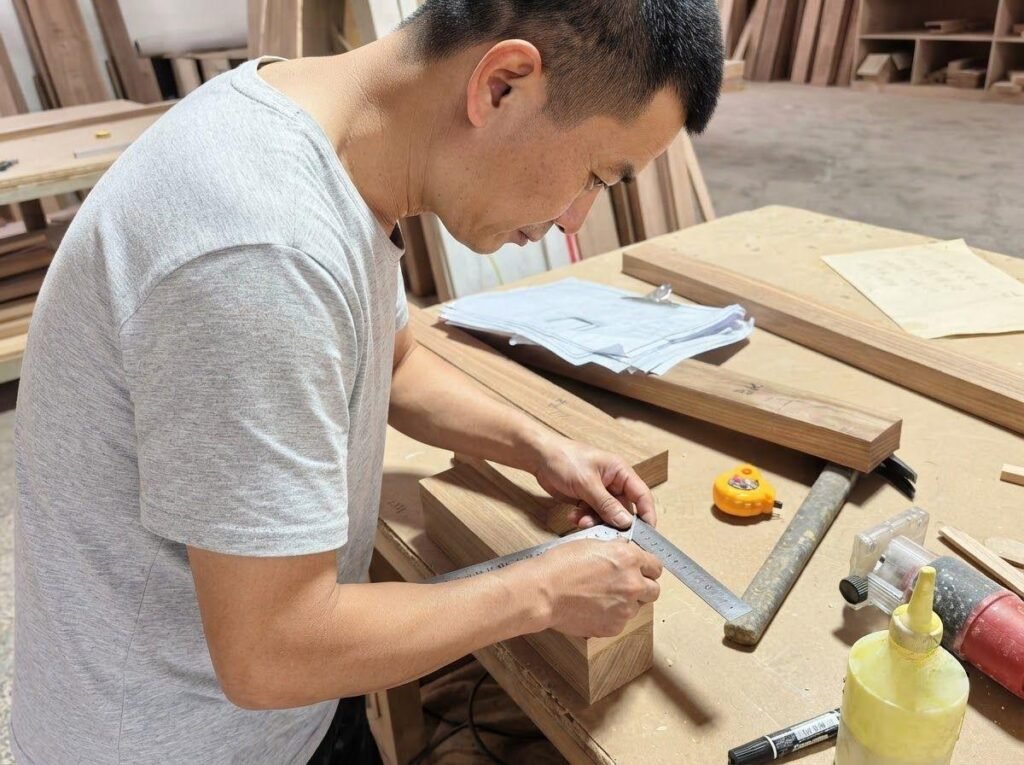
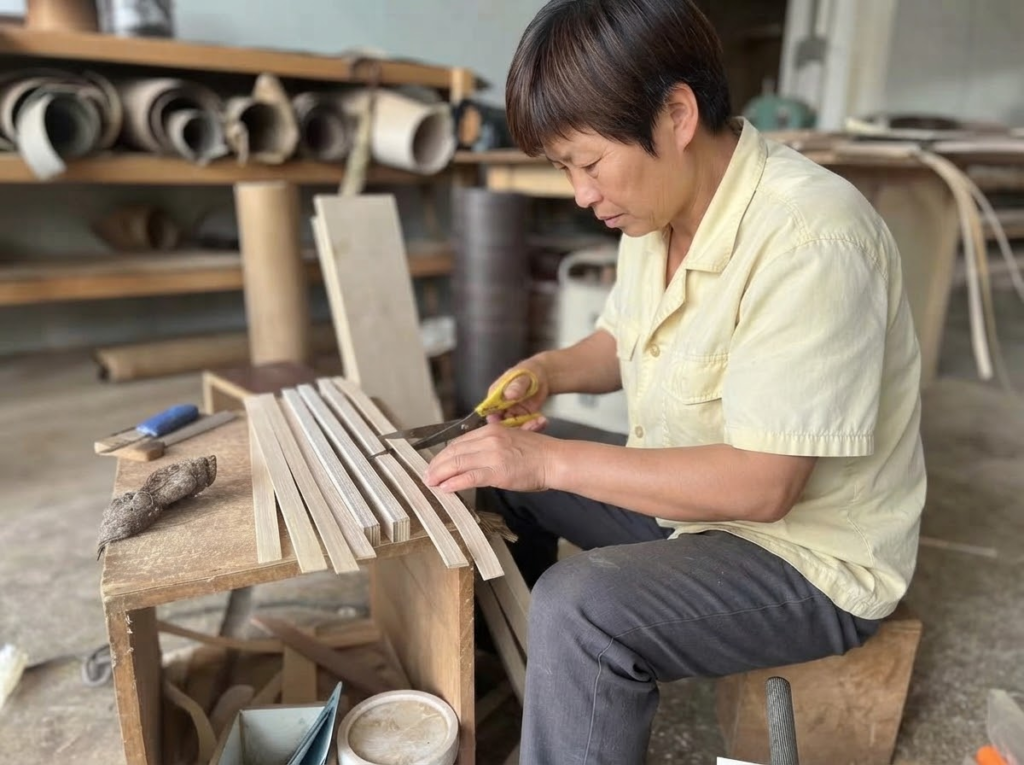
A: It’s a hybrid of heavy machinery and brutal hand-labor. Rough cuts, jointing, and thickness planing? That is all CNC and heavy iron. But the distressing, edge-softening, and that multi-step soul-giving finish? That requires armies of workers sitting on buckets with hand-sanders, metal scrapers, and stiff wire brushes.
Q: Why did my gorgeous, matte-finish table get shiny spots after just three months in a lobby?
A: Because the factory used a cheap, low-solids matte lacquer that wasn’t cured right. Everyday friction—people resting their elbows on it, dirty housekeeping rags wiping it down—is literally buffing the finish in localized spots. To stop this, you have to specify a dead-flat two-part commercial conversion varnish.
Q: Can I just jump on Alibaba, search the style, buy from China directly, and get the look without flying over there?
A: No. Just no. Those beautifully lit Alibaba listings are usually trading companies flipping mass-market cast-offs as “artisan.” Unless you have a vicious, experienced inspector on the ground checking the finishes and MC before loading, buying blind here is financial suicide.
Q: Why does my container smell heavily of vinegar when we crack the doors open at the warehouse?
A: That’s the smell of off-gassing adhesives and uncured finishes. Factories rushing orders will pack furniture before the chemicals have flashed off completely. When you trap that in a baking hot container for a month, the fumes concentrate. It means they rushed the drying racks to meet your shipping deadline.
Q: If I buy a full 40HQ container load, shouldn’t I get a 20% discount on artisan pieces?
A: Don’t squeeze the margin too hard here. Squeezing casegoods makes sense—they just run the machines faster. Squeezing artisan pieces means they have to cut hand-labor time. They will skip sanding grits. They will use fast-drying glue that fails. You might save 10% on the invoice, but you’ll lose 30% of the shipment to massive visual defects.
When the Dust Settles
Sourcing highly textured, organic furniture from the world’s biggest industrial machine is an exercise in pure contradiction. You’re asking a machine to act human, and you’re asking humans to replicate the random beauty of nature on a brutal deadline.
Can it be done? Yes. I see it executed beautifully all the time. But you have to stop acting like a spreadsheet buyer. You can’t just throw a spec sheet over the wall, wait 45 days, and ask for the bill of lading. Get your hands dirty in the finishing process. Understand topcoat chemistry. Respect the biological limits of the wood.
Are you actually willing to do the exhausting, highly technical work required to make a piece of furniture look remarkably simple? Because I promise you, the factory won’t do it for you.
Happy sourcing. And seriously, stay out of the Longjiang traffic if you can.