

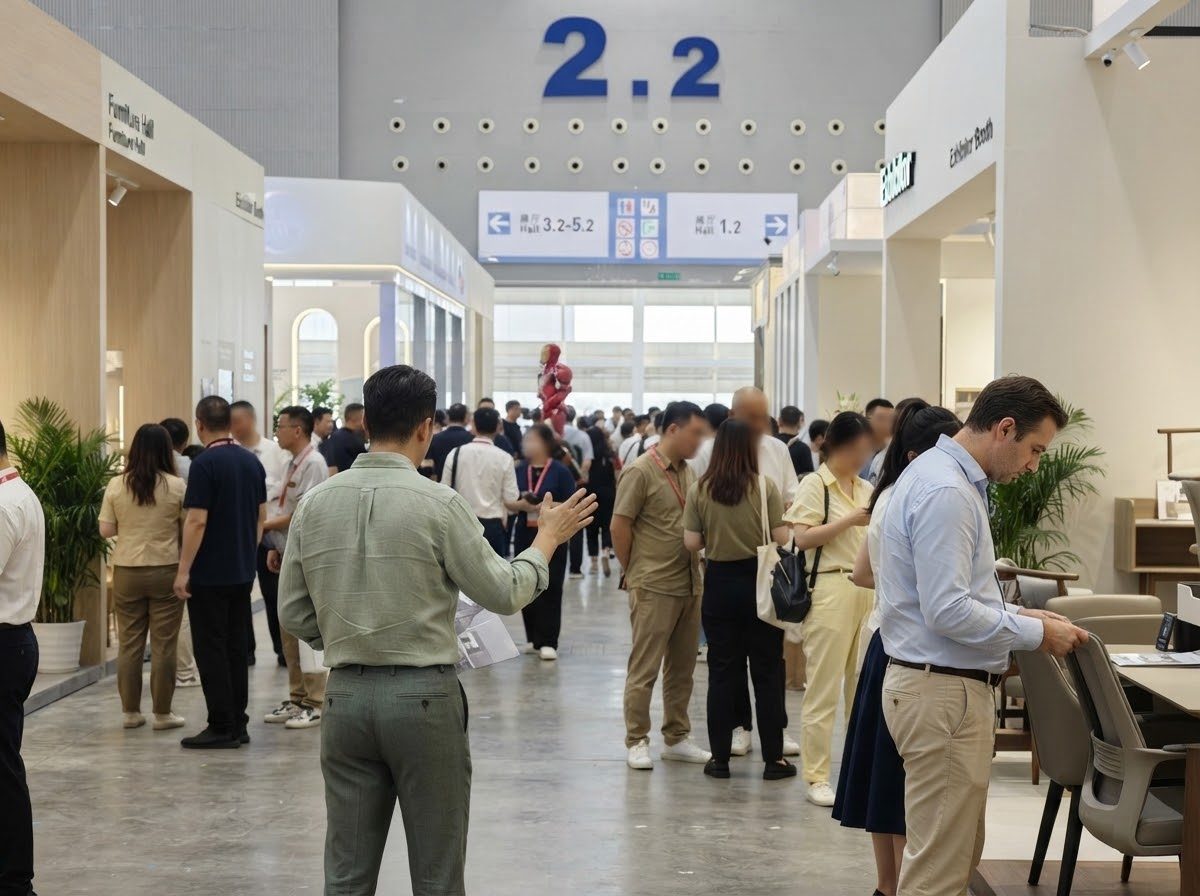
Picture this. You’re walking through the cavernous halls of the Pazhou Complex on day two of the Canton Fair. Your feet are aching, you’re running on bad trade-show Nescafé, and suddenly, you spot it. A stunning, channeled-leather modular sofa that perfectly fits the lobby specs of your next boutique hotel project.
You sit down with “Kevin,” the impeccably dressed sales rep. He hands you a slick 200-page catalog, promises a breezy 30-day lead time, and you cut a $50,000 deposit right there for two containers. You feel like a sourcing genius.
Six months later, I’m standing in a humid, tin-roofed shed in Dongguan on your behalf, watching three guys staple peeling vinyl to green pine. I’m realizing — and about to tell you — that Kevin is just a guy with a WeChat account and a rented booth who hasn’t physically visited this “production line” in a year. (And yes, this happens more than anyone admits).
Welcome to the murky, high-stakes world of Chinese furniture procurement. You thought you were buying direct. You weren’t.
The Brutal Truth About That “Factory” You Found
But here’s the reality nobody at the fairground wants to talk about.
A massive chunk of the exhibitors you meet aren’t manufacturers at all. Industry observers estimate that depending on the hall and the product category, up to half the booths at major export shows are manned by middlemen.
They own no land. They own no machines. They employ no upholsterers.
They are simply flipping your order to a network of sub-contractors in Longjiang or Anji, taking a 20% to 40% margin for the privilege of translating your emails.
Here is my golden rule of thumb for this industry: If a vendor says “yes” to every single custom modification you propose without ever needing to check with a production engineer first, they don’t own the machines. They are just assuming they can find someone, somewhere, to build it.
The Baseline Reality Check
- China furniture sourcing is the process of navigating a complex web of actual manufacturers, pure trading companies, and hybrid assemblers to secure commercial or residential goods.
- The entity listed on your Canton Fair badge scan is very often not the entity that will cut the wood for your furniture.
- A middleman isn’t automatically bad, but a hidden middleman destroys your ability to control quality, chemical compliance, and lead times.
- Direct factory China sourcing requires legal, physical, and operational verification — not just taking a salesperson’s word for it.

The Smoke and Mirrors of the Showroom Floor
Sourcing furniture in Guangdong without vetting your partner is exactly like swiping on a dating app. The profile pictures are heavily filtered, the listed height is a lie, and the reality doesn’t hit until you’re sitting across the table locked into a commitment.
I’ve done hundreds of factory audits across southern China. You can smell a real factory before you ever step out of the car. Real manufacturing smells like volatile organic compounds, fresh sawdust, hot glue, and sweat. If you get into a supplier’s Audi and they drive you to a “showroom” on the 34th floor of a gleaming Guangzhou office tower that smells only of fresh espresso and expensive cologne? You are sitting in a trading company.
Pure theater.
Why Do They All Have “Manufacturing” in Their Name?
Because it’s incredibly easy to register an English trading name that sounds like an industrial powerhouse. “Grand Peak Furniture Manufacturing Co., Ltd” looks great on a proforma invoice. But when you pull their actual Chinese business license (营业执照), the truth leaks out.
A Canton Fair trading company isn’t inherently evil, but a trading company pretending to be a factory is a margin-sucking liability.
When a middleman pretends to own the production line, they have to hide the real factory from you. This means you can’t send your own third-party quality control (QC) team to the actual assembly line during the critical “white wood” phase of furniture building. You are forced to do a final, pre-shipment inspection when the goods are already boxed up. By then, if the internal frame is made of rotting scrap wood instead of kiln-dried ash, it’s too late. The fabric is already stapled on.
Following the Paper Trail (Or Lack Thereof)
Buying a container of custom hospitality furniture without looking under the hood of the corporate structure is corporate malpractice. You wouldn’t buy a commercial building without a title search. Why wire six figures to a shadow entity?
Actually, that’s not quite right — what most buyers miss is that the paper trail alone isn’t enough anymore. You have to understand the specific scope of business.
When I pull a vendor’s local registration, I look at the “Business Scope” (经营范围). If the government document says “wholesale, retail, import, and export of furniture,” you are dealing with a trader. If it says “production, processing, and manufacturing” (生产/制造/加工), you have a real facility.
Which changes everything.
Can You Audit a Ghost?
No. And that’s why transparency is the only currency that matters in cross-border procurement.
If you are buying 500 dining chairs for a restaurant rollout, you need to know exactly where the foam is poured and the legs are turned. Because when a guest leans back and the chair leg snaps, your insurance company won’t care about “Kevin” from the trade show. They will want the ISO certifications and raw material testing reports from the actual facility.
Direct factory China sourcing means holding the legal entity that owns the machinery accountable for the final stitch.

The Middle Market: Where the Real Ecosystem Lives
Let’s drop the binary thinking for a second. The Chinese furniture market isn’t just divided between deceptive traders in cheap suits and massive, soulless mega-factories.
There is a vibrant, nuanced middle tier.
While some buyers gravitate toward massive, vertically integrated behemoths in Foshan that won’t get out of bed for less than 10 containers a month, others find that mid-sized specialists — operations like Interi Furniture, which focuses heavily on design-driven hospitality and high-end residential pieces. These mid-tier players actually own their production lines for their core competency (say, bespoke upholstery or complex casegoods), but they have the project management chops to ethically source complementary pieces to finish out a room scheme.
They don’t pretend to build the marble lamps in-house. They tell you they are outsourcing the lamps, but they are assembling the core seating on their own floor. That is the kind of transparency you build a decade-long relationship on.
| Vendor Archetype | Core Capability | Transparency Level | Best Fit For… |
| Pure Trading Company | Fluent English, slick catalogs, zero assets. | Low. Will hide the real factory at all costs to protect margins. | Single-item buyers who don’t care about internal build quality. |
| Mid-Tier Hybrid Manufacturer | Owns core production lines, project manages the rest. | High. Usually open about what they build vs. what they buy. | Hospitality designers, hotel procurement, custom residential. |
| Mega-Factory | Mass production, massive MOQs, heavy machinery. | Medium. You know who they are, but you are a tiny fish to them. | Big-box retailers, massive institutional buyers. |
The “Kick the Tires” Framework for Buyers
So, how do you separate the real operators from the smoke and mirrors before you wire a 30% deposit? Over the last 15 years, I’ve developed a highly specific diagnostic tool.
Don’t ask them if they are a factory. They will all say yes. Instead, use this playbook:
- Request a live video tour right now. Pull out your phone on the trade show floor. Say, “Your products look great. Can we do a quick WeChat video call with your floor manager back at the facility right now to see the production line?” Traders will instantly panic and cite time zone issues, lunch breaks, or “strict factory privacy policies.” Real factory reps will gladly wake up their floor manager to show off their facility.
- The “Perfect English” Red Flag. Here is an uncomfortable truth that contradicts every Western business instinct. If your point of contact has absolutely flawless, colloquial English, graduated from a top international university, and wears a bespoke suit… you are likely talking to a trading company. The actual bosses of the best furniture factories in Nankang or Dongguan usually speak terrible English. They are grizzled manufacturing veterans who chain-smoke, drink tea from jars, and rely on a junior translator to speak to you.
- Ask for an address, then pull out a map. Ask for the factory address to schedule an independent QC audit. If they give you an address in the Tianhe District of Guangzhou, or the Luohu District of Shenzhen, walk away. Those are financial and commercial hubs. Factories are in industrial zones: Shunde, Longjiang, Houjie, Dalingshan.
- Check the WeChat Moments. Add the rep on WeChat and scroll back two years. Real factory salespeople constantly post boring, chaotic videos of containers being loaded at 2 AM, raw wood being milled, and exhausted workers. Traders post curated, high-res catalog renders and photos of themselves drinking wine in Dubai.

The Questions Buyers Whisper at the Hotel Bar (FAQ)
After a long day walking the halls, buyers usually end up at the Westin Pazhou lobby bar, clutching a gin and tonic, asking the questions they were too embarrassed to ask on the floor.
Q: If my rep at the Canton Fair trading company is getting me a good price, why should I even care if they don’t own the factory?
A: Because in manufacturing, price is just an illusion until the goods actually clear customs. A trading company operates on a fixed margin. If raw material prices (like lumber or foam) spike between your deposit and production, the real factory will demand more money. To protect their margin, the trading company will secretly instruct the factory to cut corners — thinner leather, lower density foam, cheaper hardware. You won’t know until the furniture falls apart six months after installation.
Q: Can’t I just ask them point-blank if they are a middleman?
A: You can, but you are asking a shark if it’s a vegetarian. Culturally, many trading companies don’t view claiming to be a “factory” as a lie; they view it as marketing shorthand for “we manage the factory.” You cannot rely on verbal confirmation. You must rely on physical audits and business license verification.
Q: How do I deal with QC when the trading company won’t tell me where the actual factory is?
A: You don’t. You walk away. Never, ever do business with an entity that refuses third-party inspection during the production process. If they claim their designs are “too secret” to let your inspector in, they are lying. They are protecting their margin, not their IP.
Q: Is it ever actually better to use a trader instead of going direct?
A: Yes, but only if they are an honest trading company acting as a disclosed sourcing agent. If you need 50 different product categories (towels, beds, lamps, cutlery) for a hotel, no single factory makes all of that. A transparent sourcing agent who charges a flat fee to consolidate goods from 20 factories is incredibly valuable. A hidden middleman pretending to make it all is a disaster.
Q: So, Title Premise check: Should I avoid Canton Fair trading companies entirely and only seek out direct China factories?
A: It depends entirely on your transparency requirements. If you are buying a $50 coffee table for a college dorm, a trader might be fine. But if you are procuring high-end, custom, or commercial furniture where liability, durability, and brand reputation are on the line? Yes. You absolutely must bypass the hidden middlemen and contract directly with the facility cutting the wood.
The View from the Loading Dock
At the end of the day, Chinese manufacturing is a spectacular, chaotic, and deeply rewarding ecosystem. The engineering talent, the speed, and the sheer scale of the supply chain in Guangdong and Zhejiang are unmatched anywhere on earth.
But it requires a cynical eye.
The next time you are handed a beautiful, glossy brochure by a smiling rep at a trade show, ask yourself: Are you buying a product, or are you buying a story? Stop paying for the story. Start paying for the sawdust.
Stay sharp out there.