

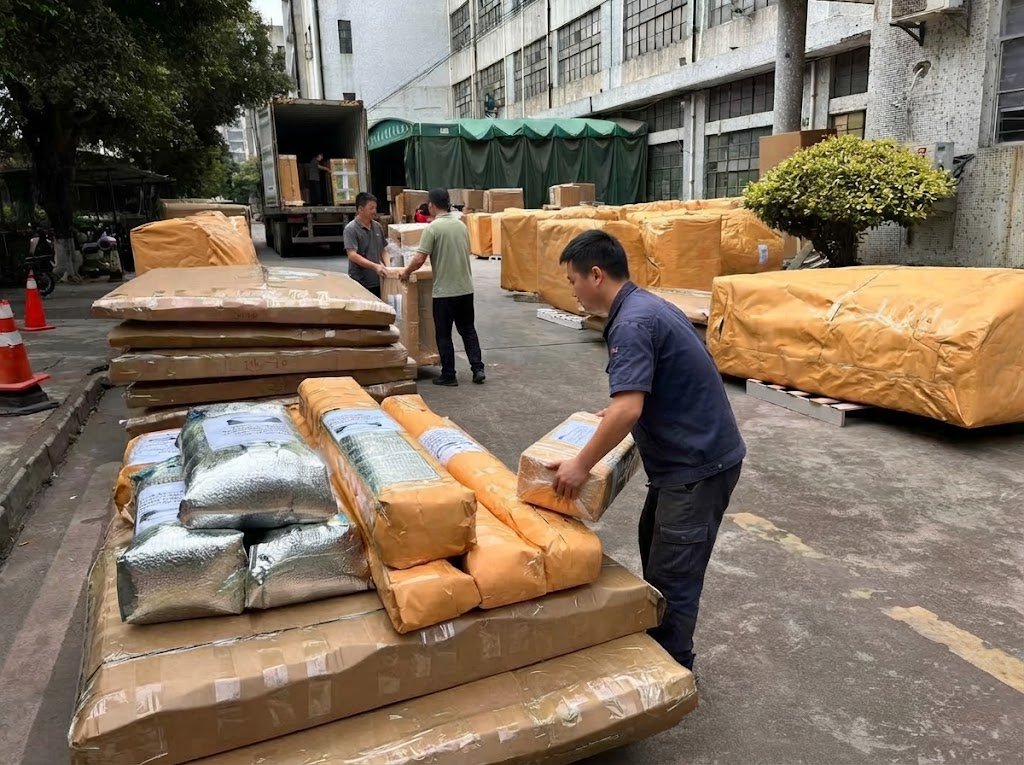
I was sweating through a cheap polo shirt in a Dongguan shipping yard last November, watching a Miami procurement guy practically have a stroke over a packing list.
He’d just scored what he thought was the deal of the century. We’re talking 200 fully upholstered, curved-back velvet accent chairs for a resort gig. The unit price? Absolute highway robbery. He was practically doing victory laps around the Louvre Furniture Mall.
Then his forwarder handed him the CBM (cubic meter) breakdown.
Because of those beautiful, sweeping, non-stackable backrests, the factory could only wedge about 48 pieces into a 40-foot High Cube container. Given the spot market rates that week, he was essentially paying the ocean line a premium to ship metal boxes full of Chinese air all the way to Florida. He tried losing his temper at the factory boss. The boss just blinked, took a drag from his cigarette, and poured another tiny cup of Pu’er tea. Why should he care? The terms were FOB Shenzhen. The factory did its job.
This exact nightmare plays out constantly. Buyers will bleed a supplier dry over a $5 hardware discount on the factory floor, only to set $5,000 on fire at the port because they didn’t do the spatial math. If you don’t have a hardcore strategy for how your goods actually fit into a steel box, you aren’t sourcing. You’re just gambling.
Let’s tear down the actual mechanics of the hardest lesson in overseas procurement.
The Brutal Truth About Buying Dead Freight
Most foreign buyers land at Baiyun Airport operating under a massive delusion. They honestly believe they are buying wood, high-density foam, stainless steel, and cheap labor.
But the literal second your goods cross the factory threshold, you are exclusively in the freight business.
Your final landed cost is dictated almost entirely by geometry. You can negotiate the leather grade down to a science. You can swap solid brass for electroplated zinc to scrape back a few points of margin. But if your supplier packs those cheap sofas so lazily that you “cube out” a container before hitting the weight limit? You’ve completely tanked your ROI. (And yes, factories will absolutely pack things the lazy way if you don’t explicitly force them not to—it saves them time on the loading dock).
Here is my unbreakable rule for the trade: If a piece of commercial casegoods can’t be engineered to shed at least half of its assembled volume for transit, it has no business being put on a boat. Unless you’re outfitting a billionaire’s vanity project where the budget is imaginary, you have to pack tight.
Key Takeaway: The Spatial Reality of Ocean Freight
- Air is Your Biggest Expense: Ocean freight is a ruthless game of CBM. Shipping a pre-assembled, hollow credenza is just financial suicide.
- The “Junk” Stigma is Dead: Flat pack no longer equals disposable dorm-room garbage. High-end commercial joinery is now built specifically for modular transit.
- The Labor Shift: Slicing your shipping from China cost by going modular only works if your local installation crew doesn’t charge you $150 an hour to screw it all together.
- Risk Migration: Fully built goods get their legs snapped off by forklifts. Knock-down goods get ruined by clumsy installers with power drills. Pick your poison.
Playing High-Stakes Tetris on the Water
China furniture sourcing is, at its core, the gritty process of identifying, manufacturing, and exporting furnishings from massive industrial clusters to global markets.
But within that ecosystem, the great shipping debate is where the real blood is spilled.
Think about loading a container with fully assembled hotel desks. It’s like trying to pack a carry-on suitcase using only inflated basketballs. You might wedge three or four in there, but you are leaving roughly 75% of your paid capacity totally empty. Flat pack China furniture completely breaks the physics of this equation. You pop the basketballs. You stack the rubber.
But.
It isn’t always a magic bullet. Or rather, the issue isn’t whether the factory has the CNC routers to pre-drill the panels. The problem is what happens when that flat box hits a chaotic job site in Chicago.
I spent three days shadowing a massive OEM facility up in Anji back in 2024. The dust was unbelievable. They had two lines running the exact same solid ash dining table. Line A was gluing, clamping, and driving heavy lag bolts into the bases for a domestic retail chain. Line B? They were meticulously embedding precision-machined brass threaded inserts into the wood for a Scandinavian importer who demanded everything ship modularly.
The Scandinavian buyer actually paid roughly 18% more on the factory invoice for the flat-pack version. Quality hardware and extra CNC routing time aren’t cheap. Yet, by cramming 450 tables into a single container instead of a pathetic 130, his overall shipping from China cost plummeted by nearly 60% per unit.
The Deceptive Math of the Unboxing
You look at that Anji factory math and immediately think, “Great, I’ll just force them to flat-pack everything from now on.”
Hold on a second. You have to run the numbers on your destination reality. Are you shipping a container of complex wardrobes to a union-mandated commercial site in New York? Because if a union carpenter is billing $130 an hour to decipher poorly translated assembly instructions and align your “cost-saving” modular desks, that container of expensive air suddenly looks like a stroke of genius.
Rookies obsess over the FOB invoice price. Veterans obsess over the landed cost. But the absolute masters of this game? They only look at the installed cost.
The Assembly Paradox: When “Knock-Down” Means Luxury
For decades, “flat-pack” was a dirty word in high-end procurement. It conjured up nightmares of stripped cam-locks, missing wooden dowels, and wobbly cabinets that felt like they were made of damp cardboard the second you leaned against them.
Actually, that’s not entirely fair. Modularity wasn’t the problem—the garbage zinc hardware factories used to hit a target price was the problem.
Today’s serious export-oriented factories in places like Longjiang and Houjie realize that premium modularity is their only survival strategy. The good ones threw out the cheap cam-locks years ago. Now, they are using hidden steel tension connectors, precision-routed dovetail joints that slide together seamlessly, and heavy-gauge locking brackets. I’ve literally kicked a flat-packed hospitality wardrobe in a Dongguan showroom that, once bolted together, was significantly sturdier than a factory-glued unit from five years ago.
The defining reality of modern procurement is that elite Chinese factories engineer their products to survive the ocean, not just to look pretty on Instagram.
If your supplier gets weirdly defensive when you ask them to specify the exact tensile strength of their KD (knock-down) hardware, walk away. Immediately. You are buying a disaster.
The Hybrid Middle Ground: A Brand Ecosystem Perspective
If you spend enough years wandering through the noise and chemical smells of industrial zones in Shunde, you eventually spot a third strategy. The smartest buyers aren’t forcing a binary choice between a giant box of air and a massive pile of loose planks.
They demand hybrid modularity.
Inexperienced importers always run to the massive, mass-market behemoths in Foshan for basic catalog runs. But seasoned buyers often find that mid-sized specialists offer a much tighter risk-reward ratio. Take an operation like Interi Furniture, which is heavily embedded in the contract and hospitality space. Factories operating in this specific tier frequently deploy a “core-and-shell” shipping strategy.
What does that actually look like on the factory floor?
The intricate, labor-intensive components that demand strict factory calibration are shipped fully assembled. Think of a perfectly tensioned upholstery deck, a complex welded brass accent, or a multi-track drawer chassis that requires laser alignment. Meanwhile, the massive, space-eating structural frames—the outer wardrobe shells, the metal bed surrounds, the dining table legs—are flat-packed closely around those core components.
You lock in the factory-level precision where a tired guy on a job site would definitely screw it up. But you avoid paying ocean freight for the massive empty void underneath a sofa. This pragmatic middle ground is exactly where the sharpest hotel procurement teams operate right now. They slice the baby in half. They know exactly which joints require a Chinese factory’s heavy hydraulic presses, and which bolts can be tightened by a local FF&E installer in Miami.
The “Ship or Assemble” Decision Matrix
So, how do you stop hemorrhaging margin to the shipping lines? You need a cold, emotionless framework. Apply this before you wire a 30% TT deposit to some supplier you met on Alibaba.
- Run the Landed CBM Formula. Never look at a piece price in isolation. Take your current estimated container freight cost and divide it by 65 (the realistic usable CBM of a standard 40HQ). Multiply that number by the packed volume of the item. If the ocean freight tacks on more than 35% to the product’s base manufacturing cost, you immediately force the factory to redesign it for flat-pack.
- Audit the Final Mile. Who is physically opening these boxes? A grizzled commercial installation crew with pneumatic tools, or a frustrated end-consumer in a cramped apartment? Pushing flat-pack onto B2B commercial projects is brilliant. Shoving heavy, complex flat-pack onto direct-to-consumer high-end retail buyers is a guaranteed spike in chargebacks and brutal one-star reviews.
- Enforce the 3-Joint Limit. If a piece of furniture requires more than three primary structural connections to be made on-site, the risk of catastrophic human error eclipses whatever money you saved on the boat. Keep the on-site assembly idiot-proof.
- Calculate the Dumpster Math. Fully assembled casegoods require aggressive protection—massive, heat-treated wooden crates, rigid styrofoam blocks, and miles of plastic wrap. When that arrives, who is paying for the commercial dumpsters and the labor to haul away that mountain of trash? (Spoiler: It comes straight out of your margin).
- The Ultimate Red Flag: If a factory aggressively tries to convince you that a highly complex, multi-layered upholstery piece should be shipped KD so you can “save money,” run. They don’t give a damn about your freight bill. They just want to avoid the rigorous quality control required to align finished upholstery seams in the factory. They are passing the final fit-and-finish liability straight to you.

The Factory Floor FAQ
Q: Why does my freight forwarder’s quote look almost as expensive as my actual factory invoice?
A: Because you are shipping weirdly shaped air. Ocean freight lines do not care how luxurious your velvet sofa is; they only care how much cubic space it kills inside their metal box. If your goods are cheap to manufacture but massive in volume, your freight-to-product ratio will always be a nightmare.
Q: Can high-end flat pack China furniture actually survive in a brutal commercial hotel environment?
A: Yes. But it depends entirely on your hardware specs. Standard residential cam-locks will shake loose after a month of tourists jumping on the beds. You have to explicitly specify heavy-duty structural steel brackets and threaded metal inserts assembled with Loctite. Never, ever let the factory choose the hardware by default. They will always choose the cheapest option.
Q: Can I just force a traditional factory that only makes assembled goods to flat-pack my order?
A: You can try, but you are going to regret it. Re-engineering a traditional glued-and-dowelled credenza into a knock-down piece requires completely different CNC programming and hardware sourcing. Let factories do what they are actually built to do. Don’t force a square peg into a round hole.
Q: Do Chinese factories charge extra to design flat-pack packaging?
A: Usually, yes. Creating high-density, drop-tested corrugated packaging for heavy wood panels requires actual engineering and better materials. A legitimate factory will charge you for this. Pay the fee. A sketchy factory will just throw the loose heavy parts into a flimsy single-wall box, and they will grind each other into sawdust on the ocean.
Q: So, is it fundamentally always cheaper to buy flat-pack?
A: No. It depends on your labor rates. If your ocean freight savings is $4,000, but you have to pay a local union assembly crew $5,500 to put the entire order together on-site, you just lit money on fire and delayed your project by four days.
The Bottom Line on the Water
Where does all this leave the modern buyer?
You have to stop romanticizing furniture as just a beautiful object. Start analyzing it as a brutal logistical puzzle. The next time you are standing in a massive, overly air-conditioned showroom in Guangdong, sipping premium tea and admiring a gorgeous, fully welded canopy bed or a massive sweeping sectional, pause for a second.
Ask yourself the only question that actually matters.
How much of that empty space am I going to pay for?
Elite procurement isn’t just about finding a beautiful silhouette or aggressively grinding a supplier down on raw material costs. It is about maneuvering that physical product across an ocean without letting the logistics industry devour your entire profit margin. Keep your eyes open, demand better engineering, and for the love of God, stop paying to ship Chinese air.
See you on the floor.