

The taxi dropped me at a gate in Shunde District, Foshan, at 8:47 a.m. on a Tuesday that already felt like a sauna. I’d flown in from Frankfurt the night before, and the buyer I was accompanying — a procurement director for a mid-size German hotel chain — had spent the entire ride talking about the “impressive showroom” he’d toured the previous afternoon. Marble floors. LED-lit display rooms. A sales manager who spoke better English than I do.
Then we walked onto the production floor.
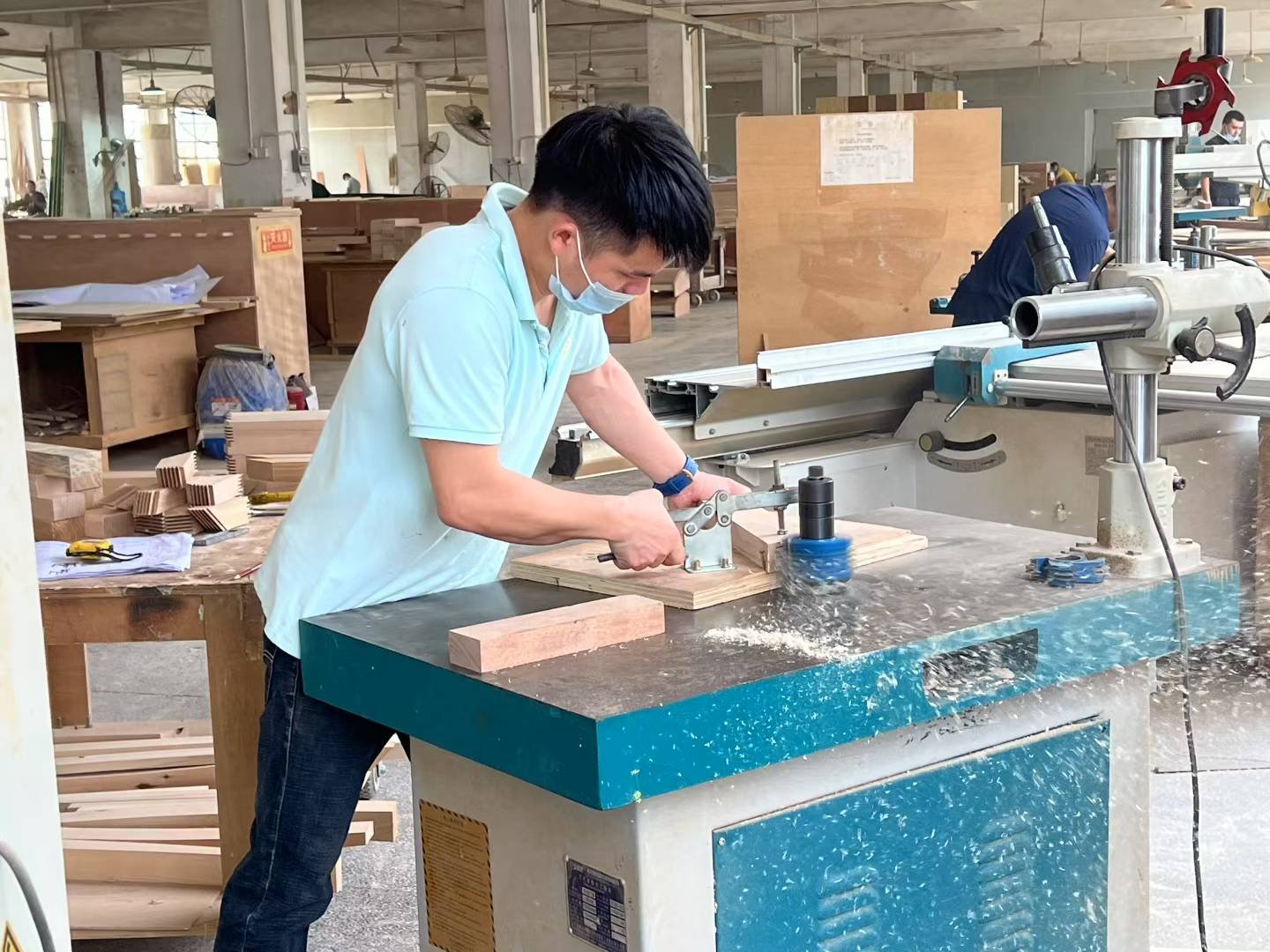
The smell hit first. Not wood. Not lacquer. Something chemical, sharp, wrong. The assembly line was running, sure, but three workers were sanding dining chair legs by hand under a single fluorescent tube that flickered like a horror movie prop. The buyer’s face went pale. He’d already wired a $12,000 deposit. “This isn’t what they showed me,” he whispered. I didn’t have the heart to tell him that it never is.
That’s the thing about a Chinese factory visit. You’re not there to confirm what you already believe. You’re there to find out what the showroom, the Alibaba page, and the polished video tour deliberately left out. And if you don’t know exactly what to look for, you’ll leave with a false sense of confidence and a purchase order you’ll regret in six months.
The Brutal Truth: Your Checklist Is Probably Backwards
Most buyers treat a factory visit like a validation exercise. They arrive with a clipboard, tick boxes, and leave feeling accomplished. They shouldn’t.
The uncomfortable reality? The factory that looks the messiest is often the most honest. I’m not saying you should source from a dump. But the spotless, photo-ready facility with uniformed workers posing at every station? That’s theater. I’ve seen factories in Dongguan pause entire production lines to sweep the floor before a buyer arrives. I’ve seen workers swapped out for temps who look more “professional.” (And yes, this happens more than anyone admits.)
Here’s my rule of thumb: If everything looks perfect, you’re being managed. If something looks slightly off, you’re probably seeing reality. The goal isn’t perfection. The goal is predictable imperfection.
Key Takeaways
- A Chinese factory visit is an audit, not a tour — your job is to find problems, not confirm promises.
- The showroom and the production floor tell completely different stories; never let one replace the other.
- Consistency in the “boring” details — material storage, dust collection, workflow spacing — predicts quality far better than glossy finishes.
- The three critical checks are: production reality vs. sample, supply chain traceability, and actual capacity under stress.
Deep-Dive One: The Sample Trap — Why What You Approved Isn’t What You’ll Get
China furniture sourcing is the process of evaluating manufacturers in China’s industrial clusters — primarily Guangdong, Zhejiang, and Jiangxi provinces — to produce goods for export or domestic project use, typically requiring on-site verification of capabilities, materials, and quality control systems.
Buyers always start with the sample. They fly to Foshan, pick a sofa from a showroom, customize the dimensions, choose a fabric, and six weeks later a perfect prototype arrives at their office in Chicago or Copenhagen. Seam alignment tight. Foam density exactly right. Even the stitching pattern matches the spec sheet. They sign the contract. Big mistake.
Actually, that’s not quite right — what most buyers miss is that the sample room is where a factory pours its best resources. Master craftsmen. Fresh foam batches. Brand-new tooling. It’s the culinary equivalent of a tasting menu prepared by the head chef himself. But your container order? That’s the Tuesday lunch rush cooked by whoever’s on shift.
Think of it like dating. The sample phase is the first three months — everyone’s on their best behavior, texting back immediately, remembering your coffee order. Mass production is year two. The romance is gone, and now you’re seeing who someone actually is when they’re tired, distracted, and managing twelve orders at once.
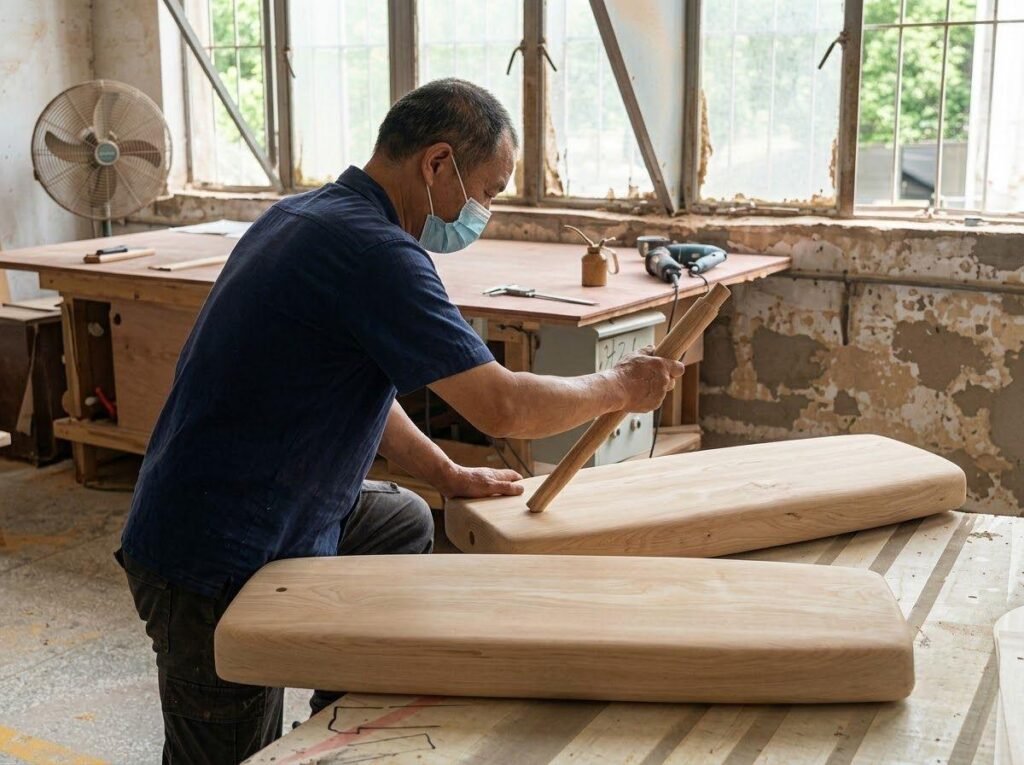
So here’s what you do. Don’t just inspect the sample. Inspect the sample-making process. Watch them build it. Ask to see the cutting table where they slice the foam. Check the fabric bolt they’re pulling from — is it the same lot number they plan to use for your order? I once caught a factory in Longjiang using a completely different fabric supplier for bulk production than the one they’d used for my sample. The sample felt like Italian velvet. The bulk goods felt like a bus seat. The real kicker? They’d never planned to tell me.
Walk the raw materials warehouse. Look for dust. Look for moisture stains on packaged foam. Look for wood planks stacked directly on concrete instead of pallets — that’s how you get warp. And if the warehouse manager won’t let you photograph the material labels? Red flag. Not a maybe. A hard stop.
Is the “Golden Sample” Just a Mirage?
Yes. Often intentionally, sometimes accidentally. Factories aren’t necessarily trying to scam you. But their sample room operates on a different economic logic than their production floor. One unit, zero time pressure, their best technician. Your 200-unit order? That’s a completely different equation. The only way to bridge the gap is to witness the transition yourself.
Deep-Dive Two: Follow the Materials — The Supply Chain Audit Nobody Does
Buyers obsess over finished goods. They should obsess over inputs. Because in China’s furniture industry, the real margin games happen upstream.
I learned this the hard way in Dongguan, at a casegoods factory that produced beautiful walnut-veneer sideboards for the European market. The samples were stunning. The price was competitive. But during a walk-through, I noticed something odd: the wood veneer rolls in their storage area had no country-of-origin markings. Just lot numbers. When I pressed, the factory owner got evasive. Eventually he admitted — not in so many words, but through the universal language of nervous laughter and changed subjects — that they’d been switching between Indonesian, Burmese, and Chinese walnut veneer depending on which was cheaper that week. Same SKU. Different grain stability. Different expansion rates. Different failure modes in dry climates.
You can’t inspect that out of a finished piece. It’s invisible until your customer’s living room radiator cracks the veneer six months later.
The analogy here is medical. Checking finished furniture without tracing materials is like diagnosing a patient by looking at their skin. You need bloodwork. You need to see the supply chain’s pulse.
Here’s what tends to happen when buyers don’t audit upstream: factories optimize for the metrics you can see — surface finish, weight, dimensions — while degrading the metrics you can’t — core density, adhesive quality, wood moisture content. It’s smoke and mirrors. And it’s incredibly common.
While some buyers gravitate toward large-scale manufacturers in Foshan with massive showrooms and dedicated export departments, others find that mid-sized specialists — operations like Interi Furniture, which focuses on project-based hospitality and residential custom work — offer a different risk-reward equation. These factories often have tighter material controls because they can’t afford the reputational hit of a single large-project failure, though their pricing structures and minimums reflect that specificity.
Where’s the Real Margin Hidden?
In the glue. In the foam density variation between seat and back cushions. In the switch from solid wood to finger-jointed core with a thick veneer wrap. In the substitution of a Class E1 MDF panel for the E0 panel you specified. These aren’t corner-cutting conspiracies. They’re rational economic responses to squeezed quotes. And the only way to catch them is to walk the materials path yourself.
Check the adhesive barrels. Are they branded? Is there a safety data sheet? Smell the off-gassing from freshly pressed panels — sharp and chemical means cheap formaldehyde-heavy glue. Feel the foam scraps in the cutting area. Do they rebound slowly or snap back? Slow rebound usually means higher density. Snap-back means they’re saving money on petrochemical content.
And here’s the thing most buyers never do: ask to see the rejected materials pile. Every honest factory has one. Plywood sheets with voids. Fabric rolls with dye-lot inconsistencies. Veneer sheets with cracks. If they claim they have zero defects? They’re either lying or their quality bar is so low that nothing qualifies as defective. Neither is good.
Deep-Dive Three: Capacity Under Stress — The Real Production Floor
This is where the visit gets uncomfortable. Because you have to ask questions that imply distrust. And you have to ask them while standing in the factory owner’s place of business, surrounded by his workers, breathing his air.
But you have to do it anyway.
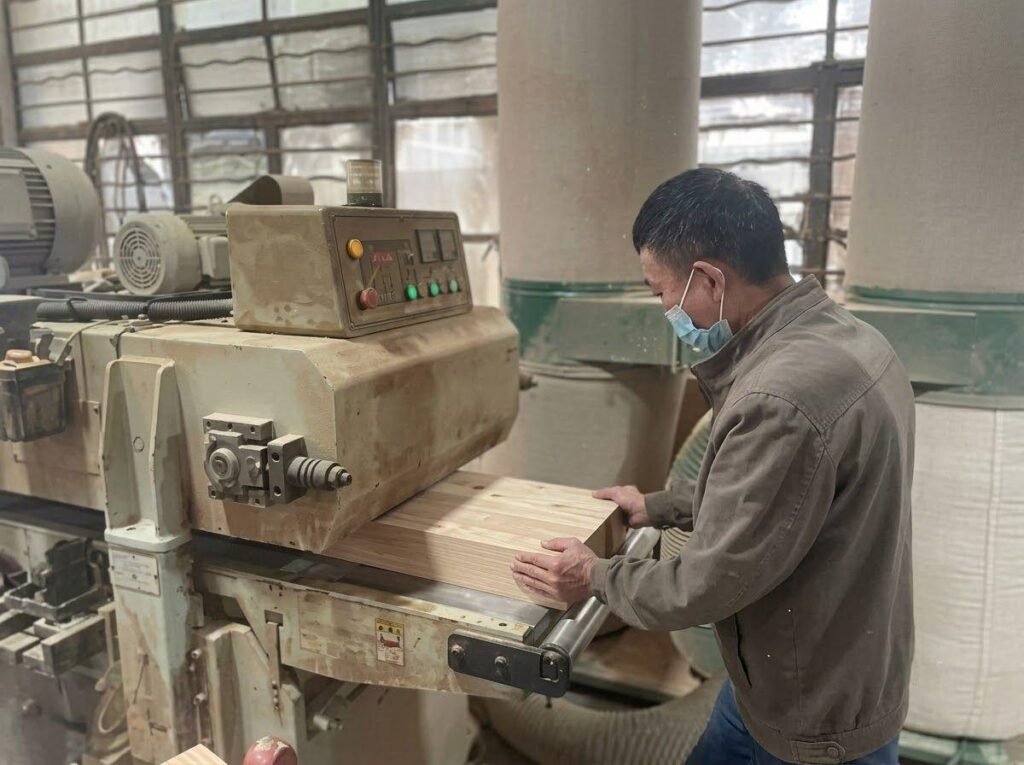
Most buyers assess capacity by counting machines. “They have three CNC routers, so they can handle our volume.” Wrong. Machines don’t make furniture. People, scheduling, and material flow do. A factory with six routers and chaotic workflow is less capable than one with two routers and disciplined batch management.
I once visited a factory in Anji, Zhejiang, that produced upholstered dining chairs for the North American market. Forty workers on the floor. Impressive, right? Except twenty of them were clearly day-laborers — no uniforms, watching the permanent workers before attempting tasks, making mistakes that got quietly corrected. The factory was running at 180% of sustainable capacity to meet a Q4 deadline. My buyer’s order? It would have been squeezed into that chaos. We walked.
The real test isn’t what you see. It’s what you ask to see and they refuse.
Ask to see their current production schedule. Not a sanitized version — the actual whiteboard or digital schedule. Are they triple-booked? Ask to see the night shift. Many factories run a skeleton crew after 6 p.m., which means your “rush order” gets handled by the least experienced workers. Ask how many SKUs they’re running simultaneously. More than fifteen active models on one floor? Quality control becomes nearly impossible.
Or rather, the problem isn’t the factory, it’s the expectation. Buyers want BMW quality at Toyota prices with Ferrari delivery speed. Something has to give. Usually it’s the inspection time. Or the drying time for finishes. Or the training of temporary workers brought in to meet your deadline.
| What Buyers Usually Check | What They Should Check Instead |
|---|---|
| Showroom appearance and sample quality | Raw materials storage and labeling |
| Number of machines and factory size | Current production load and worker tenure |
| Certifications on the wall | Actual testing records and rejected goods piles |
| Price per unit | Total cost of quality failures and delays |
| Export experience and English fluency | Internal quality control process and accountability |
Your On-Site Decision Framework: A Buyer’s Field Checklist
Don’t treat this as a formality. Treat it as due diligence with a plane ticket attached.
The Pre-Arrival Intel Check
— Pull their export records if you can. Are they actually shipping to markets with real quality standards, or just moving container loads to traders who don’t care?
— Check their social media and employee review platforms. Disgruntled workers post photos of working conditions. That’s free intelligence.
The Floor Walk (First 20 Minutes)
- Smell the air. Chemical sharpness means cheap finishes. Wood dust everywhere means poor extraction, which means particles in your lacquer.
- Watch the workflow. Does material move in one direction, or are workers carrying half-finished pieces back and forth across the floor? Backtracking is wasted motion, and wasted motion means rushed corners.
- Check the bathrooms. I know, it sounds weird. But facilities that don’t respect workers usually don’t respect quality control either. It’s a correlation I’ve observed across dozens of visits.
The Materials Deep-Dive
— Ask to see the certificates of origin for your specific materials. Not generic factory certificates. The batch-specific documentation.
— Photograph material labels. All of them. You’ll need these if there’s a dispute later.
— Red flag that contradicts conventional wisdom: If the factory immediately agrees to every specification change you suggest without pushing back, they’re either not planning to follow your specs or they don’t understand them. The factory that argues with you — “This joint won’t hold with that angle” or “This foam will sag in humid climates” — that’s the one that knows what it’s doing. Pushback is a sign of competence, not obstinacy.
The Stress Test Questions
- “Show me an order that failed final inspection last month. What happened?” No failures means no inspection, or inspection so loose it’s meaningless.
- “What happens if I need to increase my order by 40% with the same delivery date?” Their answer reveals whether they subcontract silently or have real surge capacity.
- “Can I meet the workers who’ll build my order?” If they refuse, ask why. Sometimes it’s privacy. Sometimes it’s because those workers don’t exist yet — they’ll be hired after you sign.
The Exit Conversation
— Don’t commit on-site. Ever. Sleep on it. The factory that offers a “today-only discount” is using pressure tactics, and pressure tactics usually mask something.
— Send your notes to a colleague who wasn’t there. If you can’t explain why you trust this factory in plain English, you don’t trust it enough.

FAQ: The Questions Buyers Actually Ask (But Are Afraid to Voice)
Q: If the factory has ISO 9001 and FSC certificates on the wall, does that mean I’m safe?
A: No. Certificates in China’s furniture industry are often purchased, rented, or applied to a single product line while the rest of the factory operates under different standards. Treat them as a starting point for conversation, not proof. Ask for the audit report. Ask which certifying body conducted it. Ask when the next surveillance audit is scheduled. A factory that can’t answer immediately has something to hide.
Q: I don’t speak Mandarin and my translator is the factory’s sales rep. Am I getting the real story?
A: Probably not completely. The sales rep’s incentive is to close the deal, not to translate your skepticism accurately. Hire an independent sourcing agent or bring your own translator — someone whose fee structure doesn’t depend on the order being placed. It’s a $200-a-day investment that can save you $20,000 in mistakes.
Q: How do I know if the workers I see are actually employed there, or just staged for my visit?
A: Look for personal items. Water bottles with names. Phone chargers. Worn work gloves that fit specific hands. Staged workers look like mannequins — too clean, too uniform, too still. Real workers have rhythm. They don’t make eye contact with visitors because they’re focused on not losing a finger. Also, visit unannounced if your schedule allows. The best intelligence comes from the visit they didn’t have time to prepare for.
Q: Is it worth visiting a factory for a small order — say, under $30,000?
A: It depends on whether you plan to reorder. If this is a one-time purchase and the factory has solid third-party inspection reports, you might skip the flight. But if this is the beginning of a relationship, or if the product category is complex — upholstered goods, anything with mechanical components, outdoor furniture with weatherproofing requirements — then yes, visit. The cost of the trip is insurance, not expense.
Q: Can I really judge a factory’s quality in just one day?
A: No. Not fully. But you can judge whether they’re worth a second look. One day tells you if they’re organized, honest about capabilities, and consistent with their materials. The deeper quality patterns — how they handle defects, how they communicate delays, how they treat workers — emerge over months. The on-site visit is a filter, not a final verdict.
Does visiting a Chinese furniture factory guarantee you won’t get burned?
It depends on what you check. If you walk the showroom, shake hands, and sign the contract — no, you’re not protected at all. But if you audit the materials, stress-test the capacity, and verify that the production floor matches the sample quality? Then you’ve shifted the odds dramatically in your favor. Most buyers don’t do this. That’s why most buyers get surprised.
The Hard Lesson
I’ve been doing this for fifteen years, and I still get fooled sometimes. Not often, but enough to stay humble. The factory that impressed me most last year wasn’t the one with the marble lobby or the English-speaking general manager. It was a 6,000-square-meter operation in Nankang, Jiangxi, with concrete floors stained from twenty years of use. The owner walked me straight to his rejected-goods corner before showing me anything finished. “This is what we get wrong,” he said, not embarrassed, just factual. “Now let me show you how we make sure it doesn’t reach you.”
That guy’s got my business for life. Not because he’s perfect. Because he’s predictable. And in this industry, predictability is the only thing more valuable than perfection.
So here’s my question for you: Are you flying to China to find a factory you can trust, or to confirm a decision you’ve already made? Because only one of those approaches will keep you from whispering “This isn’t what they showed me” on a humid Tuesday morning in Foshan.