

Three years back. Houjie Town, Dongguan. Humid as hell, mosquitoes everywhere. I’m hunched over a claypot congee at a roadside stall with this procurement guy, Chen — works for a boutique hotel chain out of Miami. He pulls out his phone, proud as hell. “Look at this factory. Replies in minutes. Professional, right?” I glance at the bank account in the email. “That account number’s wrong.” He laughs. Doesn’t believe me. $47,000. Wired. Gone. Three months later he’s on a flight back to the US. Paid for his own ticket. Fired before the plane landed.
I tell this story because when you’re trying to buy furniture from China, nobody wants to talk about payment. Everyone’s busy flexing about wood grades, foam density, whether that “Italian top-grain leather” actually saw an Italian cow. (Spoiler: nine times out of ten, it didn’t even see a cow.) But how the money leaves your account? That’s what decides whether your cabinet crosses the Pacific into your showroom, or sinks straight to the bottom of the Pearl River. Everything else is just noise.
The Brutal Truth Nobody Wants to Hear
Most buyers lose money before the first sofa leaves the factory. Not because the factory cheated them. Because they cheated themselves.
Harsh? Good. The safest payment method is usually the one you’re too cheap, too slow, or too lazy to use. An LC costs money. It drags. It means arguing with your bank. So everyone defaults to T/T — Telegraphic Transfer — because it’s fast, it’s familiar, and it feels like you’re in control.
You’re not.
Standard 30/70 split. Thirty percent deposit to start production. Seventy percent balance before the ship loads. Once that final wire clears, your leverage dies. The factory has your cash. You have a promise. And in this business, a promise is worth about as much as the veneer on a piece of MDF — looks thick, peels right off.
Bottom line: if you can’t afford to lose the full order value, you don’t get to skip the safety catch.
Key Takeaway
- China furniture sourcing is the grind of finding Chinese factories, haggling, supervising production, and wiring money — and payment terms are the most ignored landmine in the whole process.
- T/T dominates Chinese payment methods, but once that balance leaves your account, buyer protection drops to zero.
- An LC works like a referee — protects both sides — but factories hate the paperwork and banks love the fees.
- There’s no such thing as a “safest” payment method. Only the one that fits your order size, your factory relationship, and your appetite for risk.
What T/T Actually Means on the Factory Floor
Why Factories Love It (And Why That Should Make You Nervous)
Walk into any trading office in Foshan’s Lecong district on a Tuesday afternoon. You’ll hear the same script: “Thirty percent deposit, seventy before loading. Standard terms. Everyone does it.” They’re not lying. Based on what I’ve seen walking these floors for fifteen years, over eighty percent of furniture export transactions out of China run on some flavor of T/T. It’s the air this industry breathes.
But here’s what the sales rep won’t say out loud: T/T tilts hard toward the seller. Deposit hits their account — now they can buy boards, pay workers, keep the lights on. Balance clears — now they have zero operational reason to care if your dining chairs match the March approval sample. The incentive chain is broken from day one.
I learned this in Dongguan. Factory I’d worked with for two years. Shipped a batch of headboards. Fabric was two shades darker than the approved swatch. On the color card? Barely noticeable. Under warm LED in two hundred hotel rooms? Completely different product. What could I do? Balance was paid. B/L was issued. Factory’s response: “Lighting issue. Not our problem.”
Wait — that’s not quite right. The problem isn’t T/T itself. It’s that the payment milestones and verification milestones don’t line up. Your money’s gone. The goods aren’t. And nobody’s watching the gap.
The Email Scam Nobody Talks About Over Beer
And here’s the real kicker. The biggest T/T risk isn’t the factory running off with your cash. It’s someone else running off with your cash.
The scam is stupidly simple. A third party hacks the supplier’s email — phishing, weak password, whatever — then sits there. Silent. Waiting. Like a spider. When payment’s due, they fire off an email that looks exactly like it’s from your contact. “Hi, our bank details have changed. Please wire to this new account.” You wire. Factory gets nothing. Goods don’t ship. Good luck chasing that money through a Chinese bank account you can’t even verify.
The fix? Embarrassingly simple. Call the factory before every transfer. Use a number from a verified previous conversation — not the one in the suspicious email. Two minutes. Zero dollars. Total protection. And I’d bet fewer than half the people reading this actually do it every single time.
Letter of Credit: Safety Net or Straitjacket?
How an LC Works, and Why Factories Roll Their Eyes
Think of an LC like a vending machine. You put the money in. The factory feeds documents in. If the docs match exactly what the machine’s programmed to accept — shipping date correct, consignee spelled right, every comma in place — the money drops out for the factory. Anything off? The machine spits it back. No negotiation. No “but we discussed this.” Just rules.
Your bank issues it. Backed by your cash or credit line. The factory’s bank reviews documents against the LC terms. Match? Payment releases. Buyer protected — bank won’t pay without compliant documents. Factory protected — bank guarantees payment once conditions are met.
Sounds perfect, right?
Here’s why it isn’t. LCs bleed money. Opening fees, amendment fees, document review fees. On a $50,000 furniture order, LC charges can eat $800 to $1,500. That’s real money when you’re running thin margins. Plus, LCs slow everything down. The factory’s shipping department — usually the most chaotic corner of the building, staffed by whoever lost the office politics that week — has to get every detail perfect. In my experience, roughly one in four first-time LC deals needs at least one amendment because someone wrote “Foshan” instead of “Foshan, Guangdong” on a certificate of origin.
Factories know this. And plenty of mid-sized manufacturers, especially in custom furniture, will simply refuse LC terms below a certain threshold. They’d rather lose the order than drown in paperwork. Can’t blame them, really.
The Middle Ground Nobody Teaches in Business School
So T/T’s risky. LC’s expensive. What’s the play?
Depends on where you rank in that factory’s priority list. First-time buyer, $15,000 order? You get standard 30/70. No discussion. Hotel group dropping $400,000 a year? You get terms that would make a trade finance banker blush.
Here’s the pattern: relationships evolve. First order — 50/50 or 30/70, balance before loading, inspection mandatory. Second or third order — 30/70, but now balance is due after the Bill of Lading issues. Established relationship — 30/70 with net-30 or even net-60 terms.
But you don’t have to wait two years to improve your hand. There are levers you can pull right now.
Inspection-linked balance payment. Structure the contract so the final 70% drops only after a third-party inspection passes. Factory gets paid once quality is verified. You get verification before your money leaves. Yeah, an inspection costs $300–$600. Pocket change compared to receiving three hundred chairs with the wrong foam density. Or the wrong color. Or both.
Escrow services. For smaller orders or first-time relationships, verified escrow splits the risk. You deposit with the escrow provider. Factory ships. You confirm receipt and quality. Escrow releases. Neither side can screw the other without consequences.
Document control. Never — and I mean never — pay the final balance against only a B/L copy. A copy is a PDF. An original Bill of Lading is a legal document of title. It gives you control of the cargo. Only an original B/L or an official telex release gives you leverage if things go sideways. Everything else is just paper.
The Factory Landscape: Why Payment Terms Vary Wildly
Big Players vs. Mid-Sized Specialists
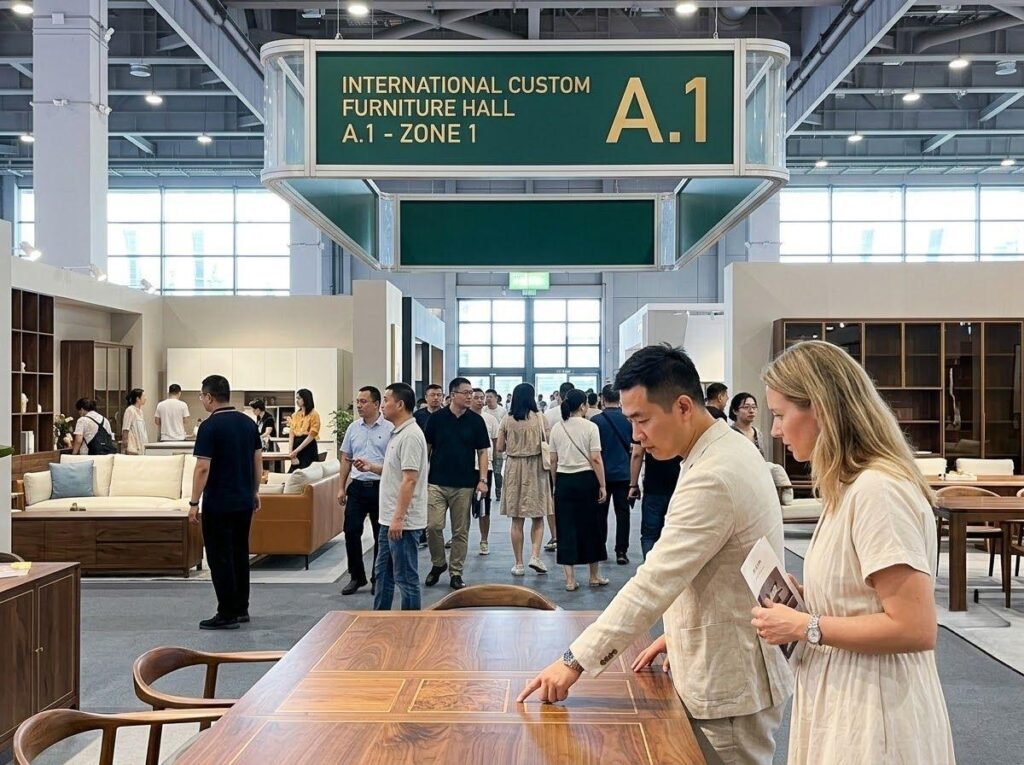
Not all factories play by the same rulebook. Walk through Foshan’s furniture districts and you’ll see the full spread. Massive campuses with 200,000 square meters and export departments that look like airline booking centers. They’ll take an LC. They’ll take T/T. They’d probably take a duffel bag of cash if you asked. They’ve got volume to absorb banking fees and staff to handle documentation.
Then you’ve got the mid-sized specialists. Operations like Interi Furniture, based in Panyu, Guangzhou — a 40,000-square-meter manufacturing center with 500-plus craftspeople, focused on high-end custom contract furniture for hotels, villas, and hospitality projects. Founded in 2003, they’ve spent two decades chewing through bespoke, no-MOQ production for clients across 40-plus countries.
Some buyers gravitate toward the mega-factories for volume. Others find that mid-sized specialists — operations like Interi Furniture, which focuses on custom hospitality and residential FF&E — offer a completely different risk-reward equation. Their flexibility on minimums and customization means you’re not locked into container-sized commitments. But that same flexibility makes standardized payment terms harder to negotiate, because every project is bespoke and they can’t easily resell your rejected goods to the next guy.
The point isn’t to promote anyone. It’s to recognize that your payment strategy should match the factory’s business model. A commodity producer in Longjiang cranking out 10,000 identical dining chairs can afford to be rigid on terms — someone else will buy those chairs if you walk. A custom furniture shop in Guangzhou building one-off hotel suites has different cash flow pressures and different risk exposures. Know which one you’re dealing with before you wire a dime.
Your Decision Framework: Which Payment Method for Which Situation
The Checklist That Saves Orders
There’s no universal “best” way to pay. Only the best way for your order, your factory, and your tolerance for sleepless nights.
Start with order value:
- Under $10,000 — T/T with escrow or PayPal if they’ll take it. LC fees eat too much margin.
- $10,000–$50,000 — T/T with inspection-linked balance. Hire a third-party inspector. Non-negotiable.
- $50,000–$150,000 — Consider an LC if the factory will accept it. If not, negotiate 30/70 T/T with B/L-controlled release and mandatory pre-shipment inspection.
- Over $150,000 — LC unless you’ve got a multi-year relationship. At this scale, banking fees are rounding errors compared to your exposure.
Red flag that contradicts conventional wisdom: If a factory insists on 100% upfront payment for a first order, that’s not “standard practice in China.” That’s a factory with cash flow problems, a scam, or both. Walk away. Even the most aggressive legitimate factories will take 30% deposit. Anyone demanding full payment before cutting a single board is waving a flag you should see from orbit.
Verify before you wire:
- Compare the beneficiary name on the Proforma Invoice against the company’s official business license. A mismatch — especially a personal name instead of a company name — is a dead giveaway.
- Call the factory on a previously verified phone number to confirm bank details. Do this every single time, even with suppliers you’ve used for years.
- Check that the bank is in the same province as the factory. A Guangdong manufacturer wiring to a bank in Fujian or Zhejiang isn’t automatically suspicious, but it demands an explanation.
Document everything:
- Get payment terms in writing on the Proforma Invoice and the Purchase Order.
- Specify inspection rights, acceptance criteria, and what happens if goods fail inspection.
- Define “shipment” precisely. “Before shipment” means different things to different people. Nail it down.
FAQ: The Questions Buyers Actually Ask
Q: Is a 30% deposit normal when I buy furniture from China, or am I getting ripped off?
A: It’s absolutely normal. Industry standard across Foshan, Dongguan, Longjiang, Anji — everywhere — is 30% deposit to kick off production. Don’t waste your energy negotiating the deposit percentage. Focus on securing inspection rights and document control before that final payment is due. The deposit isn’t your risk point. The uncontrolled balance is.
Q: My factory says they don’t accept Letters of Credit. Should I be worried?
A: Not necessarily. Plenty of legitimate mid-sized factories — especially custom furniture specialists — avoid LCs because the documentation burden and bank fees cut into already thin margins. What should worry you is if they refuse LCs and they refuse any alternative safeguards like escrow or inspection-linked payments. A factory that won’t accept any form of buyer protection is either paranoid from past trauma, or planning to burn you.
Q: Can I get my money back if the factory ships garbage and I’ve already paid the full balance?
A: Realistically? Probably not. Recovering money from a Chinese supplier through legal channels is complex, costly, and often futile for overseas buyers. Your entire strategy has to be prevention, not cure. That’s why inspection-before-balance matters so much — it’s your last checkpoint before leverage disappears.
Q: The factory sent new bank details by email. Should I just wire to the new account?
A: No. Call the factory immediately on a verified phone number. Email fraud is the single most common way buyers lose money when they buy furniture from China. The scam is so prevalent that some experienced buyers won’t even open payment-related emails anymore — they handle all bank detail confirmations by phone. Two minutes of verification eliminates this risk entirely.
Q: So which is actually safer — LC or T/T?
A: It depends on your situation. An LC is structurally safer for the buyer because the bank controls payment release based on documented compliance. But if your order is small, the factory refuses LC terms, and you don’t have the banking relationship to make it cost-effective, a well-structured T/T with inspection linkage and document control can be just as safe in practice. The safest payment method is the one that’s appropriate for your order size, properly documented, and verified at every step.
The Hard Question You’re Avoiding
Here’s what keeps me up at night: buyers who read this, nod along, and then wire $30,000 to a factory they’ve never visited based on a WeChat conversation and a few glossy photos. Because the truth is, payment method selection isn’t really about banking instruments. It’s about discipline.
The factory in Panyu with 500 workers and a 20-year track record? They’ll work with you on terms because they have a reputation to protect. The “factory” that exists only on Alibaba with stock photos and a Gmail address? They’ll take your T/T and vanish. And no LC in the world protects you from choosing the wrong partner to begin with.
So maybe the real question isn’t “LC or T/T?” Maybe it’s this: Have you done enough homework to deserve the protection you’re paying for?
Because at the end of the day, the safest way to buy furniture from China isn’t a payment method. It’s the boring, unglamorous work of verification, documentation, and refusing to let excitement override caution. The banking instrument is just the wrapper. The due diligence is the gift.