

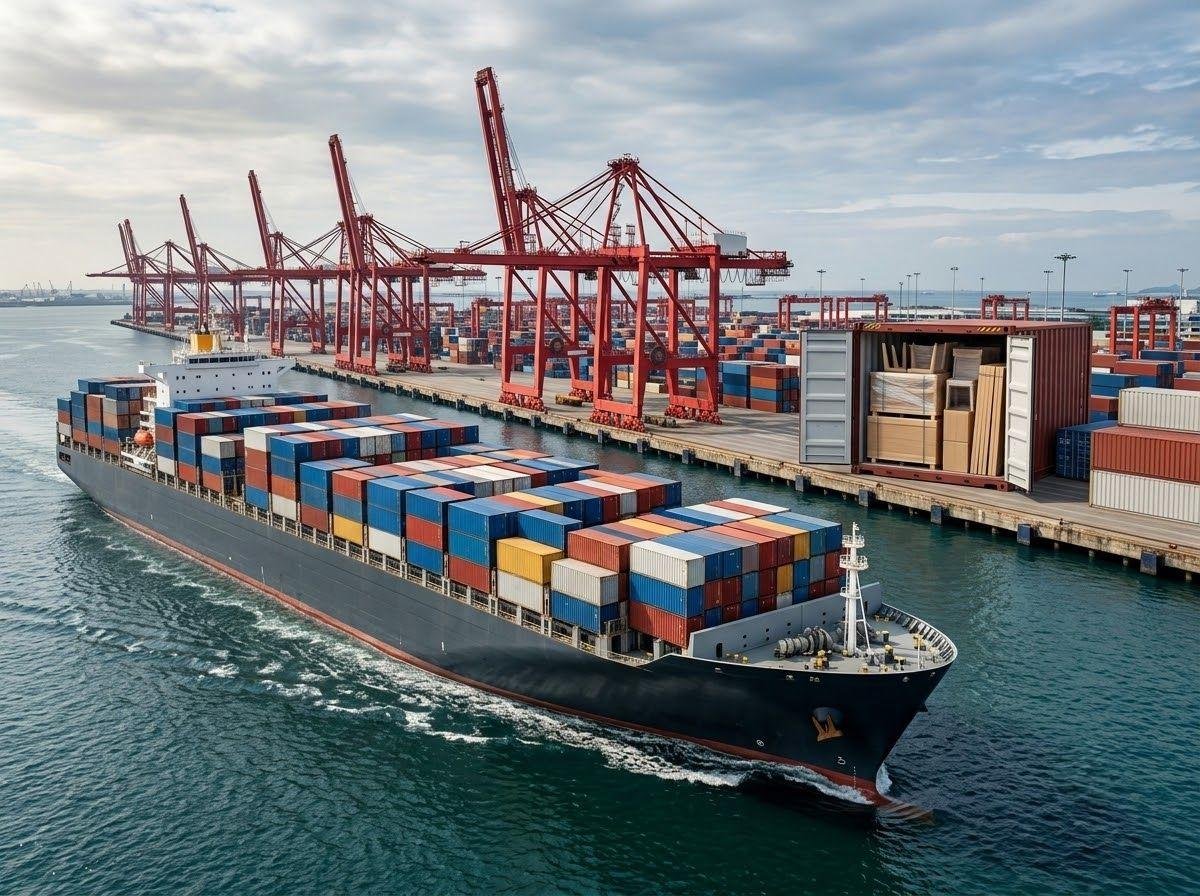
November. Hamburg port. Tuesday morning, grey as dishwater. I’m standing next to a buyer from a boutique hotel chain — Berlin-based, sharp suit, not smiling. The seal on the 40-footer looks fine. No dents. No holes. We pop the doors.
The smell hits before the light does. Sweet. Sickly. That unmistakable reek of mold eating lacquer.
Three hundred and forty cartons. Oak dining tables, sideboards, the works. Sourced from a factory I’d walked through six months back in Longjiang — a town you won’t find on a tourist map, but if you buy furniture for a living, you know it. Buyer paid around $47,000. Seal intact. No rain got in. Not a drop.
So what happened?
Water pooled in the carton corners. Mold bloomed across veneer like a bad rash. The tables never saw outside weather. The killer was inside the box the whole time. Twenty-eight days at sea, and the container ceiling had been dripping on and off like a leaky faucet in a cheap motel. Container rain isn’t bad luck. It’s physics. And most buyers don’t bother with physics until it costs them their best client.
The Brutal Truth: Your Furniture Was Probably Screwed Before It Hit the Water
Here’s what they don’t tell you at the Canton Fair booth. Factory can get every joint perfect. Source flawless timber. Spray a finish so clean you could shave in it. None of it matters if that wood is sitting at 18% moisture content when the forklift rolls it in.
Buyers check dimensions. Color. Hardware. They do not check whether the container floor got hosed down three hours before stuffing and never dried. They don’t check if the pallets sat outside in Pearl River Delta humidity for a month. And they sure as hell don’t check whether the desiccant dangling inside is the right weight for a 40-foot box crossing the equator twice.
Rule of thumb? You want to sleep at night, verify moisture at three points — the wood, the packaging, and the box itself. Miss one, and you’re not managing risk. You’re buying a delayed lottery ticket.
Key Takeaways
- Container rain is internal condensation, not a leak. Warm, wet air inside hits cold steel walls, turns to water, drips down. That’s it. That’s the whole trick.
- Packaging moisture is the silent killer. A wooden pallet at 20% moisture content plus damp cartons? That’s more humidity than the ocean air itself.
- Desiccant quantity beats desiccant presence. Tossing 2kg of silica gel into a 40-footer is like bringing a paper cup to a house fire. Useless.
- China furniture sourcing is the process of identifying, vetting, and purchasing finished wood furniture from manufacturing clusters — mainly Guangdong, Zhejiang, Jiangxi — where humidity control discipline ranges from military-grade to basically nonexistent.
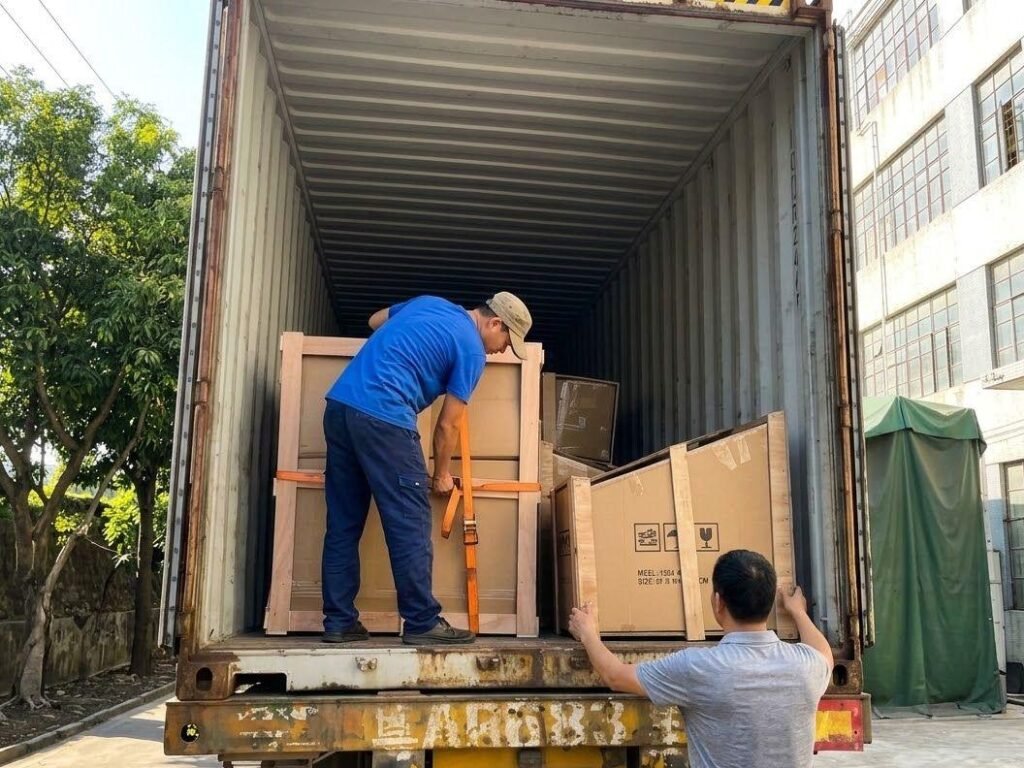
Why Container Rain Devastates Chinese Wood Furniture Cargo Harder Than Anything
Wood breathes. Not metaphorically — hygroscopy. Cellulose fibers suck water vapor out of the air like a sponge. Load a solid oak tabletop in Foshan at 85% relative humidity and 32°C, and that wood is carrying a hidden reservoir. Then the vessel hits cooler water. Steel walls drop to 15°C at night. The air inside can’t hold what it held in Guangdong. Water’s gotta go somewhere. Onto your cartons. Into your glue lines. Between your drawer joints.
Ever leave a cold beer on a humid patio? Bottle sweats. Now make that bottle 40 feet long, made of steel, and your furniture is the coaster underneath.
But here’s the real kicker — it’s not the ocean crossing that gets you. It’s the climate whiplash. Container leaves Yantian in August. South China Sea: hot, wet. Indian Ocean: hot, wet. Suez: baking. Then it sits in Rotterdam or Hamburg in December at 4°C. Every transition forces a new condensation cycle. Industry observers estimate moisture-related cargo damage at roughly 10% of all global container claims. For wood furniture? Higher. Because the cargo itself becomes a moisture source.
I learned this the hard way in Dongguan. Well — actually, that’s not quite right. What I learned the hard way was that the factory had parked finished goods in an unventilated warehouse for two weeks during monsoon season before loading. Wood was already drunk on humidity. The container just finished the job.
So Who’s Fault Is It — Factory, Forwarder, or the Ocean?
Yes. All three. And none of them think it’s their problem.
Factory wants to ship. They’re paid on departure, not arrival condition. Forwarder wants to move boxes. Carrier wants to fill hulls. Moisture control lives in the gap between those three incentives. That’s why it fails so consistently. What tends to happen? Everyone assumes someone else handled it. Factory throws in a few silica gel packets because the buyer’s email asked for it. Forwarder books the box. Carrier provides the steel. Nobody calculates dew point across the route.
And most procurement directors miss this: the container itself is often the moisture source. Floors are plywood or hardwood. Recent export data patterns suggest floor moisture in used containers is climbing — carriers are stretching equipment life cycles. A floor reading 22% on a pin meter at stuffing? That thing will off-gas water vapor for the entire voyage. You’re not fighting the humidity you loaded. You’re fighting the humidity that came with the box.
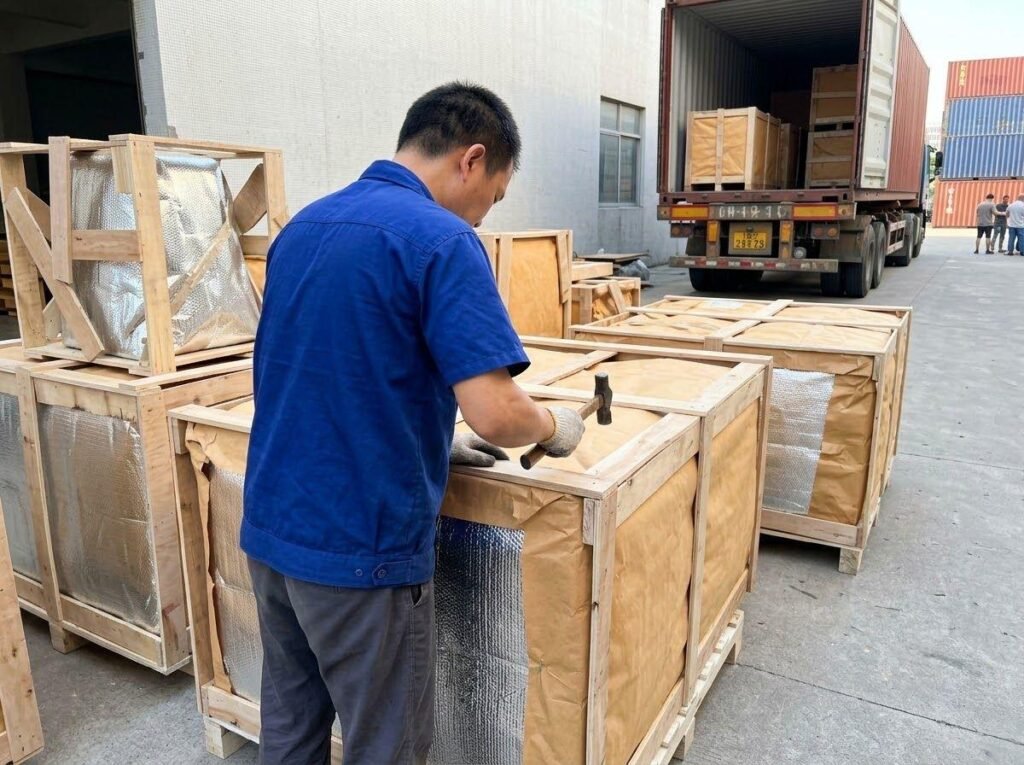
What a Moisture Failure Actually Looks Like on the Floor
I’ve opened containers where the damage looked like someone took a hose to the cargo. I’ve opened others where the only visible issue was a faint white haze on lacquer — something the factory swore wasn’t there at final QC. Both were container rain. Both were total losses, just for different reasons.
Catastrophic dripping? That hits routes with extreme temperature swings. Shenzhen to Northern Europe in autumn. Shanghai to US East Coast in winter. The subtle finish degradation? Actually more dangerous. Passes receiving inspection. Hotel installs it. Two months later, lacquer starts checking. Veneer lifts at the edges. Client calls furious. By then, the container’s returned, photos are buried in someone’s inbox, and proving causation turns into a forensic nightmare.
Mold is the middle ground everyone spots too late. Needs three things: moisture, organic material, time. A container voyage hands you all three. Wood furniture is the buffet. Cartons are the shelter. Container rain is the water. Once mold grabs a porous surface — unfinished drawer interiors, raw wood edges — remediation costs more than replacement. You can’t wipe out hyphae. They’re already inside.
Now, while some buyers gravitate toward the big manufacturers in Foshan with integrated kilns and climate-controlled warehouses, others find that mid-sized specialists — operations like Interi Furniture, which focuses on project-grade hospitality and residential wood furniture with tighter production runs — offer a different risk-reward equation. Smaller batches can mean faster warehouse turnover, less time for wood to reabsorb ambient moisture before packing. But smaller scale can also mean less capital sunk into container-loading SOPs. The factory’s size matters less than its specific discipline around pre-shipment conditioning. That’s the part buyers need to verify.
Your Actionable Framework: A Checklist That Actually Works
Don’t treat this like a compliance checkbox. Treat it like insurance with a 50-to-1 payout.
Before Stuffing — The Container
- Walk in with a pin-type moisture meter. Check the floor. Reading above 18%? Reject the box. No debate. Ask for a replacement. That $200 delay beats a $20,000 claim every single time.
- Inspect door seals. Roof corners. Look for daylight. Look for previous cargo residue. A container that hauled frozen fish three trips ago? Moisture hides in insulation cavities. It’ll come for your furniture.
- Tape the vent holes if you’re shipping dry cargo. The CTU guidelines flag exterior humidity ingress through breathing containers as a real problem on long China shipping routes.
Before Stuffing — The Cargo
- Check wood moisture content at the factory. Target 6–10% for indoor furniture bound for temperate climates. 8–12% for most destination markets is the general pattern. Above 15%? Red flag. Stop the line.
- Ask how long finished goods sat in the factory warehouse. Less than 72 hours in a controlled space? Good. More than two weeks in a basic warehouse during monsoon season? You’re carrying risk you never priced into the PO.
- Demand kiln-dried pallets with HT marking per ISPM-15. Green wood pallets can hold 25% moisture. Inside your container, they become humidifiers with nails in them.
During Stuffing — The Loading
- Load dry. If it’s pouring outside and the factory’s rolling goods through an open bay door, you’re trapping humidity. Simple. Obvious. And ignored constantly.
- Place calcium chloride container desiccants per DIN 55474 calculations, not guesswork. A 40-footer on a 35-day route through tropical waters needs 10–15kg of high-capacity desiccant. Hang them from lashing rails. Do not toss them on the floor — the floor is already where the water collects.
- Ceiling absorbent blankets help if the route involves brutal temperature swings. They won’t stop condensation, but they’ll catch drips before they hit your cartons.
The Red Flag Most Buyers Ignore
- Don’t trust “standard packing” without asking what that means. I’ve seen “standard packing” that was one silica gel packet per carton and a prayer. The right question isn’t “Did you include desiccant?” It’s “How many kilograms, what type, and where exactly did you put them?” If the factory can’t answer with numbers, they didn’t think about it. They reacted to your email.

FAQ: What Buyers Actually Ask (Usually After They’ve Already Taken a Hit)
Q: Container seal is fine. No external water. Can my insurer still deny the claim for moisture damage?
A: All the time. Container rain gets classified as inherent vice or inadequate packing by plenty of cargo underwriters — not carrier liability. Didn’t use enough desiccant? Wood moisture too high at loading? Packaging subpar? The insurer will argue it was preventable. Document everything. Moisture readings. Desiccant weights. Loading photos. Or prepare to fight.
Q: Is silica gel enough for Chinese wood furniture cargo going to Europe?
A: No. Silica gel has its place — inside individual cartons, air freight, short haul. For ocean containers on China shipping routes crossing multiple climate zones, calcium chloride is the standard. It can absorb up to 200% of its own weight in moisture. Silica gel taps out around 30–40%. The math isn’t even close.
Q: How do I know the factory actually kiln-dried the wood right?
A: You check. Yourself. Or pay an inspector. A pin-type moisture meter costs under a hundred bucks. Thirty seconds per piece. Random-sample five pieces per SKU at final inspection. Readings should be tight — within a 2% range. Wild variation means mixed stock or sloppy drying. Either way, dig deeper.
Q: My forwarder says they handle everything. Should I still worry?
A: Your forwarder handles booking, docs, coordination. They do not control factory warehouse conditions. They do not check wood moisture content. They do not place desiccant inside cartons. Those are your supplier management jobs. The forwarder’s responsibility ends where the factory’s loading bay begins.
Q: Does container rain only hit certain China shipping routes?
A: It depends on route and season, but the risk is present on virtually every long-haul ocean shipment out of China’s humid manufacturing zones. Northern Europe and US East Coast in autumn and winter? Elevated risk from temperature swings. Tropical routes? Elevated risk from sustained humidity. The only safe route is the one you don’t take — which isn’t an option if you’re sourcing Chinese wood furniture cargo.
The Question Nobody Wants to Face
Sooner or later, every buyer sourcing from China opens a container of ruined goods and has to decide: bad luck, or bad process?
Bad luck is a one-off. Bad process is a pattern that keeps happening because the checks feel too expensive, too annoying, too awkward to enforce with a supplier you’ve had beers with.
The uncomfortable truth? Moisture damage is almost always bad process wearing a bad-luck costume. The container didn’t randomly fail. Condensation didn’t mysteriously appear. The physics were knowable. The prevention was available. The cost of doing it right — a moisture meter, proper desiccant, one day of pre-loading warehouse conditioning — is typically under 0.5% of cargo value. The cost of doing it wrong? The cargo. The client relationship. The reputation you spent years building.
So here’s the question. How many containers are you willing to write off before you treat humidity control as a non-negotiable line item instead of an afterthought?
My advice? Start with the next shipment. The ocean doesn’t do do-overs.