

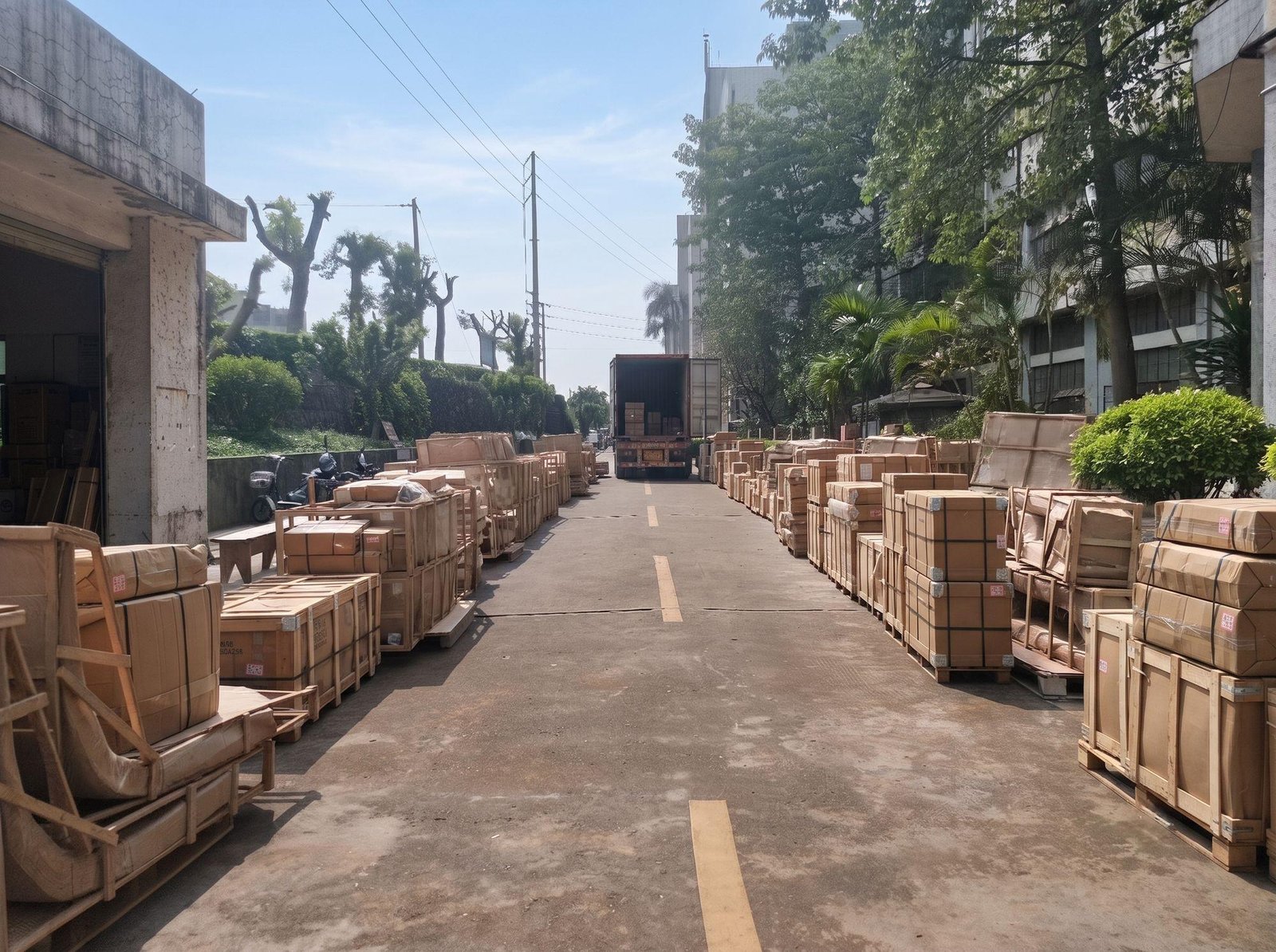
March. Lecong, Foshan. A hotel procurement director from Miami—let’s call him Mike—stood in the warehouse looking green. Not metaphorically. Actually green around the gills. In front of him lay a $42,000 Calacatta marble console table. In two pieces. Not snapped during production. Not cracked during polishing. Broken during crating.
How’d the factory pack it? Bubble film, two wraps around the stone. Slid into a plywood box. Nail gun. Done. “Export standard”—four characters stamped on the side like a talisman. Then a forklift operator, rushing, sightline blocked by a stack of sofa crates two meters high, clipped the corner. The box split like wet cardboard. The marble sheared clean along the vein.
Mike had flown sixteen hours to do his own pre-shipment inspection. Smart, right? He checked the wood. The upholstery. The joinery. He never checked the box. Later, smoking outside the warehouse, he told me: “I figured ‘packed for sea freight’ meant something.”
Something? Please. Fifteen years walking factory floors across the Guangzhou-Foshan corridor, and I’ve learned this: “export standard” is probably the most watered-down phrase in the entire Chinese furniture trade. It can mean a custom-engineered crate with shock mounts, moisture barriers, and tilt indicators. It can mean three temps with a nail gun and a roll of tape. Which one you get depends on whether you asked, checked, and followed up. And most buyers? They don’t find out until they’re standing in a Rotterdam warehouse, crowbar in hand, staring at the damage.
China furniture sourcing, at its core, is the process of navigating China’s manufacturing maze—those industrial clusters in Guangdong, Zhejiang, Jiangxi—and finding a factory that can build beautiful things, while staying clear-eyed about one fact: building the piece and getting it to you alive are two completely separate negotiations.
The Brutal Truth
Nobody at the Canton Fair booth tells you this. For the factory, crating is a cost sink, not a profit center. They spent three weeks crafting your furniture. Then they hand it to a subcontracted packing crew paid by the piece.
What’s the crew’s mindset? Finish fast. Go home. Your $30,000 dining table and your $300 side table? Same treatment. Actually, your table probably gets worse—it’s heavier, harder to maneuver, and the guy with the stapler is already running behind.
So here’s the rule of thumb, plain and simple: If you can stand on it and jump, and the lid bows, it’s not a crate. It’s a coffin for your margin.
Key Takeaways
- Zero-breakage crating isn’t a factory default. It’s something you negotiate, specify, and enforce.
- “Export standard” crates fail under real-world port handling more often than anyone admits.
- Proper crating runs roughly 3% to 8% of goods value. Replacement cost? One hundred percent, plus project delays that no insurance covers.
- Crate requirements belong in a separate document from your product spec sheet. Write them into the PO. Inspect them separately. Photograph them independently.
What “Export Standard” Actually Means (Spoiler: Not Much)
Four words. Thousands of victims.
“Export standard” sounds official, doesn’t it? Like there’s a national bureau somewhere with clipboards and checklists. There isn’t. In Longjiang, when a factory says “export standard,” what they usually mean is: plywood box, some foam, corner protectors if the last buyer complained. It’s theater. Like the facade on a Western movie set—impressive from the front, nothing but scaffolding behind it.
I once opened an “export standard” crate at a warehouse in Dalingshan, Dongguan. Inside: a $12,000 glass-top credenza held in place by two strips of expanded polystyrene and a prayer. The prayer didn’t survive the Pearl River Delta humidity. The foam compressed. The glass shifted. We caught it before the container sealed. But how many buyers don’t get that chance? They’re in New York. The cargo’s at sea. By the time they open the box, the window for arguing is gone.
Actually—no. That’s not quite right. What most buyers miss isn’t the crate itself. It’s the gap between what they assumed “export standard” meant and what the factory actually delivered. You imagined engineering. They delivered convention. How wide’s that gap? Wide enough for your marble top to fall through and shatter.
Who builds your crate matters more than what’s in it
At a lot of factories, the people packing aren’t the people who built the furniture. It’s outsourced. Local packing cooperatives. Guys show up on three-wheeled carts with pre-cut plywood and pneumatic staplers. What’s inside the box? No idea. Miami or Mombasa? Doesn’t matter. The truck to Yantian Port leaves in forty minutes. That’s the only clock they’re watching.
The real kicker isn’t the materials. It’s the incentive structure. Reinforcing a crate with an extra crossbeam takes twenty more minutes. That’s twenty minutes they don’t get paid for. So they skip it. You think they’ll tell you?
And here’s something ninety percent of procurement directors never see: the same factory can produce furniture that takes your breath away, then crate it in a way that makes you want to scream. The furniture team has craftsman’s pride. The packing crew has piece-rate anxiety. Two different worlds. Two different outcomes. (I learned this the hard way in Dongguan, standing in a loading bay at 9 PM while a guy tried to convince me that staples were “basically the same as screws.”)
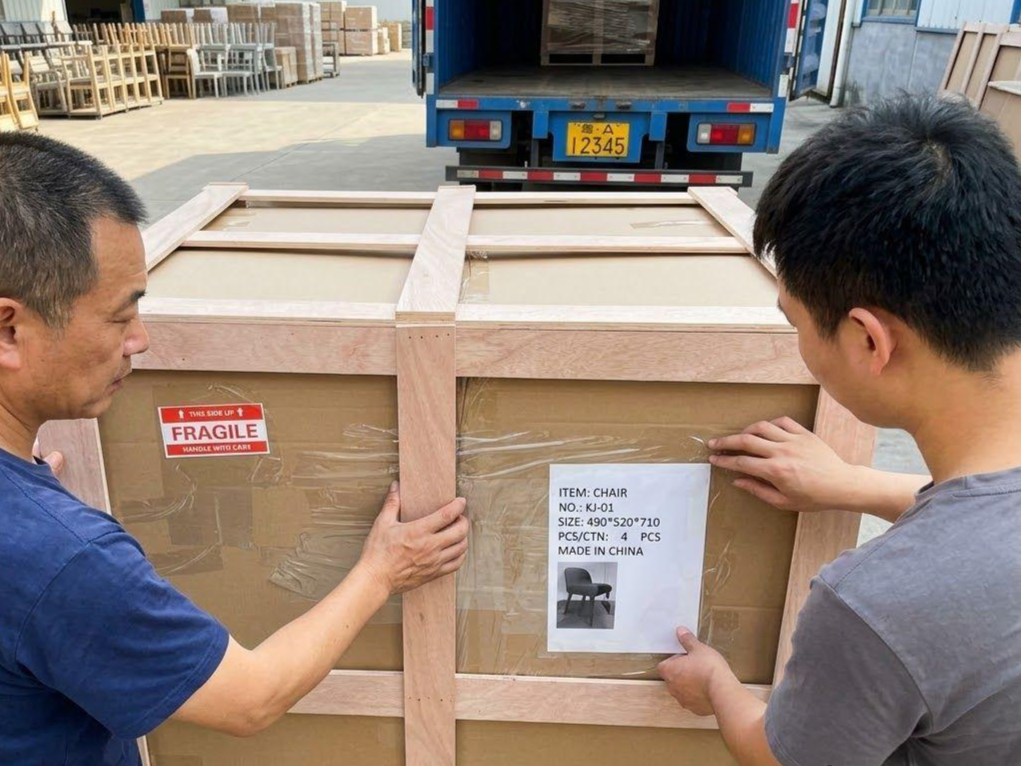
What Zero-Breakage Crating Actually Looks Like
It’s a system, not a box
Ever moved a Steinway grand piano across the country? You don’t just wrap it and hope. You build a custom skid. You suspend the load. You account for vibration, tilt, and the one mover who definitely won’t read the “THIS SIDE UP” label.
Ship from China for Chinese luxury furniture works the exact same way. The crate isn’t a container. It’s a suspension system, a microclimate manager, and an instruction manual for handlers—all at once. The exterior tells people how to move it. The interior controls the environment around your piece. The base distributes weight so a single forklift tine doesn’t become a lever against your furniture’s weakest joint.
A proper crate starts with a skid base rated for the actual weight—laminated pine or hardwood, not the cheapest plywood on the market. The furniture sits on a sub-frame that creates air gap and shock absorption. The sides aren’t just screwed on; they’re interlocked, glued, reinforced at stress points. Desiccant goes inside. Not on top. Inside. Because container rain is real, and it doesn’t fall evenly from the ceiling. I’ve opened containers where the ceiling was bone dry and the floor was soaked. Your crate needs to survive both.
The materials buyers usually get wrong
Buyers love to ask: “How thick is the plywood?” It’s not a stupid question. But it’s the wrong question.
What you should ask is: What touches my furniture? Raw foam? (Melts into lacquer in tropical heat. I’ve seen it. Looks like a burn scar.) Bubble wrap? (Traps moisture like a greenhouse. Your piece sweats inside.) Cardboard? (Compresses to nothing under sustained load. Might as well use tissue paper.)
Better operations use a layered approach: a soft interface that won’t off-gas or react with finishes; structural foam that distributes impact; a rigid outer shell that transfers force around the piece instead of through it. In my experience, factories that invest in vacuum-sealed inner bags and VCI film for metal components see dramatically lower damage rates on high-value shipments. No published study to quote. Just container after container of hard-won evidence. That counts for something.
A crate that looks good from the outside but has the wrong foam inside? Just a prettier coffin.
Factory Size, Specialization, and Crating Culture
This part’s counterintuitive. Those massive manufacturers in Shunde, Foshan? Production lines like something out of a tech museum. But crating is their bottleneck. They want containers out. Speed beats precision every time.
Some buyers swear by the big names, assuming scale equals reliability. But others find that mid-sized specialists—operations like Interi Furniture, which focuses on hospitality-grade case goods and custom upholstered seating for export markets—play a different game. Lower SKU volume per batch, but higher complexity per piece. That means crating can’t be conveyor-belt. It has to be bespoke. You’re more likely to find a foreman who knows your shipment by name, not just by container number.
But don’t romanticize the small workshop either. I’ve seen one-man operations in Anji build crates with more care than fifty-person teams. And I’ve seen boutique workshops ship $50,000 pieces in repurposed cardboard because “the client didn’t specify.” The variable isn’t size. It’s culture. And culture? You assess it with your eyes and your nose, not their brochure.
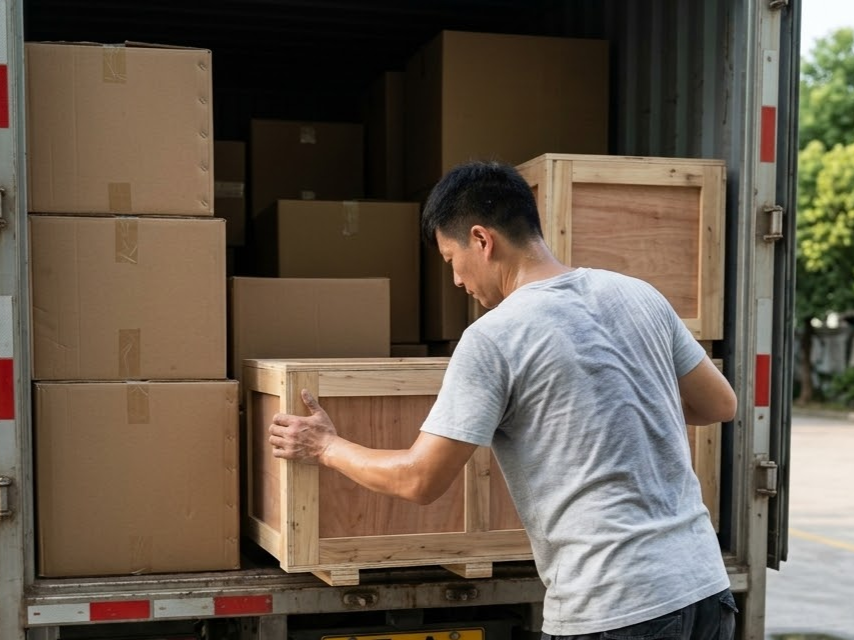
Your Zero-Breakage Checklist
Print it. Bring it to the factory. Make someone initial every line. It’s less hassle than litigation in New York.
Before Production: Specify or Suffer
- Crate engineering review — For pieces over $5,000 or anything with glass, marble, lacquer, or mirror: require drawings. No drawing, no production start. Full stop.
- Material manifest — Every single material that contacts your furniture, in writing. They say “foam,” you ask what grade. They say “plywood,” you ask the rating and thickness. Vagueness is a landmine.
- Handling instructions in three languages — English, Chinese, and your destination port’s language. Laminated. Bolted to the crate, not taped. Tape doesn’t survive three days in Yantian humidity.
Before Shipment: Verify or Regret
— Stand on it and jump. I’m serious. If the lid deflects more than a few millimeters under your weight, reject it. A crate that can’t take 100 kg on top won’t survive a container stack.
- The shake test — With permission, push the crate walls. Feel for movement inside. Any shift means insufficient internal bracing. Movement equals impact damage in transit. Guaranteed.
- Moisture management check — Desiccant must be inside the inner sealed wrapping, not loose in the corners. Humidity at sea can sit above 80% for weeks. A few silica packets taped to the exterior? That’s a placebo, not protection.
Documentation: Cover Your Back
— Photograph every face of the crated piece before the container door closes. Include the crate markings. Include the seal number. Email them to yourself and your freight forwarder simultaneously. Not WeChat. Email.
- The red flag that contradicts conventional wisdom — If the factory says, “Don’t worry, we’ve shipped this way a thousand times, never had a problem,” worry more. Familiarity breeds complacency. The factory that shipped a thousand glass cabinets without incident is exactly the one that skips the extra corner protector on number 1,001 because “we never needed it before.”
| Element | Standard Export Practice | Zero-Breakage Specification |
|---|---|---|
| Base construction | 9mm plywood sheet, minimal framing | Hardwood or laminated skid, reinforced corners, load-rated for 2x piece weight |
| Interior interface | Generic foam or bubble wrap | Material-specific: non-reactive foam, felt, or custom-cut polyethylene |
| Moisture control | Silica gel packets, exterior placement | Desiccant inside sealed inner bag, humidity indicator card visible |
| Shock absorption | None, or minimal corner pads | Engineered suspension, floating base for marble/glass, tilt indicators |
| Exterior labeling | Paper sticker, “FRAGILE” in English | Laminated multilingual placards, handling icons, weight distribution marks |
| Fasteners | Staples and basic screws | Reinforced screws at stress points, steel banding for heavy pieces |

FAQ
Q: Do I really need to fly to China just to check how they pack a box?
A: Not necessarily you personally. But someone you trust has to. A third-party inspector. Your freight forwarder’s local rep. A sourcing agent with furniture experience. What you absolutely cannot do is rely on factory photos taken from the one angle that looks good. If you’re spending $50,000+ on a furniture order, budget $800 to $1,500 for a pre-shipment inspection that specifically includes crating verification. Highest ROI spend in your entire logistics chain. Bar none.
Q: Who pays when a $15,000 piece arrives in pieces?
A: Depends on your Incoterms and your documentation. If you bought FOB and didn’t specify crating standards in your purchase order, the factory will claim the goods were “in apparent good condition” when they left the dock. Your insurance might cover it. Might. But insurers love denying claims for “insufficient packaging” if you accepted the factory’s default crate. Safest play: specify the crate in your PO, photograph it, and make the factory’s signed acceptance of those specs a condition of payment.
Q: Is plywood actually better than solid wood for crates?
A: For most furniture shipping, yes—if it’s the right plywood. Marine-grade or hardwood plywood resists warping and splitting better than cheap pine boards. But thickness matters less than construction. A well-built 12mm plywood crate with proper framing outperforms a sloppy 18mm box every single time. Don’t let the factory sell you on thickness alone.
Q: Can’t I just use a freight forwarder who promises “white glove” handling and skip the heavy crating?
A: No. White glove service at destination doesn’t protect your piece during the ocean leg, the port shuffle, or the customs inspection where someone opens your container with a crowbar. The crate is your insurance against everyone else’s indifference.
Q: Is zero-breakage crating actually achievable, or is it just marketing?
A: Achievable, but it depends on your definition. If you mean “no damage ever, guaranteed,” then no—shipping is inherently risky. But if you mean “damage rates below 1% on fragile luxury furniture shipped from China,” yes. Absolutely. The key is treating the crate as a designed component of your product, not an afterthought.
Closing
At the end of the day, the crate is the only part of your order that every single handler will touch. The woodworkers who built it. The truck driver to Yantian. The crane operator at the Port of Singapore. The customs inspector in Hamburg. The last-mile crew in Chicago. They won’t admire the joinery. They won’t notice the hand-rubbed lacquer. They’ll grab, lift, tilt, and stack the box you paid for.
So here’s the principle I learned the hard way in Dongguan: The money you save on crating is borrowed from your damage budget. And the interest rate is brutal.
What’s the most expensive piece you’ve ever received intact? And did you ever stop to wonder whether someone actually cared enough to build the box right—or whether you just got lucky?