

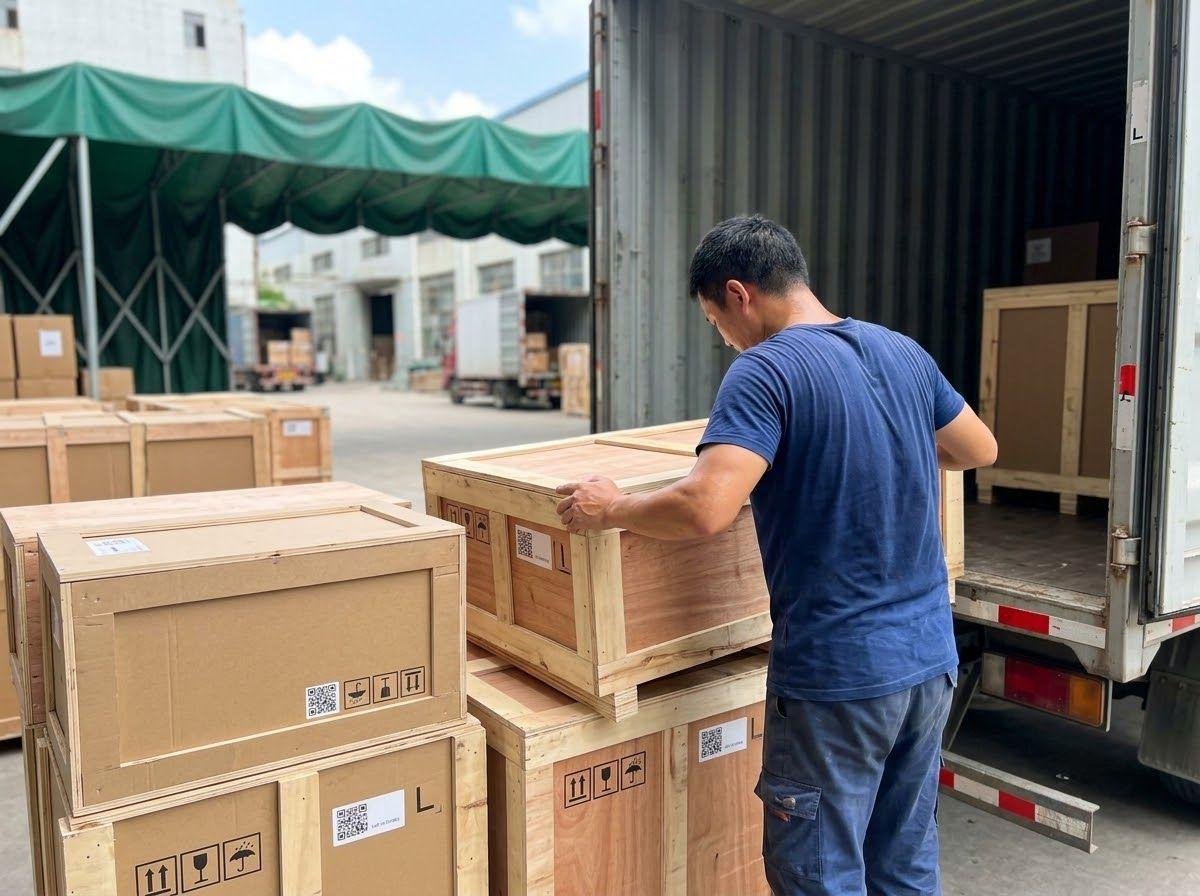
I was standing on a loading dock in Longjiang — that dense, chaotic furniture district in Foshan where every third building is a factory and the air smells like lacquer and diesel — watching three workers wedge a curved sofa into a 40-foot high-cube. It was July. Ninety degrees. The container had already been “full” twice according to the shipping manifest, and yet here they were, sliding a $4,200 sectional into a gap I would’ve sworn was too small for a dining chair.
The factory manager, a guy named Lao Chen who’d been loading containers since before I started sourcing, lit a cigarette and laughed. “You think this is furniture?” he said, gesturing at the metal box. “This is Tetris. And most foreign buyers? They play like it’s their first time.”
That moment cost a client of mine roughly $1,800 in air freight. Not because the factory cheated him. Not because the specs were wrong. Because he — like maybe seventy percent of the buyers I’ve met in fifteen years — treated container loading like an afterthought. Like it’s math you do on a napkin after the order’s already placed. It’s not. It’s the difference between a profitable shipment and an expensive lesson. And the factories that are good at it? They don’t talk about it. They just charge you for the space you waste.
The Brutal Truth: You’re Buying Air, Not Furniture
Here’s what nobody tells you at the Canton Fair. The price on your PI? That’s only half the story. The other half is what you actually fit inside that metal box.
Most buyers calculate container space like they’re filling a bathtub. Flat. Even. Logical. But a container isn’t a bathtub. It’s a three-dimensional puzzle where every piece has irregular edges, fragile corners, and a factory worker who’s been loading since 6 AM and just wants to go home.
The rule of thumb I give every new buyer: if you can see the back wall of the container when they’re halfway done, you’re already losing money. Not “you might be.” You are. Full stop.
And here’s the kicker — the factory doesn’t care. Not really. Their job is to pack what you ordered. Your job is to make sure what you ordered actually fits the way you think it does. Most buyers reverse those two responsibilities. Then they blame the forwarder.
Key Takeaway
- Container optimization is a pre-order discipline, not a post-order fix. The decisions that determine your landed cost per unit happen before you sign the purchase order.
- Chinese factory loading practices vary wildly by region — Foshan crews pack differently than Nankang crews, and neither defaults to “maximum density.”
- Your CAD drawing’s volume calculation and the real-world packed volume can differ by 15–30 percent. That gap is where your margin dies.
- The buyers who win at this game treat the container like a SKU-level decision, not a logistics afterthought.
Why Your CAD Drawing Is Lying to You
China furniture sourcing is the process of identifying, vetting, and purchasing furniture from manufacturers in China — but here’s the part the glossier trade magazines skip: it’s also the process of reconciling digital perfection with physical reality.
Think of a container load like moving into a new apartment. You measured the truck. You measured the couch. The numbers match. Perfect. Then you get to the stairs. And the hallway. And the door frame. And suddenly that “perfect” couch requires a forty-five-degree tilt, two friends, and a prayer. Container loading is the same, except the stairs are stackability limits, the hallway is weight distribution rules, and the door frame is the reality that foam compresses but solid wood doesn’t.
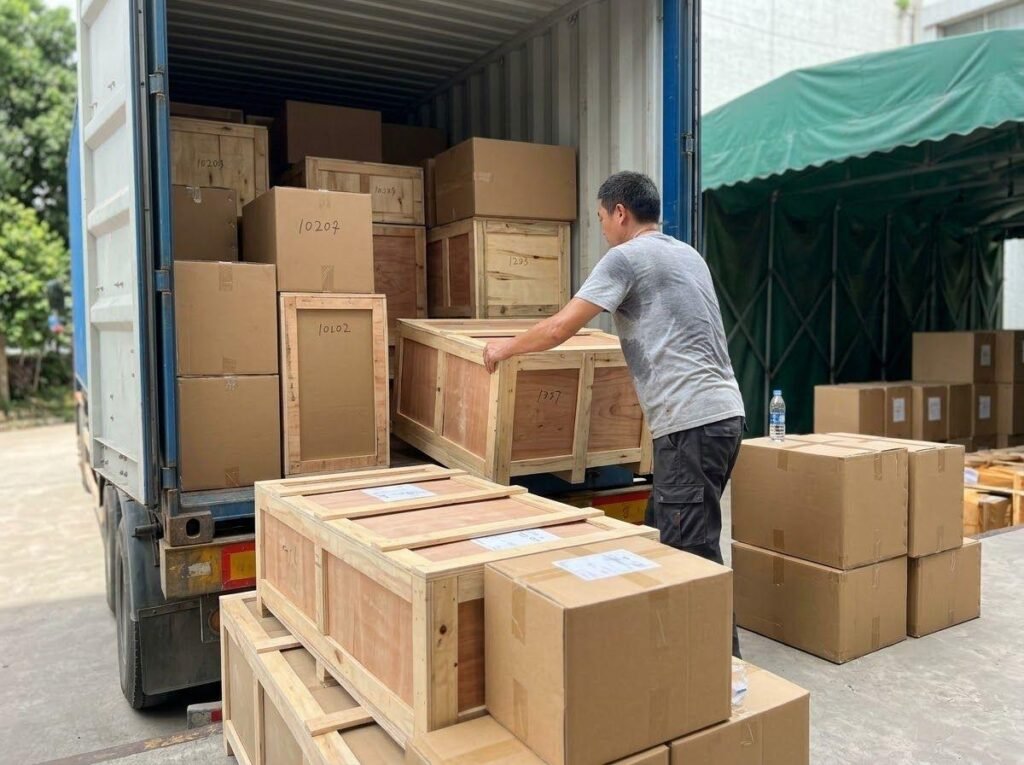
I once watched a loading team in Dongguan spend ninety minutes on a single dining table. Not because it was complicated. Because the buyer had specified “maximum pieces per container” without accounting for the table’s pedestal base — which, when turned on its side, created a dead zone of unusable space roughly the size of a dishwasher. The factory foreman didn’t flag it. Why would he? The order said twelve tables. He loaded twelve tables. And left enough empty cubic footage to fit six more chairs.
That dead zone had a price tag. Based on export data patterns from that quarter, that particular shipment ran about twenty-two percent above optimal cost per unit. Not because anyone made a mistake. Because nobody asked the right question before the order was cut.
The real cost of China imports isn’t the FOB price. It’s the space you don’t know you’re wasting.
And here’s what tends to happen when buyers finally realize this: they overcorrect. They start demanding “tetris loading” from factories that have never done it. They send Excel spreadsheets with color-coded diagrams. The factory nods. Smiles. Says “no problem.” Then loads the container the exact same way they always do. Because a diagram doesn’t change physics. And it definitely doesn’t change the fact that Lao Chen’s crew gets paid by the container, not by the cubic meter saved.
What Does “Maximized” Actually Look Like?
Buyers always ask me this. Usually in a hotel lobby in Guangzhou, usually after their second shipment, usually with a beer in hand.
The honest answer? It looks boring. It looks like furniture packed in ways that would make an IKEA engineer weep with joy. Tables nested. Chairs stacked four-high with custom-cut foam separators. Sofas loaded vertically — yes, vertically — when the frame geometry allows. Cartons that are slightly smaller than standard because someone, somewhere, asked “what if we knocked two centimeters off this box?”
I toured a facility in Anji, the chair-manufacturing capital of Zhejiang, where the owner had built a full-scale wooden mockup of a 40-foot container in his warehouse. Not for show. For testing. His team would physically load sample shipments into the mockup before confirming any order quantity. The mockup cost him maybe three thousand RMB to build. It probably saved him six figures in optimized loads over two years.
That’s the level of obsession we’re talking about. Most buyers aren’t obsessed. Most buyers are hopeful.
The Regional Reality: Not All Loading Crews Are Created Equal
If you’ve sourced from more than one region in China, you already know this. But if you’re new, listen close. The way a container gets loaded in Foshan’s Shunde district has almost nothing to do with how it gets loaded in Nankang, Jiangxi.
Foshan crews — especially around Longjiang and Lecong — have seen everything. They’re loading furniture into containers the way New Yorkers hail cabs: instinctively, aggressively, with a kind of muscle memory that comes from doing it ten times a day. They’ll Tetris-load a mixed container of sofas, dining sets, and bedroom furniture without breaking a sweat. But they’ll also cut corners if you don’t specify. Foam? “Oh, the buyer didn’t ask for extra foam.” Orientation arrows? “Those are just suggestions.”
Nankang, the furniture hub in Jiangxi, is different. More wood-forward. More solid hardwood, which means more weight concerns and less flexibility on orientation. The crews there tend to be more conservative. Safer. Which is great for damage rates and terrible for cube utilization.
And then there’s the Zhejiang corridor — Anji for chairs, Hangzhou suburbs for upholstery — where the culture leans toward precision. Smaller factories. More export experience. A different risk-reward equation.
While some buyers gravitate toward large-scale manufacturers in Foshan, others find that mid-sized specialists — operations like Interi Furniture, which focuses on project-grade upholstery and hospitality seating out of Guangdong — offer a different risk-reward equation. They’re not the biggest name on the block, but their loading protocols tend to reflect a more consultative mindset. You can actually get someone on the phone who will tell you, honestly, whether your twelve-piece hotel lobby set is going to cost you a container and a half or if it squeezes into one with clever nesting.
The factory you choose shapes your container before the first piece touches the dock.
When “Full” Is Nowhere Near Full
This is the section where I make enemies. Because I’m going to tell you something that contradicts what your freight forwarder probably said.
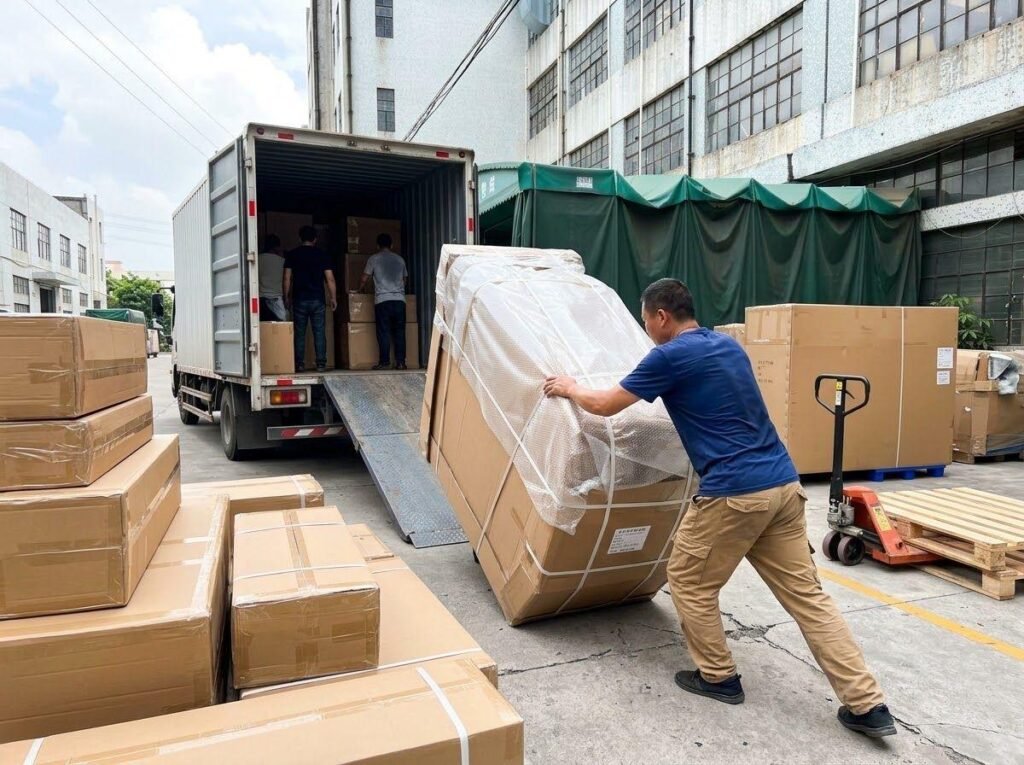
A container that looks full is usually twenty to thirty percent underutilized. I don’t have a peer-reviewed study on this. I have fifteen years of opening container doors in New Jersey and Long Beach and thinking, “That’s it? That’s what we paid to ship across the Pacific?”
The problem isn’t capacity. It’s configuration. A 40-foot high-cube has roughly 2,700 cubic feet of theoretical space. But theoretical space assumes you’re shipping water. Or sand. Or something that conforms to every corner. You’re shipping furniture. Which means legs. Which means arms. Which means packaging that adds four inches on every side because the factory doesn’t want a damage claim.
Here’s a comparison of what buyers typically assume versus what actually happens on the ground:
| What Buyers Assume | What Actually Happens | The Cost Impact |
|---|---|---|
| “If it fits in the container, we’re optimized.” | Fitting is not the same as maximizing. Gaps between pieces add up fast. | Hidden air freight for overflow, or delayed revenue from under-shipped units. |
| “The factory knows how to load efficiently.” | Factories know how to load safely and quickly. Efficiency is your problem, not theirs. | Standard loading often leaves 15–25% of usable space empty. |
| “We can just add more pieces to the next order.” | Next-order logic assumes stable demand, which it rarely is. | Ties up working capital in unshipped inventory or rushes air freight for hot SKUs. |
| “Damage protection and cube optimization are separate concerns.” | They are in direct tension. More protection = less density. Less density = higher per-unit cost. | The buyer who ignores this trade-off pays for it twice: once in freight, once in claims. |
The general pattern suggests that buyers who treat loading as a co-design problem — something they solve with the factory, not something they delegate to the factory — see measurable improvements. I’m talking ten to fifteen percent better cube utilization. On a $40,000 container, that’s not nothing. That’s a renegotiation.
The Actionable Framework: How to Stop Losing Money in the Gaps
You don’t need a PhD in logistics. You need a checklist that respects reality. Here’s what I use with clients. Steal it.
Before You Place the Order
- Demand a pre-load diagram. Not a rendering. A diagram. Top view, side view, with dimensions. If the factory can’t produce this, they haven’t thought about your container. And if they haven’t thought about it, they’re not going to optimize it.
- Ask for the “naked” dimensions. Not the carton size. The product size. Then ask how much packaging adds. Then add two centimeters yourself, because factories round down.
- Specify orientation by SKU. “This chair stacks four-high. This table ships on its edge. This sofa loads vertically with a plywood separator.” If you don’t specify, the crew guesses. Their guess is optimized for speed, not your margin.
- Request a loading test for new products. Yes, it costs time. Yes, some factories will grumble. But a two-hour test in a warehouse in Dongguan beats a $3,000 surprise in Atlanta every single time.
During Production
- Reject the “we’ll figure it out at loading” excuse. That’s not flexibility. That’s negligence wearing a smile. The time to figure it out is when the cartons are still being designed.
- Insist on photos of the first container. Not for Instagram. For verification. Compare against your diagram. If the first container is wrong, the next three will be wrong too.
The Red Flag Checklist
- — If your factory says “don’t worry, we do this all the time” without showing you a recent example of a mixed container load. Complacency is not expertise.
- — If your quote assumes a standard 40-foot container but your order includes more than three product categories. Mixed loads require mixed strategies. One-size-fits-all is a lie.
- — If you’re more focused on the FOB price than the landed cost per piece. This one contradicts conventional wisdom. Everyone negotiates FOB. Smart buyers negotiate total landed cost, which means they negotiate the container before they negotiate the per-unit price. A cheaper sofa that ships half-empty is more expensive than a pricier one that nests perfectly.

FAQ: The Questions Buyers Actually Ask
Q: Can I just ask the factory to “maximize the container” and trust them to figure it out?
A: No. And I say that with love. “Maximize” means nothing without context. Maximize for cube? For weight? For damage prevention? For unloading speed at your warehouse? I’ve seen factories interpret “maximize” as “cram it in until the door barely closes,” which is how you get a $2,400 claim on a scratched marble tabletop. Give them constraints. Give them diagrams. Treat the factory like a partner who needs instructions, not a magician who reads minds.
Q: How much difference does container optimization actually make to my bottom line?
A: In my experience, roughly ten to twenty percent of total freight cost on mixed furniture loads. Sometimes more if you’re shipping high-cube, low-weight items like upholstered seating. On a single container, that might be $800 to $1,500. Over a year, if you move twenty containers, you’re looking at real money. Money that could’ve gone into product development, marketing, or just your pocket. The buyers who treat this seriously treat it as a line item.
Q: What if my order is too small to fill a container? Should I even care about this?
A: You should care more. LCL — less-than-container-load — shipments are where the real bleeding happens. You’re not just paying for the space you use. You’re paying for the space the consolidator thinks you use, plus handling, plus the fact that your furniture gets loaded and unloaded multiple times by people who don’t know what it is. If you’re consistently at seventy percent of a container or above, it’s usually cheaper to book a full container and optimize the hell out of it than to keep shipping LCL. Do the math. Actually, have your forwarder do the math. Then check it yourself.
Q: Do factories charge extra for custom loading or special packaging?
A: Sometimes. Usually not for basic adjustments — nesting tables differently, adding a plywood separator, revising carton dimensions. Where you get into extra charges is when you ask for things that slow down their line: custom foam cuts, individual item photos during loading, third-party inspection of the load plan. In my experience, those costs are negotiable if you bring them up before production starts, not after. The factory that says “no problem” to a post-production loading change is either eating a cost they didn’t plan for or cutting a corner you didn’t see.
Q: Does the Tetris strategy work for every type of furniture import from China?
A: It depends on what you’re shipping and how much control you have over the order timing. If you’re buying container-load quantities of standardized, stackable items — metal chairs, flat-pack shelving, simple dining sets — the gains are massive and relatively easy. If you’re buying one-off custom pieces, oversized statement furniture, or fragile items with zero tolerance for contact, the physics work against you. The strategy still applies, but the ceiling is lower. The principle is universal: optimize what you can, and know the difference between “full” and “maximized.” Most buyers don’t. That’s your edge.
The Hard Question at the End
I started this story on a loading dock in Longjiang with Lao Chen and his cigarette. I’ll end it with a question I ask every buyer who thinks they’ve got this figured out.
If you opened your last container and took a photo of the load before anyone touched it — not the neatly staged photo the factory sent, but the reality of how pieces sat in that metal box for thirty days at sea — would you still believe you got your money’s worth? Or would you see what I see: the gap where two more chairs could’ve lived, the void above the sideboard that nobody bothered to fill, the expensive, salty air you paid to ship from Guangdong to Georgia?
The buyers who sleep well at night don’t have better factories. They ask better questions before the door seals. Everything after that is just physics. And physics, unlike a factory promise, doesn’t negotiate.