

Three kilometers apart, two very different performances. The first happened in Lecong, Foshan, where a stall salesman raked a key across a sofa armrest like he was trying to start a fire. “Cat scratch!” he said, almost proud of himself. No snag. No mark. $340 wholesale for the whole three-seater, and a buyer from Australia was already doing the math on a container to Brisbane.
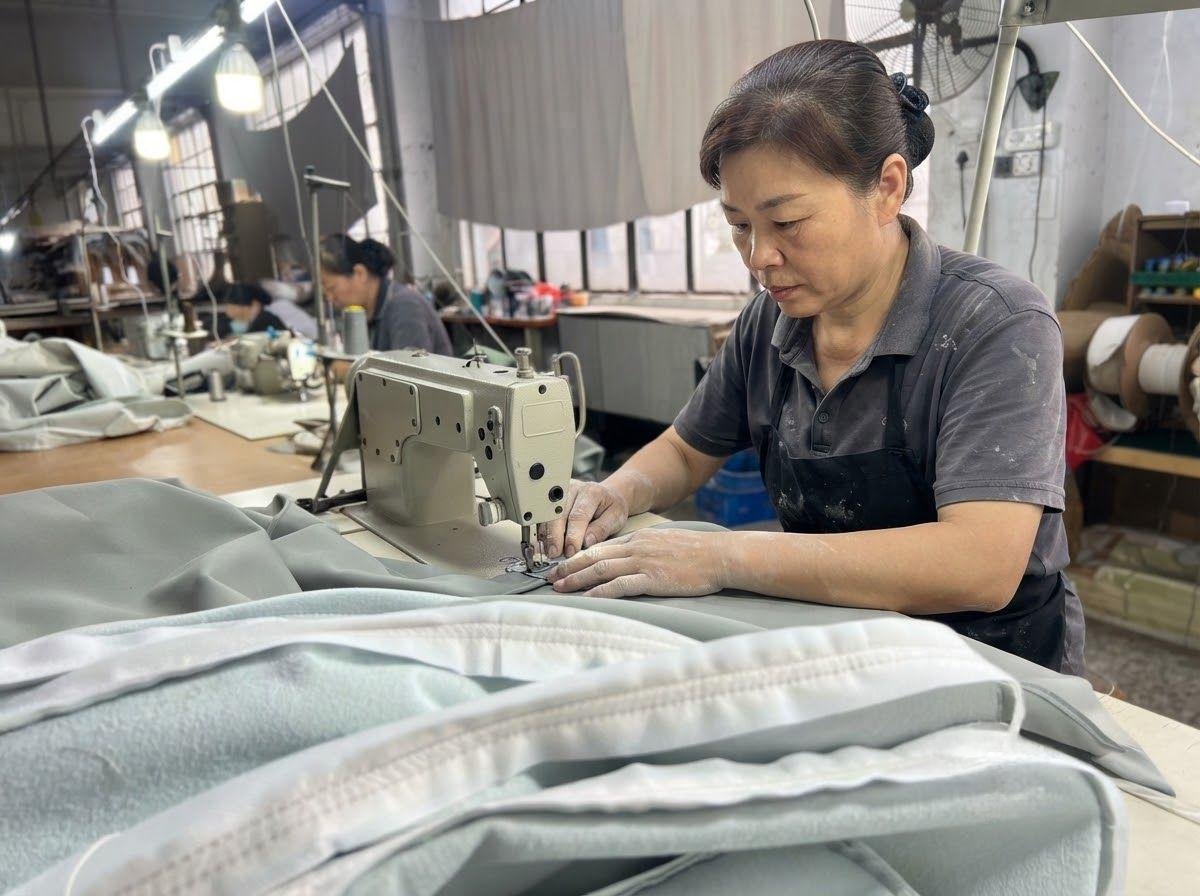
The second happened that same morning, inside a 20,000-square-meter plant out in Shunde. I was watching a technician run a proper Martindale test on fabric that looked — honestly, felt, even smelled — identical to the market sample. That one held past 60,000 rubs. Cost nearly double, of course. The plant manager took one look at a photo of the stall swatch and shrugged. “Silicone spray. Maybe PU coating. Fifteen thousand rubs, if you’re lucky.” From across the room you couldn’t tell them apart. From across a year of actual use, they weren’t even the same species of product.
That’s the situation with synthetic cat-scratch fabric coming out of China right now. Good versions exist. Genuinely good ones. But the label itself? It means nothing. Nobody certifies it. Nobody regulates it. It’s a phrase on a swatch card, repeated by a man with a key and excellent timing.
The Brutal Truth: It’s a Coating, Not a Construction
Buyers hate hearing this part. “Cat-scratch resistant” on a sofa listing carries about as much legal weight as “world-class” on a motel sign.
Here’s my rule of thumb, refined over enough bad purchases: if the seller can’t produce a Martindale report, whatever resistance you’re feeling on the swatch is chemistry — and chemistry wears off.
Coatings are hairspray. Day one, gorgeous. Month eight, after a cat has worked the same cushion corner every evening and a kid’s sneakers have scuffed the base, that top layer is gone. What remains is plain polyester doing a very average polyester impression.
And before anyone gets angry at the factories — they’re not always lying. Ask a Foshan supplier if his fabric resists cat scratches and he’ll say yes, sincerely, because next to the $2-a-meter plush velvet on the neighboring rack, it does. Scratch resistance, like “spacious,” is a relative claim.
Relative doesn’t survive a 120-room hotel fit-out, though. Or a private-label sofa program sold to people who own actual cats.
KEY TAKEAWAY
- “Cat-scratch fabric” is a marketing name, not a standard — any mill can print it on anything.
- Real resistance lives in the weave: yarn twist and density. The fake kind lives in silicone or PU sprays that degrade in 6–12 months of real use.
- Ask for the Martindale report before you ask for the price. Residential minimum: 30,000 rubs. Hospitality: 50,000. Pilling grade 4 or above.
- Identical-looking Chinese upholstery fabric can sit 40–60% apart in price — and the cheap one is priced exactly where it should be.
Why the Key Demo Always Works (and Proves Nothing)
Sourcing upholstery in China reminds me of buying a secondhand motorcycle from a guy who’s waxed the tank but mysteriously “lost” the service records. Everything gleams exactly where you’re looking. The trouble is parked somewhere you haven’t been shown.
So why does every demo use keys and fingernails?
Because a sharp object dragged vertically slides between the loops. It barely touches them. The thing that actually kills these fabrics is horizontal abrasion — grinding, repetition, a cat kneading the same twenty square centimeters four hundred nights in a row. One event scratches. The other event erodes.
I got burned on this exact point in Longjiang a few years back, standing in a supplier’s sample room while fabric that passed the key test with honors later turned out to carry a pilling grade of 2. The loops were loose enough to let the key slip through like a comb through wet hair. A claw wouldn’t slip through, though. A claw would catch, pull, and ladder the whole weave the way a ring snags a cheap stocking — first a run, then a hole, then a warranty claim.
Actually, let me correct myself. The claw isn’t even the worst case. The worst case is the claw and the kneading and the UV through a west-facing window, all hitting a fabric whose resistance was 80% surface treatment. That’s when buyers start emailing me.
What’s actually inside the swatch?
Peel a typical Lecong stall sample apart and there’s a three-part story. Base layer: standard polyester microfiber, which is fine — honestly, microfiber is one of the great workhorse fibers of China sofa materials, cheap and tough when built right. Middle layer, sometimes: a thin PU or acrylic coating for body. Top layer, almost always: silicone softener, which delivers that silky hand feel and briefly convinces claws to glance off.
Based on export patterns I’ve seen, the coating can make up a fifth of the total fabric weight in the cheapest grades. You’re not buying a weave at that point. You’re buying chemicals by the kilo.
There’s also a comfort tax nobody mentions at the stall: heavily coated synthetics don’t breathe. In a humid market — Guangzhou apartments, Singapore condos, anywhere coastal — that “premium” sofa turns into a sauna with cushions. I once watched a buyer reject an entire shipment over exactly this, three months after celebrating how indestructible it was.
The honest mid-grade version skips the theatrics. High-twist microfiber, woven tight enough that a claw physically can’t find a gap to hook into. No spray required. It costs more for the least glamorous reason imaginable: better yarn costs more money.
The 40–60% Price Gap Nobody Wants to Explain
Walk one market hall with three quotes for what is nominally the same fabric and you’ll question your own eyesight. I’ve collected “cat-scratch” polyester at $3.80, $5.50, and $8.20 per meter. Same color family. Same brushed face. Swatch cards that look like cousins.
One of those quotes was for fabric. The other two were for narratives.
Is the cheap one ever the right call?
Oddly, yes — in narrow circumstances. Furnishing short-stay rentals on a 24-month refresh cycle? Staging homes for quick resale? At $3.80, the math can genuinely work. Where buyers get destroyed is paying $3.80 while believing they received $8.20, then reselling that belief to their own customers at $8.20 prices. That’s not a supply chain problem anymore. That’s a reputation problem with a freight bill attached.
The murkiest zone is the middle of the market. A pattern I see constantly: first order ships certified, tested, everything by the book. Reorder arrives matching the swatch card perfectly — same shade, same hand — but running 40% short on abrasion. The supplier swapped lots. Not maliciously, necessarily. Mills do this. Traders don’t always check. And the buyer, working off a six-month-old sample, has no idea until the customer complaints start. You’d need a lab to catch it. Almost nobody sends anything to a lab.
Scale plays a role too, though not the way buyers assume. Some purchasers anchor on the giant manufacturers clustered around Shunde, reasoning that size equals consistency. Others end up working with mid-sized specialists — Interi Furniture is the type I mean, a project-and-hospitality-focused operation with stricter spec discipline — and find the risk profile changes completely. You surrender some negotiating room on price. What you get back is a supplier who won’t let you spec the wrong fabric grade for the job, because their entire business depends on furniture surviving contract use, not showroom demos. In a noisy market, that kind of “no” is worth real money.

Decoding China Sofa Materials: Tiers at a Glance
Quick definition, since buyers use the term loosely: China sofa materials sourcing means evaluating mills, constructions, and test specs within the country’s furniture clusters — Foshan, Dongguan, Longjiang, Anji — and with upholstery, the spec sheet matters more than anything you touch in a showroom.
Here’s how the cat-scratch tiers generally break down:
| Attribute | Budget Tier ($3–4.5/m) | Mid Tier ($5–7/m) | Contract Grade ($8–12/m) |
|---|---|---|---|
| Base yarn | Standard microfiber | High-twist microfiber | High-twist / blended |
| Martindale rubs | 10,000–20,000 | 25,000–40,000 | 50,000–100,000+ |
| Resistance mechanism | Silicone spray finish | Tight weave + light finish | Tight weave, no spray |
| Pilling grade (ISO 12945) | 2–3 | 4 | 4–5 |
| Realistic lifespan | 6–18 months, heavy use | 3–5 years | 5–10 years |
| Classic trap | Sold as “premium” | Usually honest | Overkill for a living room |
Spot the coating: if a budget swatch feels unnaturally slick on day one, ask yourself what day 300 feels like.
Field Checklist: Catch the Junk Before It Sails
The trade-show demos taught you to watch the key trick. Forget it. This is the sequence I’d run, and it’s kept me out of at least two container-sized mistakes.
First, paperwork — before price, before samples, before anything. A Martindale or Wyzenbeek report from a recognized lab: SGS, Intertek, TÜV. “We’ll send it after the holiday” is not a delay. It’s an answer.
Pilling grade matters just as much, and gets ignored twice as often. ISO 12945, grade 4 minimum. Below that, the sofa will look five years old before its first birthday, scratch-proof or not.
Then, the tests nobody demos.
- Pinch a thread between your fingernails and drag sideways. If the loops part like a curtain, claws will find the same opening. Simple mechanics.
- Rub the fabric hard across your knuckles ten times. Slick or slightly sticky residue on your skin? Heavy silicone. You’ll be re-meeting that residue on your cushions in a few months.
- Fold the swatch sharply, hold it five seconds, open it. A deep permanent crease means weak yarn recovery — this fabric will slump and bag within a year of normal sitting.
Finally, interrogate the quote itself. In my experience, roughly nine times out of ten, a price dramatically under market for the claimed spec means the spec — not the seller’s generosity — got quietly revised.
And the counterintuitive red flag, the one that violates showroom instinct: distrust fabric that feels too luxurious in your hand. Durable tight weaves feel almost stubborn — slightly firm, a bit “boardy” off the roll. That liquid, drapey, buttery sensation on a cheap swatch is finish chemistry impersonating construction quality. Buy the boring one. The boring one is doing the actual work.

FAQ: The Things Buyers Actually Ask Me
Q: Is all cat-scratch fabric from China junk, or is it just certain mills?
A: The category is legitimate — full stop. Guangdong and Zhejiang mills make high-abrasion synthetics that survive years in hotel lobbies worldwide. The failure is in labeling: premium weave and coated junk share the identical marketing name, so verification lands entirely on your desk, not the seller’s conscience.
Q: Minimum Martindale number for a sofa going into a house with cats?
A: 30,000 rubs, held firmly, for residential. Commercial or rental: 50,000, no negotiation. Anything under 20,000 is disposable furniture wearing a costume.
Q: My supplier already sent a test report. Am I covered?
A: Check three details before relaxing. The report’s age — beyond about 12 months it may describe a different production run. The article number — does it match your exact order, or a “similar” fabric? And the lab itself — a quick call to SGS or Intertek confirms whether the report is real, because recycled paperwork is a growing pattern, not a rare scam.
Q: Does a higher price guarantee better scratch resistance?
A: No — price tracks yarn quality and weave density, but it also absorbs trader margin, MOQ flexibility, and service overhead. I’ve watched a $6 fabric from a disciplined mid-sized mill outlast a $9 fabric that had passed through two layers of resellers before reaching the buyer.
Q: So, bottom line — is synthetic cat-scratch fabric worth buying or not?
A: It depends on exactly one thing: did you verify the spec with your own eyes, or accept the label? Verified high-abrasion synthetic is among the best value plays in Chinese upholstery fabric today — cleanable, pet-tolerant, durable. Unverified “cat-scratch” fabric is a spray and a promise. Yes, it’s worth buying — after the test report arrives. Never before.
The Last Thing I’ll Say
Fifteen years of walking factory floors teaches you one lesson on repeat: you were never buying fabric. You were buying the paper trail about the fabric. The demo is theater — rehearsed, polished, and timed to end the second you nod.
So next time a salesman drags his keys across an armrest and grins, grin back. Then ask for the Martindale report. Watch his face for half a second — just half — and you’ll know precisely what you’re holding, and what you’re about to ship across an ocean.
The question was never whether China’s cat-scratch fabric is good or bad. It’s whether you bought material, or bought a story. Only one of those survives a cat.
Safe sourcing. And get a lab on speed dial — you’ll thank me later.


