

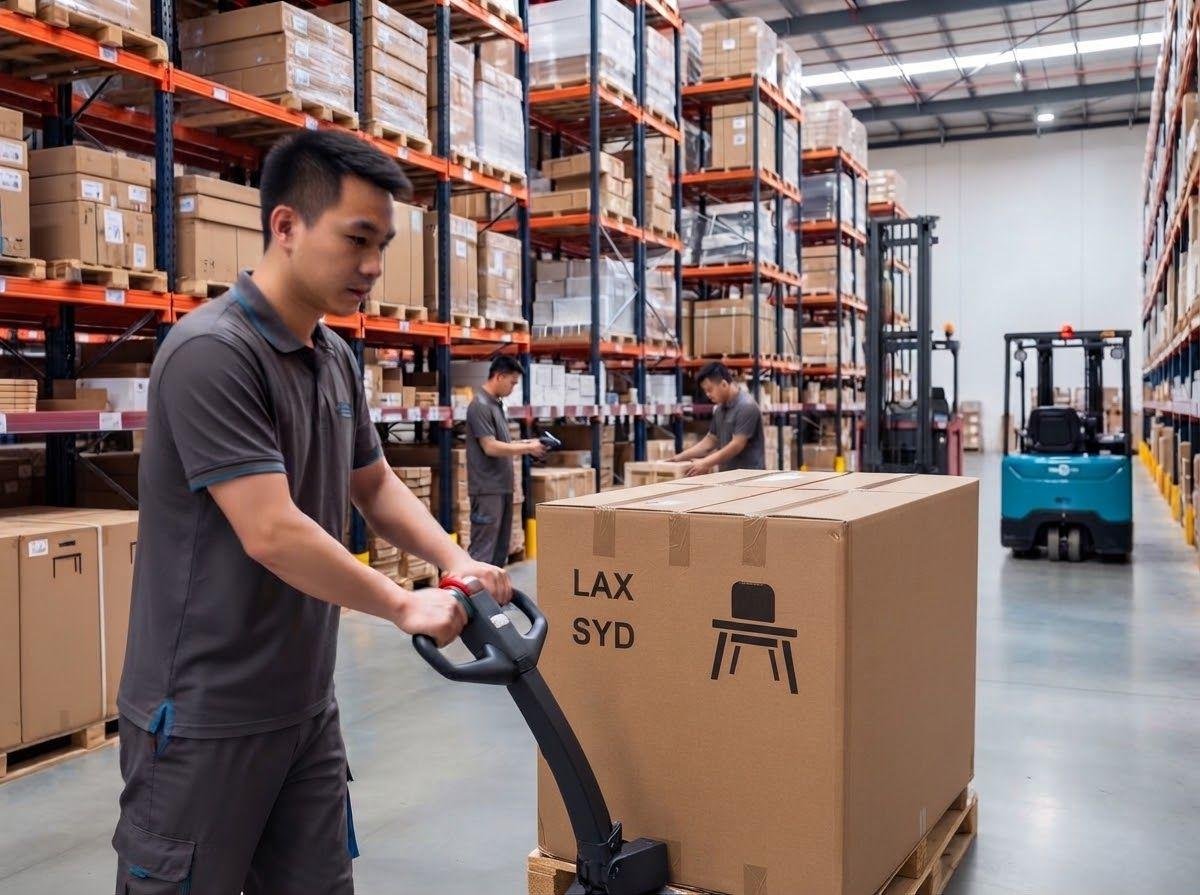
Last month I got a voice message from a procurement guy in Denver. He’d just had a quote blow up on him — the 40-footer from Ningbo to LA that cost him $1,900 back in March was suddenly $4,700, and the forwarding agent said, and I quote, “the market moved.” That’s it. That’s the explanation. Four grand of “the market moved.”
He asked me the question everyone asks me now. “Is there any way around this, or do we just bend over and take it?”
There kind of is a way around it. But it’s not what the logistics influencers on LinkedIn are selling you. It involves doing something most buyers hate: letting your furniture sit still inside China for a while. Not in a container. Not on a ship. In a warehouse, two hours from the port, waiting for you to decide when — and whether — it moves at all.
Sounds backwards? Maybe. It also happens to be what the sharpest operators I’ve met this year are quietly doing while everyone else fights over spot rates like it’s a Black Friday sale.
The Brutal Truth: You Bought a Sofa, But You’re Trading Freight Futures
Nobody wants to hear this at a trade show. So I’ll say it here.
Most of the China furniture rates pain this year is self-inflicted. Not all of it. But most.
Here’s the pattern. Tariff deadline gets announced. Every buyer with a PO open rushes their cargo to the port in the same three weeks. Carriers see the queue and — surprise — rates spike. Truce gets signed two months later. Rates collapse. The same buyers who paid $5,000 a box now watch the lane drop to $2,200. They feel robbed. They wait for it to get cheaper. The market tightens again. Repeat forever.
I’ve watched this cycle spin maybe four times in 2026 alone. Industry observers estimate the China-to-West-Coast lane has swung harder in ten months than it did in the three years before that. And furniture takes the beating worse than almost anything else, because — let’s be honest about what a sofa is — it’s foam, timber, and air. You’re paying ocean freight by volume for air.
One rule of thumb I give clients, free of charge: if freight per unit bounces more than your factory’s margin per unit, you’re not sourcing furniture anymore. You’re gambling on shipping, and the house always wins.
There is no arguing your way out of that market. You can’t negotiate with a rate spike. But you can step outside the timing that creates it. That’s the whole game. Everything else is noise.
Key Takeaway
- China furniture rates in 2026 punish timing, not distance. Shipping during tariff rushes or GRI weeks costs more than the product does to make. That’s not an exaggeration — I’ve seen it on invoices.
- A Chinese warehouse network breaks the link between “factory finished” and “container sails.” Park the goods, consolidate them, ship when the lane is sane.
- Nobody’s warehouse is free. But storage at roughly $8–15 per CBM per month (rates shift city to city; inland Foshan runs cheaper than port-adjacent Shanghai) is small change next to a $3,000 rate swing on one container.
- The buyers coming out ahead treat Chinese storage as a weapon. Everyone else treats it as an accident they have to pay for.
How 2026 Broke a Playbook That Was Already Cracked
Wasn’t “just ship it when it’s done” good enough before?
It was. For a long time, it genuinely was. You wrote the PO, the factory ran the goods, the box sailed, and the whole chain hummed like a cheap quartz watch. Nobody needed a warehouse strategy because time itself was cheap.
That died years ago, honestly. What’s different about 2026 is that the squeeze now comes from both ends at once. Ocean freight is stormy — Red Sea reroutings pushed transit times up, capacity keeps lurching between shortage and glut. Meanwhile tariff calendars flip like weather vanes, and every flip sends a herd of buyers stampeding the same sailings.
Based on conversations across maybe thirty importers this year, roughly seven in ten got hit with at least one cost layer they never budgeted. A GRI announced after they booked. A PSS that appeared from nowhere. A duty change that made their landed math wrong before the goods even cleared the factory gate.
Picture filling a bathtub while somebody keeps yanking the plug. You can fiddle with the tap all day. The water level is decided by the drain, not the faucet.
I was in Longjiang this spring — the furniture town in Shunde, Foshan, where they make so many recliners the air smells like foam curing — and a factory owner walked me past shrink-wrapped hotel headboards stacked to the ceiling of his on-site warehouse. “Buyers book production, then tell me hold it two months for a cheaper ship,” he said, shrugging the particular shrug of a man who has stopped being surprised. “My warehouse is full. So now I charge waiting fee.” Storage fees. Slow-turn surcharges. Cost of capital buried in the fine print of the PI.
Actually, let me correct something. The cost didn’t just move upstream from port to factory. It multiplied. There’s a warehouse layer now and a freight layer. You pay both unless you plan for the first one.
So You Park the Goods. Then What?
Warehousing sounds smart until you actually try it.
Before we go further, let’s define the thing properly, because definitions matter when you’re building this into a landed-cost model. China furniture sourcing is the process of specifying, producing, and shipping furniture from Chinese manufacturers — and increasingly in 2026, staging it inside China before it ever sees an ocean. That staging piece is where a Chinese warehouse network earns its keep.
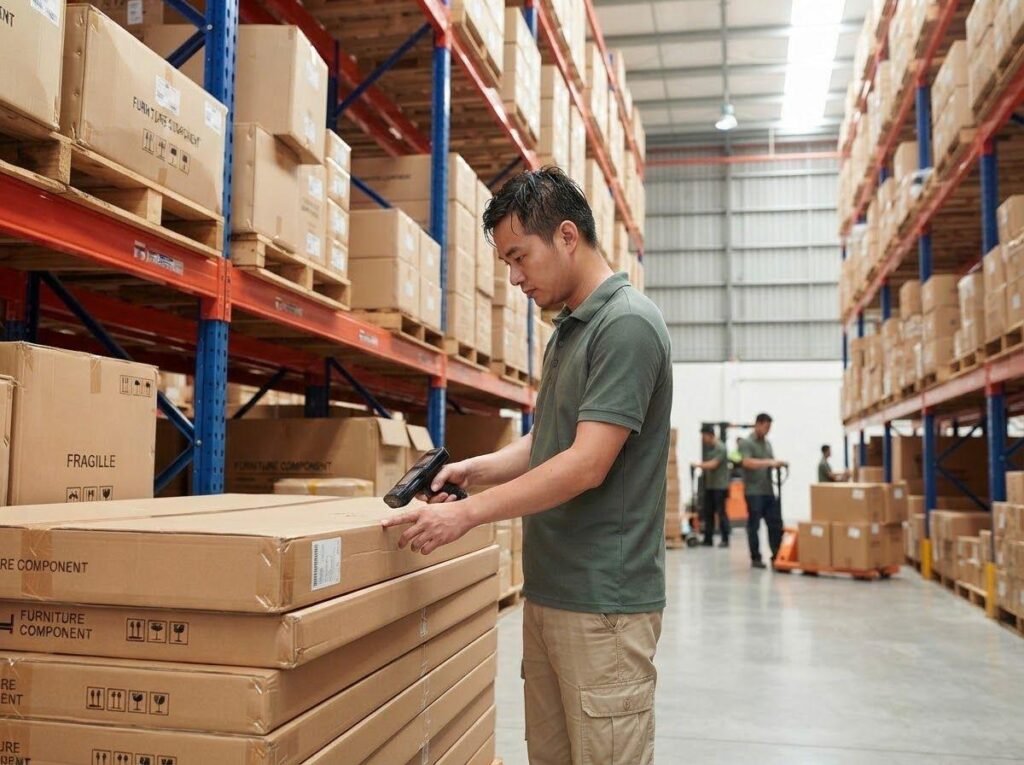
When I say “network,” I don’t mean one shiny bonded facility with a website. I mean three rough layers working together. First: factory-side storage in the production clusters — Foshan and Dongguan for casegoods and upholstery, Anji for chairs, Nankang for solid wood, Ningbo orbit for the smaller stuff. Second: consolidation warehouses near the load ports — Shenzhen, Ningbo, Shanghai — where cargo from three different factories gets married into one full container. Third: bonded zones, where goods can sit without domestic duties or VAT complications, which buys you flexibility on paperwork and timing.
Think of it like the difference between hailing a taxi and catching a bus. Spot shipping is the taxi — door to door, instant, surge-priced at exactly the moment you can’t walk. A warehouse network is the bus depot. You wait for the scheduled run, you share the ride, you pay a fraction per seat. Slower. Way cheaper per unit.
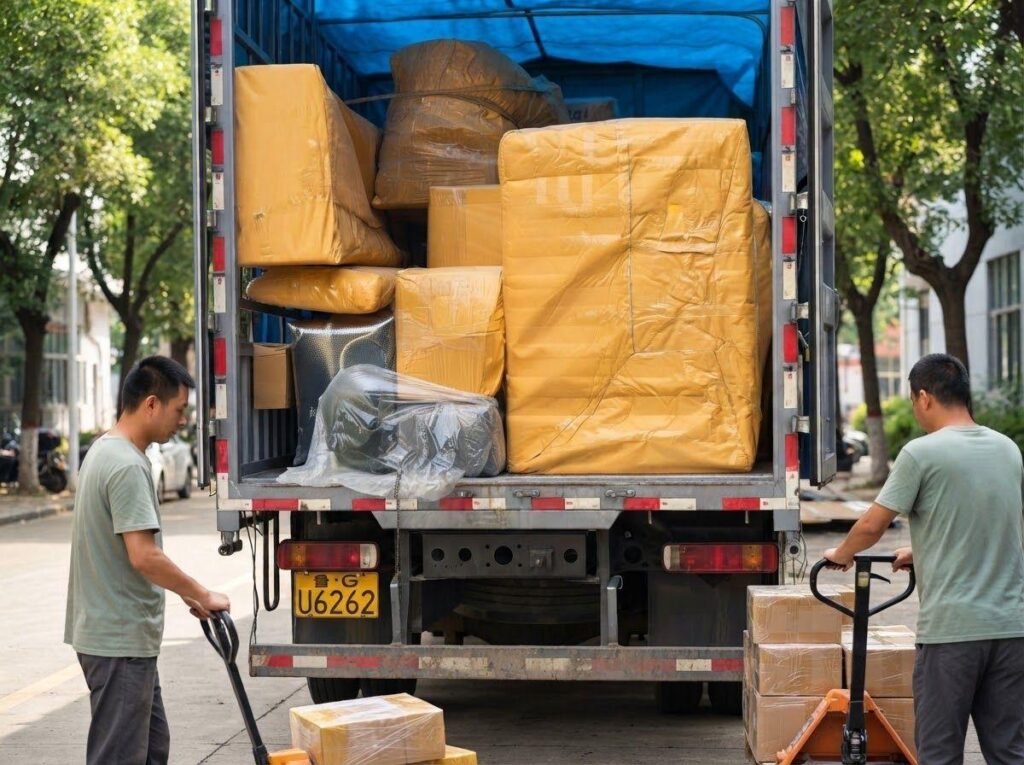
The real money, though, isn’t in the storage at all. It’s in the consolidation. Last month I stood on the dock of a consolidator’s facility outside Shenzhen watching a crew re-palletize cargo from three separate factories into a single 40’HQ — casegoods from a Dongguan shop, sofa frames from Foshan, light fixtures out of Zhongshan. The buyer, running FF&E for a 200-room hotel project, cut her container count from eleven to seven. Do that math on this year’s rates. That’s the quiet stuff nobody posts about: consolidation is where the warehouse strategy pays its own rent, not the storage line item.
But don’t get romantic. Storage has a failure mode, and it’s called “too long.” Six months in a humid Guangdong warehouse and your cartons are soft, your hardware bags are rusting at the staples, and your insurance broker is asking questions you’d rather not answer.
The Factory Side of the Equation
Who you buy from changes how well this works.
Walk the showrooms in Foshan and every big manufacturer sells you the same package: we produce, we store, we ship, we even deliver duty-paid to your door. One throat to choke, they’ll tell you. Convenient? Sure. Transparent? Not even close. When the same party writes the product quote, the storage quote, and the freight quote, you can’t see a single one of them. It’s like asking your casino host to audit your gambling.
The mid-sized shops play it differently. Take an outfit like Interi Furniture — the kind of export-focused manufacturer you’d find in the Guangdong industrial belt, serving project and hospitality buyers who need project-grade goods rather than showroom pieces. Shops in this tier can’t quietly absorb warehousing costs the way the giants do, so they’re more likely to let you — or your own forwarder — control the storage piece separately. More work for you. Also more visibility into where every dollar goes.
What tends to happen, watching buyers operate across tiers, is that the best results come from matching the factory to your risk, not to their brochure. In a freight storm, alignment of incentives beats brand size every time. Ask me how I know.
What To Actually Do
Here’s the checklist. Not theory — this is the sequence I watched a buyer in Austin run, start to finish, over about six weeks.
- Do the spread math before anything else. Pull your worst 2026 spot rate against realistic storage — call it $8–15 per CBM monthly depending on city and rack versus floor storage. If the gap between “ship now at peak” and “wait 60 days” is under 15%, the buffer isn’t worth building. Move on.
- Split your SKUs into two buckets. Bucket one: repeatable core items — the chair model you reorder every quarter — those belong in the buffer. Bucket two: custom project goods on penalty clauses. Those ship straight through, because a late room-opening costs you more than any rate spike.
- See the warehouses with your own eyes. Not a video tour. Fly in, walk the floor, smell the humidity. A clean racked facility in Nanshan versus a damp shed in the outskirts with one forklift and a leaky roof — that difference is the difference between strategy and insurance claim. Visit one consolidation warehouse near Shenzhen and one in the Ningbo–Shanghai corridor before signing anything.
- Never let the factory write both quotes. Warehouse and freight, separate vendors, separate contracts. When one hand controls both, you’ve handed over your only negotiating lever. Non-negotiable, this one.
- Pick your trigger number now. Decide, today, the rate at which you’ll ship versus wait — write it down, put it in the SOP, and when the market hits that number, you act. No committee. No “let’s watch it one more week.” Discipline beats optimism, every single cycle.
- Now the red flag that breaks conventional advice: run from any warehouse offering “free storage.” Everyone tells you to negotiate thirty free days. Wrong move. Free storage is where the real margin hides — it’s either priced into your product quote at 3x, or it converts to punitive fees after a month, guaranteed. Pay a transparent rate instead. Boring. Honest. Cheaper in the end.
None of this is clever. Clever doesn’t survive contact with a rate spike. Boring does.

The Questions I Actually Get Asked
Q: Does a Chinese warehouse network really bring my China furniture rates down, or does it just move the cost somewhere I can’t see?
A: It brings them down — if you use it to consolidate partial loads and to ship on your calendar instead of the panic calendar. If you park cargo and then book peak season anyway, all you’ve done is add a storage invoice on top of a peak invoice. The network is a tool for choosing your moment. It is not magic.
Q: How long is too long to leave furniture sitting in China?
A: Sixty to ninety days is the sweet spot for most hotel and residential goods. Past six months, in my experience, the math goes quietly bad — humidity damage in southern China’s wet season, insurance fine print, and monthly fees that stack a digit onto your landed cost without you noticing until the reconciliation.
Q: Can bonded warehouses help me delay or avoid tariffs?
A: It depends — heavily — on your destination market and your structure, and this is the one place where you hire a licensed customs broker before moving anything, not after. Bonded storage inside China is standard practice for re-export flows. It is not a loophole for US-bound duties, and anyone pitching it as one is selling you an audit.
Q: What if my factory won’t release the goods to a third-party warehouse?
A: Then your PO was missing a release clause. Put it in before production, not after: release against your forwarder’s booking to your designated facility within X days of inspection pass. Factories push back on this — until they don’t. Once it’s in the paperwork, compliance follows.
Q: Does any of this make sense under five containers a year?
A: Honestly? No, not on your own. Under five boxes you’re better off renting space in a consolidator’s shared warehouse or riding a trading company’s program. The fixed costs of your own network only clear around eight to ten containers annually — unless your freight spread is genuinely brutal, which, this year, on some lanes, it absolutely is.
The Part Where I Tell You What the Smart Money Already Knows
Back to Denver. That buyer ended up splitting the order — half on the water immediately, half parked in a bonded facility outside Shenzhen while he watched the lane. Six weeks later the rate dropped. He consolidated three factories’ worth of leftover cargo into one box and saved more on that single sailing than the entire storage bill for both months. His client never knew there was a storm. That’s the point.
Most buyers will never do this. They’ll pay the spike, swallow the margin, and call it “market conditions.” It wasn’t conditions. It was a decision they didn’t realize they were making.
The principle, earned the expensive way across too many warehouse floors and one memorably humid afternoon in Dongguan: in a freight storm, the person who controls the waiting wins. The warehouse isn’t overhead. It’s the one link in your chain where time stops costing you and starts working for you.
So ask your operation one question this quarter. If rates spiked tomorrow morning, would you be holding the umbrella — or standing in the rain arguing with it?
— Catch you at the loading dock.