

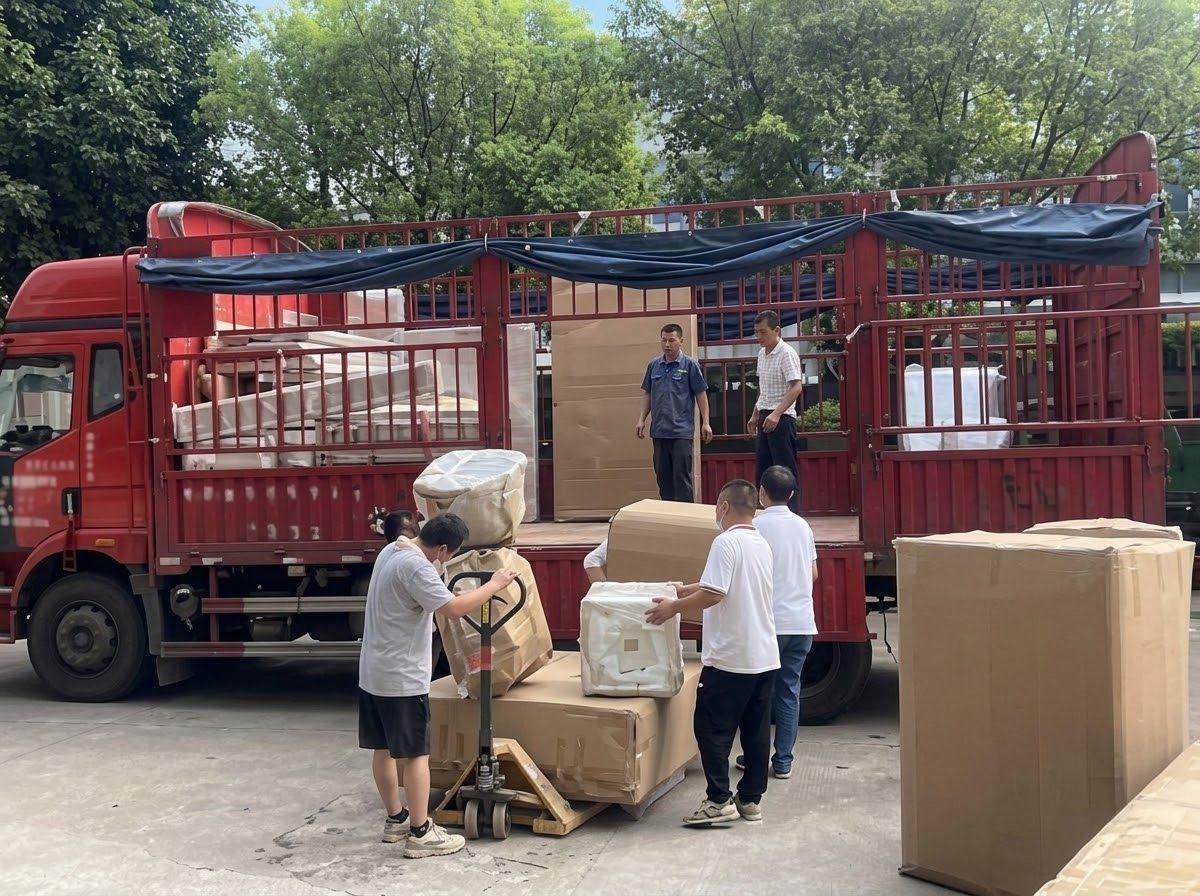
Dave flew in from Miami. First time. Longjiang, that industrial sprawl on Foshan’s edge — air thick with lacquer fumes and something else. Dust, probably. Or broken dreams. Wednesday afternoon, loading bay. Six months he’d spent grinding that factory down eleven percent. Felt like a king. Then he watched his guys — loaders in stained vests — stack fully assembled velvet sofas like they were firewood. Legs sticking out. Angles all wrong.
“How many we getting in?”
Foreman didn’t even look up. “Twenty-three.”
Forty-foot high-cube. Should’ve held triple. Dave’s face went white. Freight per unit? About $140. Just to hit the port. He’d saved maybe eight bucks at the factory gate. You do that math.
That’s the moment. Not in some boardroom with PowerPoint. On a concrete loading bay in Guangdong, watching your margin bleed out into empty container space.
The Truth Is Ugly. Someone’s Gotta Say It.
Your factory quote is a decoy. It’s the number you can negotiate, so you fixate. But when you actually ship furniture from China, that invoice is often less than half your landed cost. The real money dies in cubic meters. In damage claims. In the quiet horror of a container that’s sixty percent fresh air.
Buyers don’t want to hear this. They love squeezing five percent in a Lecong showroom. Big win? Hardly. If you’re moving assembled case goods and the box is half empty, that five percent doesn’t even touch your freight overrun.
Rule of thumb on the ground: if it eats more space than a dining chair, flat-pack is your default. Not because it’s trendy. Because math doesn’t care about your feelings.
Key Takeaway
- Flat pack typically slashes shipping volume by 30–50% versus fully assembled. That directly determines how many units you cram into a box.
- A 40′ HC holds roughly 76 CBM internally. Well-packed flat loads can push 60–70 CBM of usable product space. Sofa-heavy assembled loads? Often crash to 50–55 CBM.
- Per-unit freight can swing from a few dollars for a flat-pack chair to $100+ for an assembled equivalent on the same lane.
- There is no universal “best way.” Your product category, destination labor rates, and whether you own the screwdriver work at the receiving end — those three things call the shot.
What “Ship Furniture from China” Actually Means
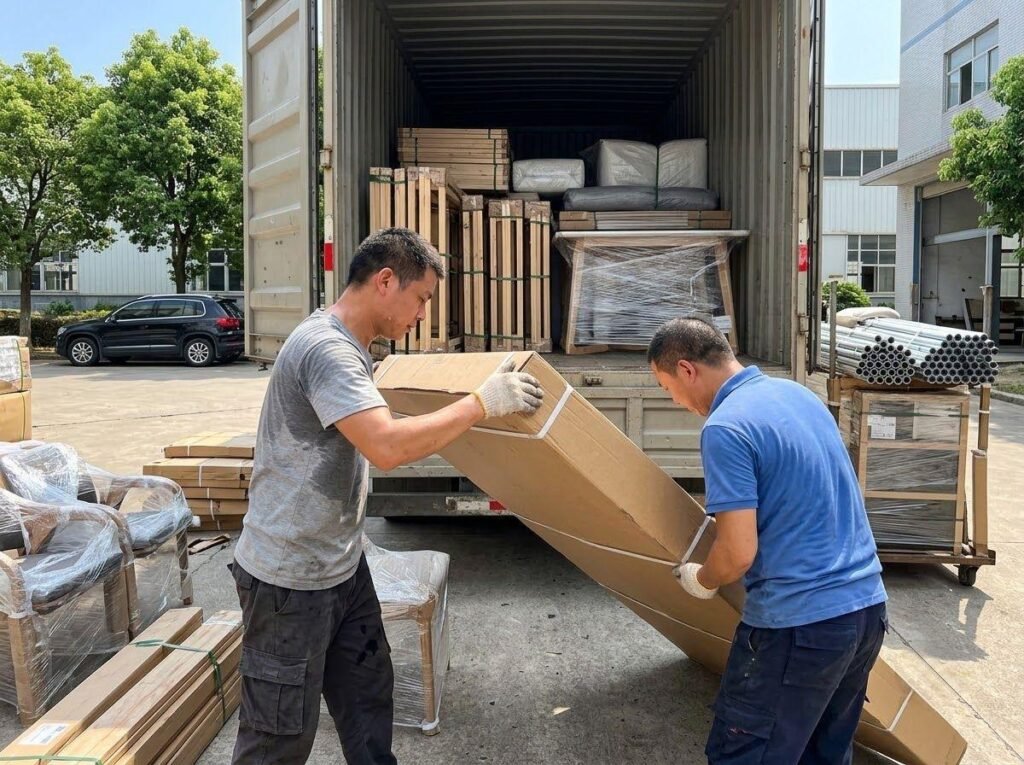
Say “Chinese logistics” and most people picture a boat. That’s like saying cooking is just lighting the stove. From a Shunde workshop to your Chicago warehouse — it’s a chain of handoffs. Every single one is a place where things break, cost more, or both.
Think moving house. You don’t just rent a truck. You pack boxes. You separate plates from lamps. You hit traffic. You unload in rain. Then your couch won’t fit through the door. Stretch that across twelve thousand nautical miles, three customs jurisdictions, and a language barrier. That’s Chinese furniture logistics. The real thing.
Factory packs. Domestic truck hauls to Nansha or Yantian. Consolidator stuffs the box. Ocean carrier floats it. Broker clears it. Drayage drags it to your door. Somewhere in that chain, someone drops a pallet. Someone mislabels a carton. Someone treats your “fragile” stickers as decoration.
I learned this the hard way in Dongguan. (Those marble-top coffee tables arrived as modern art. We don’t talk about it.)
Why Flat Pack Became the Default
There’s a reason volume residential ships KD. Standard 40-foot high-cube: about 76 cubic meters inside. After packaging, dunnage, and the fact that loaders are human, you’re working with maybe 60 to 70 usable.
Assembled three-seat sofa? 1.5 to 2 cubic meters of air, foam, frame. You might squeeze 35 to 45 in if you’re lucky. Same sofa, knocked down — frame pieces in one carton, cushions vacuum-bagged in another — drops to maybe 0.4 cubic meters. Suddenly you’re at 150 to 170 units in the same box. Freight per unit collapses from triple digits to pocket change.
Guys who’ve been doing this for decades will tell you flat-pack runs 40% to 70% less on shipping than assembled, depending on category and lane. For a 500-unit hotel FF&E program, that gap isn’t a line item. It’s profitable project versus write-down.
But here’s the thing — flat pack isn’t free. It just moves the cost from the shipping line to your labor budget.
The Cost Shift Nobody Talks About
Flat pack saves money at the China end. No argument. A 40′ HC to US West Coast runs $3,500 to $6,000 these days, season depending. Every wasted cubic meter is one you paid for. Peak season — August through October — spot rates spike 30% to 40%. Under that pressure, container efficiency isn’t a metric. It’s survival.
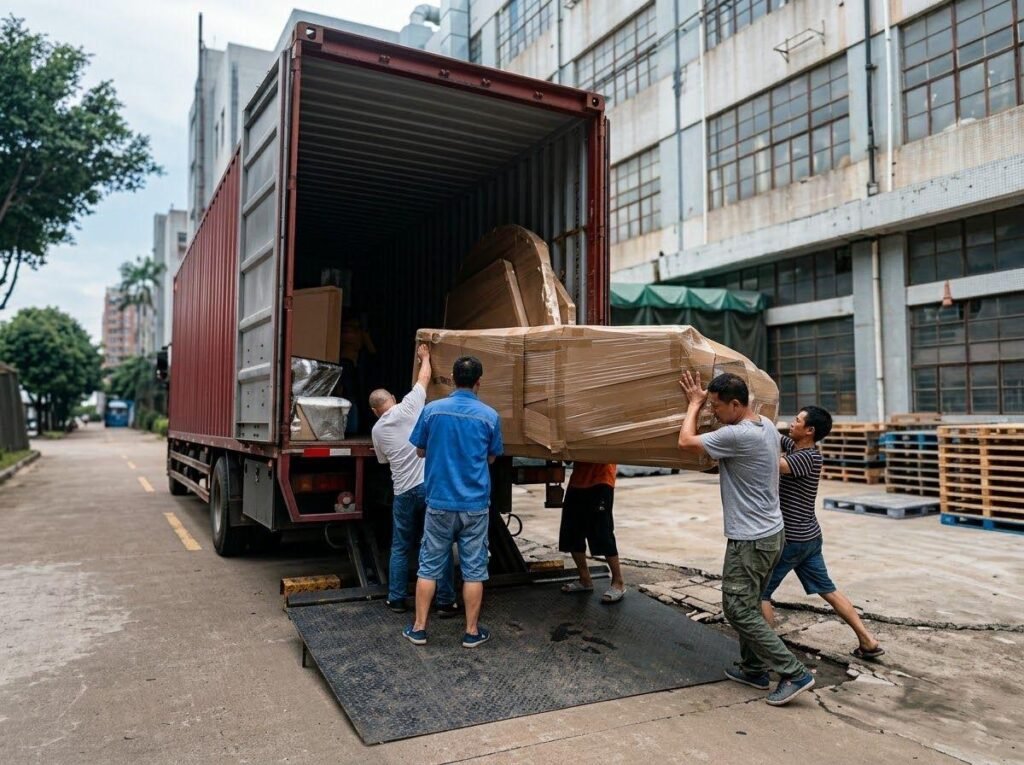
But you’re not cutting cost. You’re relocating it. Instead of paying a Chinese factory worker to assemble, you’re paying a local installer, warehouse crew, or — worst case — your customer with an Allen key and regret.
Hotel projects: this is where it gets sharp. Fully assembled headboard arrives, gets unwrapped, bolted to wall. Flat-pack version arrives as panels, hardware bags, and an instruction sheet translated by someone who’s never seen the product. Installation crew at $75 an hour, extra 45 minutes per room — that “shipping savings” evaporates fast.
Damage? Different beast. Assembled pieces get scratched, dented, legs snapped in transit. International furniture damage rates can hit around 6%. Damaged assembled sofa is a nightmare — bulky, expensive to return, usually unsellable. Flat-pack parts are smaller, individually boxed. Crush one panel, replace one panel. Lower component damage rate, but assembly brings its own hell: misassembly, missing hardware, the dreaded “leftover screw” haunting every PM.
Actually, that’s not quite right. What most buyers miss isn’t transit damage. It’s assembly damage. Scratched panel because factory skipped corner protectors? That’s shipping. Wobbly desk because installer stripped the cam lock? Different budget line entirely.
Some categories, shipping assembled isn’t just defensible — it’s smarter. Upholstered beds with integrated headboards. Complex case goods with glass inlays. Anything where factory finish is the value and reassembly kills the joints.
Like buying a tailored suit. You don’t sew it in Naples then ship pieces to New York for final assembly. Some craft stays where the craft lives. High-end hospitality case goods — matched veneer, dovetail drawers, integrated LED channels — often fit here. Factory in Panyu or Shunde has the clamps, climate-controlled spray booths, technicians who’ve built ten thousand units. Your local installer? Cordless drill and a deadline.
This is where operations like Interi Furniture — Guangzhou custom manufacturer, luxury hotel projects since 2003 — get interesting. Some buyers swarm Foshan megafactories. Others find mid-sized specialists — shops like Interi Furniture, focused on bespoke hospitality and high-end residential case goods — offer a different risk-reward. Their sweet spot? Projects where flat-pack would trash the finish, but volumes don’t justify mass-market assembled freight penalties. They’ll KD bed frames and desk carcasses where it makes sense, ship fully built where it doesn’t. Not ideology. Just arithmetic.
Pattern suggests boutique hotel renovations, branded residential towers, high-touch commercial spaces end up hybrid: flat-pack the utilitarian stuff, assemble the signature pieces at origin. Trick is knowing which is which before you sign the PO.
The Decision Framework: A Buyer’s Gut-Check List
How do you actually decide? Here’s my framework, standing in a factory showroom, blocking out the sales rep’s enthusiasm.
Start with the product:
- Flat-pack if: rectilinear, panel-based, no complex joinery. Desks, wardrobes, bed frames, shelving. Looks like giant IKEA? Ship like IKEA.
- Assembled if: integrated upholstery, curves, glass, or finish you can’t replicate in the field. Lobby sofas, ornate headboards, high-gloss lacquer.
Then run the math:
- All-in landed cost per unit. Not FOB plus freight. Plus destination assembly labor, tooling, and your PM’s sanity.
- Compare container utilization. Ask factory for packed dimensions both ways. Good factory has a spreadsheet. Bad one guesses. (You know which costs you later.)
- Factor destination labor market. Delivering to Manhattan with union carpenters at $120/hour? Flat-pack might be false economy. Dallas distribution center with trained warehouse crew? Savings stick.
Red flags:
- Factory only offers assembled on case goods. Not a feature. They never invested in KD engineering, passing freight inefficiency to you.
- Supplier quotes CIF but won’t break out ocean freight. Look at the export data long enough and you’ll see plenty of Chinese furniture factories inflate freight 10% to 15% and pocket the spread. FOB means you control the forwarder. That visibility matters.
- Flat-pack assembly needs more than eight steps and specialized tools. Your customer’s patience isn’t infinite. Neither is your customer service budget.
And here’s the contrarian bit: Shipping LCL? Flat-pack advantage shrinks. LCL charges per cubic meter, consolidation warehouse doesn’t care how your cartons stack. Mixed LCL handling adds touch points, adds damage risk. Orders under 10 to 15 CBM — math sometimes favors fewer, larger assembled pieces over a swarm of flat-pack cartons getting manhandled at the CFS.

FAQ: The Questions Buyers Actually Ask
Q: “If I ship flat-pack, will customers think quality is cheap?”
A: Not if you do it right. Flat-pack is logistics, not quality statement. Cheap feel comes from thin materials, sloppy hardware — cam locks that strip, dowels that snap, edges that chip. Well-built KD uses proper edge banding, metal-to-metal connectors, carton engineering that actually protects the finish. Problem isn’t the format. It’s the execution.
Q: “How much can I really save on freight?”
A: Depends on lane and product, but the swing is massive. Standard 40′ HC, China to US West Coast, you’re looking at roughly $3,500 to $6,000 these days. Flat-pack lets you fit 400 units instead of 80 — do the division, your per-unit freight collapses. Per chair, assembled versus flat can be $100-plus against single digits. Run a full container of case goods and you’re talking low five figures saved per shipment.
Q: “What about damage? Heard flat-pack gets beat up more.”
A: Other way around, usually. Individual panels in tight cartons take less abuse than assembled pieces with legs, arms, glass sticking out. But — and this is a big but — if the factory cheaped out on the box, you’re in trouble. Industry damage rate sits around 6% across both formats. Difference is whether you’re swapping a $12 panel or trashing a $400 assembled unit. Palletized delivery and solid corner protection matter way more than whether it was KD or not.
Q: “My factory says only assembled. Should I walk?”
A: Not necessarily. Ask why. Some pieces genuinely can’t break down without falling apart. Others can’t break down because the factory never bothered designing for it. If it’s the second one, you’re eating a freight premium for their laziness. Push for KD. They can’t engineer it? Get packed dimensions both ways and run the container math yourself. Let the spreadsheet decide.
Q: “So which is actually better — flat pack or assembled?”
A: Depends who pays for the screwdriver work at the other end. Got trained crews, warehouse space, predictable labor rates? Flat-pack is almost always the smarter way to ship furniture from China. Drop-shipping to end consumers? Or installing somewhere skilled labor costs a fortune and takes weeks to book? Assembled might save you more than it costs. Best way to ship isn’t a universal answer. It’s about who owns the assembly headache, and where.
The Hard-Earned Lesson
Fifteen years walking factory floors in Guangdong. Seen containers loaded with Swiss-watch precision. Seen loaders treat a $4,000 armchair like a sandbag. One principle held through every project, every port delay, every customs surprise: the cost you see is never the cost you pay. Factory quote is just the opening bid. Winners optimize what they control — container utilization, packaging spec, incoterm — instead of obsessing over what they don’t.
Next time you’re in a Foshan showroom, sales manager pouring tea, telling you his assembled dining set is “premium quality.” Nod. Smile. Then ask for flat-pack dimensions. Run the CBM. Remember — the boat doesn’t care how pretty your furniture is. Only cares how big the box is.