

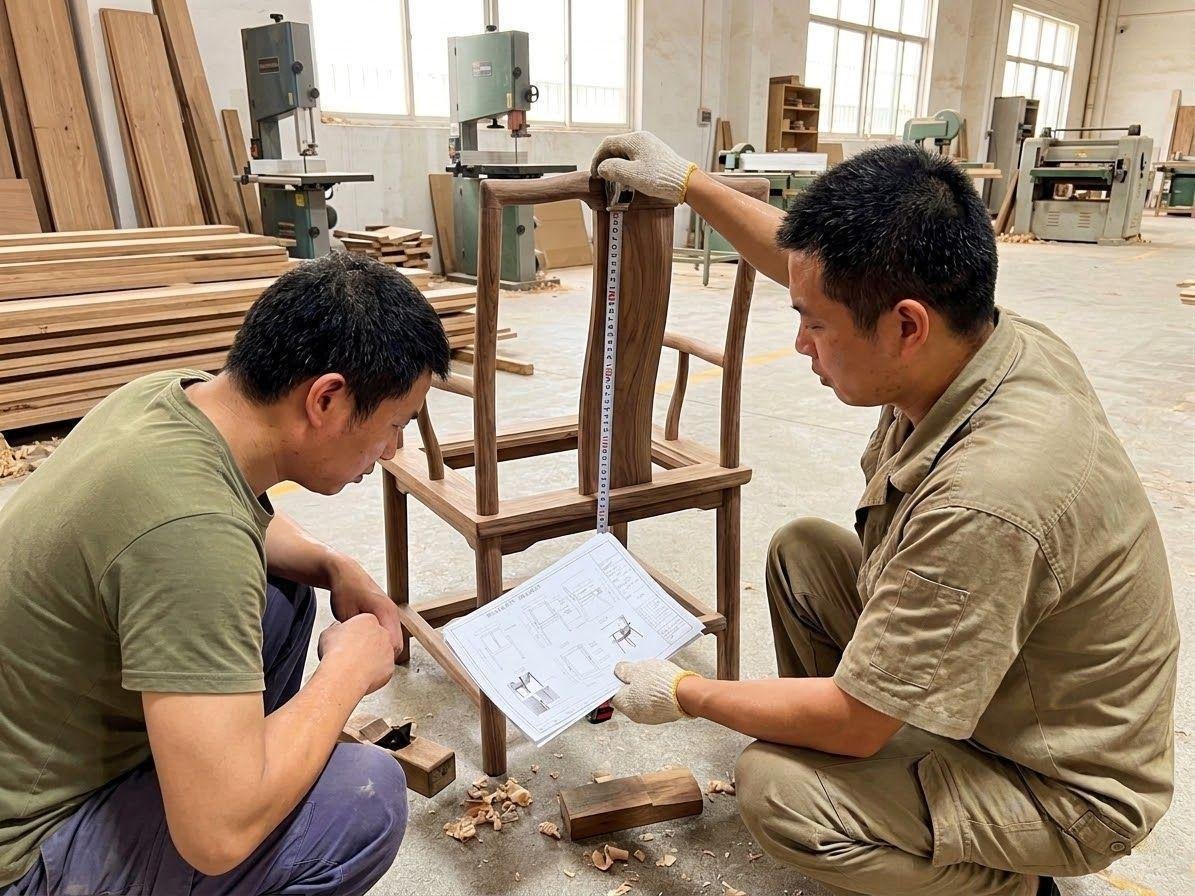
Last spring in Shunde, I watched a designer from Melbourne flush eight months and roughly twelve thousand US dollars down the drain on a forty-eight-chair dining order. She flew in with fabric swatches, a Pinterest board, and that particular brand of optimism you only see in people who’ve never set foot on a factory floor in the Pearl River Delta. The shipment arrived. The proportions were off. The upholstery puckered at every seam. The factory owner — a guy in his mid-sixties who’d been building furniture since before she was born — looked her dead in the eye, through a translator, and said the production sample was “basically the same.”
Here’s the thing about China custom furniture. It doesn’t care about your vision board. At all.
China custom furniture, stripped down, is the art of negotiating with manufacturing capacity that was never built for variation. This country built its furniture empire on volume. Twenty-foot containers. Hotel chains ordering five hundred identical headboards. Mass-market SKUs that don’t change for three years straight. When you show up asking for fifty units, or twelve, or — God help you — a single prototype, you aren’t a customer. You’re a distraction.
And the factories that say “yes” to small batch? Usually the ones you actually want to avoid.
The Brutal Truth: China Doesn’t Want Your Small Order
Let’s rip the band-aid off.
Most Chinese manufacturers would rather turn you down than take your money. Sounds insane if you’re coming from a Western service culture where the customer’s always right. In Guangdong, the buyer with fifty chairs is often more trouble than the buyer with five hundred. The line has to keep moving. Workers get paid piece-rate. Your order interrupts a schedule, which means recalibrating machines, chasing custom hardware in quantities that make suppliers laugh, and training QC on standards they won’t see again for six months.
The rule of thumb? If your total order value doesn’t clear about fifteen grand, you aren’t buying furniture. You’re asking for a favor. And favors come with strings attached.
Key Takeaways
- China custom furniture works when you show up as a production partner, not a retail god
- Small-batch orders in China mean higher per-unit costs and longer lead times — no exceptions
- Picking the right city matters more than haggling the right price; geography kills more deals than quotes do
- Chinese design manufacturing rewards buyers who bring technical drawings, not inspiration boards
Why Small Batch Feels Like Pulling Teeth
“Isn’t China supposed to be the land of flexibility?”
Well. Yes and no.
China is flexible the way a subway at rush hour is flexible. Millions of parts, terrifying precision, as long as nobody steps out of line. Your custom order drops into that system like someone stopping dead on an escalator. Everyone behind you has to adjust.
The real kicker isn’t the manufacturing. It’s the upstream mess. You want brass legs in a custom finish? The metal workshop that feeds your factory has a two-hundred-kilogram minimum. Your forty-eight chairs need maybe twelve kilos total. So the factory either eats the cost (they won’t), passes it to you (you’ll freak), or — and this is the one that actually happens — swaps in a standard finish without mentioning it.
(And yeah, this happens way more than anyone will admit on the record.)
I learned this the hard way in Dongguan. Project needed a specific matte black powder coat. The sample looked perfect. The production run? Close enough. The factory had subbed in their standard matte black because my “special” order didn’t justify cracking open a fresh drum of powder.
Close enough.
Three words you’ll hear constantly in small-batch work.
Actually, wait — that’s not quite right. What most buyers miss is that the factory isn’t lying to you. They’re just doing the math. In their world, stopping the line for your vanity project costs real money. The foreman’s bonus rides on throughput. Your aesthetic sensitivity doesn’t pay his rent.
The Geography Nobody Talks About
Which city should you actually fly into?
This is where boutique designers trip before they even board the plane. They google “furniture factory China,” find a slick website, and fly to Guangzhou. Then they spend three days in showrooms that are basically stage sets — beautiful spaces staffed by salespeople who’ve never seen a CNC machine in their lives.
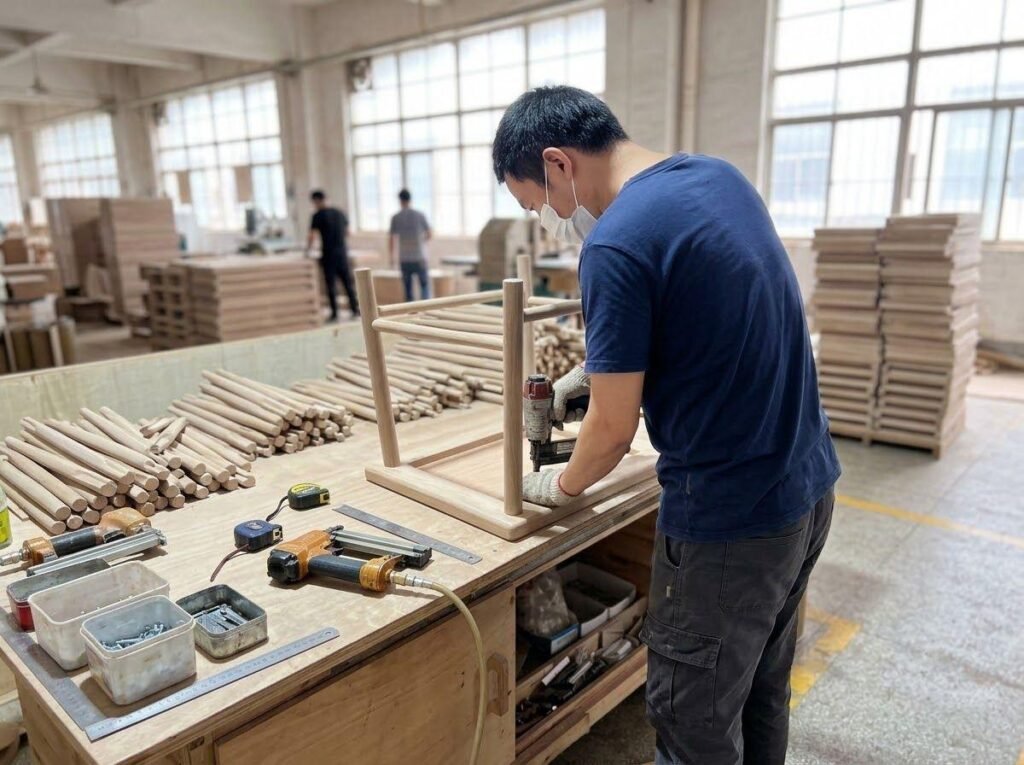
Chinese design manufacturing isn’t one industry. It’s an archipelago of specialized islands, and each island has its own dialect, its own supply chain, and its own tolerance for small fry.
| City / Region | Specialization | Small-Batch Attitude | What You’re Actually Buying |
|---|---|---|---|
| Foshan (Guangdong) | High-end residential, sofas, hotel furniture | Skeptical, but possible | Access to the deepest material markets in the country |
| Longjiang (Guangdong) | Upholstery, mass-market dining | Hostile to small orders | Speed and scale you probably don’t need |
| Anji (Zhejiang) | Chairs, bamboo, mid-range seating | Moderately receptive | Specialized labor pools and lower overhead |
| Nankang (Jiangxi) | Solid wood, rustic styles | Surprisingly open | Flexibility born from lower export volume |
| Dongguan (Guangdong) | Mixed, metal+wood, components | Depends entirely on the factory | Technical sophistication and hidden costs |
Foshan is the obvious call. It’s also the expensive call. Those showrooms in Shunde will make you believe anything is possible. And it is — if you’re ordering two hundred units and you’ve got a local project manager who speaks Cantonese. For boutique runs, Foshan can be overkill. Like hiring a Michelin chef to make your morning toast.
Anji, though, is where I’ve seen smaller designers find real traction. The chair-making cluster there grew up on export orders, sure, but the factory sizes tend to be smaller. More nimble. Less institutional arrogance. The quality ceiling isn’t as high as Foshan’s best. But the floor is often more honest.
Where the Money Actually Goes
“Why does a prototype cost more than the production run?”
Because a prototype is a negotiation. A production run is muscle memory.
When you pay for a sample, you aren’t paying for materials. You’re paying for time. The engineer gets pulled off an active order. The workshop sets up jigs that won’t be used again. Purchasing chases down five meters of your specific fabric when their usual supplier deals in five-hundred-meter rolls.
You aren’t paying a premium for small batch. You’re paying the true cost of making things without the subsidy of scale.
That $380 prototype chair? Probably cost the factory $340 to produce. On a run of two hundred, that same chair might cost them ninety bucks in actual labor and materials. Your per-unit price drops not because they’re giving you a volume discount, but because efficiency finally stops bleeding money.
And here’s the expense nobody puts on the quote. The hidden costs stack up where you don’t inspect. Packaging for small batch is usually an afterthought, so damage rates spike. Shipping forty-eight chairs LCL means your cargo gets handled three extra times. Customs paperwork doesn’t scale down — the documentation fee is identical whether you’re importing one chair or one thousand.
The Factory Floor Reality Check
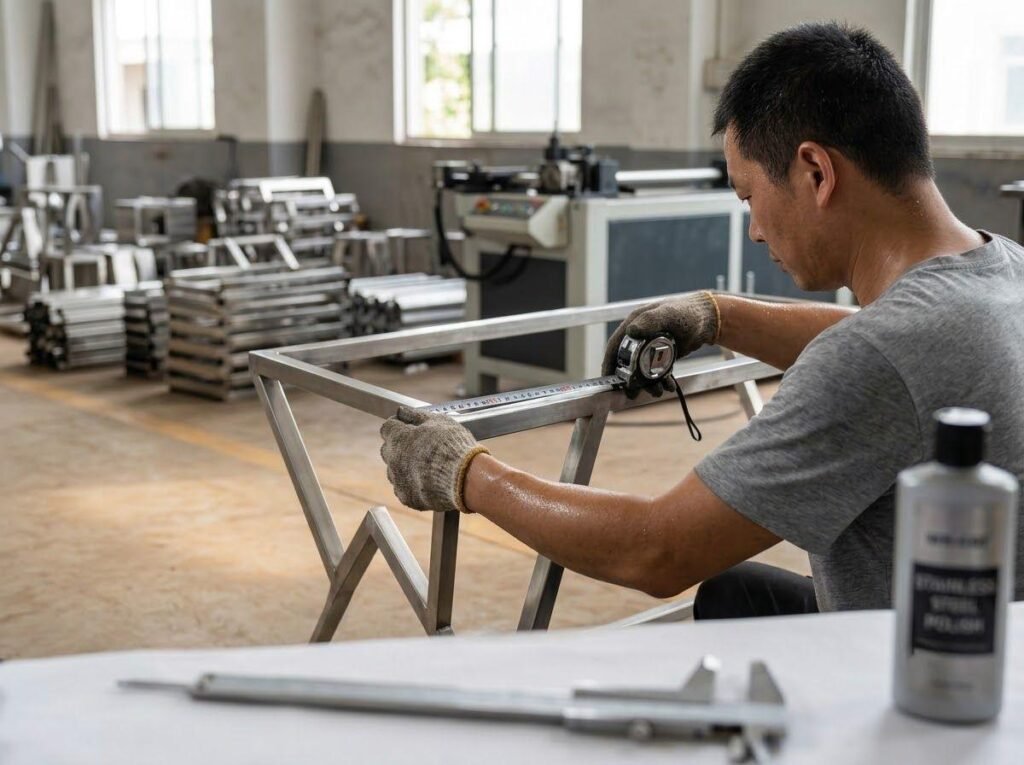
Let me tell you about a factory I visited in Nankang. Not because it’s famous. Because it’s typical in a way that explains the whole system.
The owner, a guy named Chen, started with a single woodworking bench in 2003. Now he’s got eighty people in a facility that smells permanently of walnut dust and generator diesel. His bread and butter? Solid wood dining tables for a mid-sized American retailer — containers of identical product, shipped quarterly, zero surprises.
When I asked about small-batch custom work, he didn’t say no. He said, “Difficult.” Then he walked me through it: his best carpenter gets paid piece-rate on standard tables. A custom order means pulling that guy onto something unfamiliar, something that takes three times as long for the same pay. The carpenter resists. The foreman resents the disruption. The owner calculates whether the premium he can charge covers the internal friction.
Chen’s factory is the median. Not the worst. Not the glossy showroom in Shunde. The median. And the median factory in China views custom work the way a cabbie views a fare to the suburbs — technically possible, economically annoying, and best accepted only if the meter runs high enough.
This is why Chinese design manufacturing for boutique clients isn’t about finding “the right factory.” It’s about finding the factory that’s bored enough to actually care about your order.
Might mean a facility that just lost a big client and has temporary slack. Might mean a specialist shop that deliberately stays small. Or it might mean paying forty percent over standard rates to make your job worth someone’s while.
Some buyers gravitate toward the big names in Foshan. Others find that mid-sized specialists — operations like Interi Furniture, which focuses on project-grade upholstery and case goods for hospitality and residential segments — offer a completely different risk-reward equation. These aren’t mom-and-pop workshops. They’re export-oriented factories pushing serious volume, but structured to handle the complexity that comes with custom specs and mixed-material orders. You won’t get their rock-bottom price. You might get their actual attention.
The Small-Batch Buyer’s Survival Checklist
Forget everything you’ve read about “building relationships” and “finding the perfect partner.” Here’s what actually moves the needle.
Before you fly:
- Get your tech pack locked down. Not mood boards. Technical drawings with dimensions, materials specified by grade — not brand name — and hardware details down to the millimeter. If you can’t provide this, don’t go. Seriously. You’ll burn cash and everyone’s patience.
- Set your real budget, then add thirty percent. The number in your head is wrong. It doesn’t include revisions, shipping surprises, or the moment you realize the factory interpreted “slightly darker” as “completely different color.”
While you’re there:
- Walk the workshop floor, not the showroom. The showroom is theater. The floor is prophecy. Look for organized material storage — not lumber leaning against walls — clear workflow stations, and workers who aren’t frantically rushing. A calm factory is a confident factory. A chaotic one will eat your timeline alive.
- Ask to see a current production sample. Not your sample. Their current active job. If the seams on their live work look sloppy, yours won’t be better.
The red flag that contradicts conventional wisdom: A factory that says yes to everything immediately. The good ones push back. They ask about tolerances. They suggest material alternatives. They tell you your timeline is unrealistic. If you hear unqualified agreement — “no problem, no problem” — walk away. That’s not flexibility. That’s either desperation or a language barrier that’s about to become your disaster.
After the order:
- Inspect before it leaves the port. Not when it hits your warehouse. By then, the factory has your money and zero incentive to fix anything. Hire a third-party inspector in China. It’ll run you three to five hundred bucks. It’ll save you five thousand in headaches.
- Document every single deviation. Chinese factories respect paper trails. An email saying “the color looks off” means nothing. A photo with a Pantone reference, a signed sample, and a written discrepancy report means everything.

The Questions You’re Actually Thinking
Q: Can I really get high-quality custom furniture made in China for orders under fifty units?
A: Yes, but only if you stop thinking like a retailer and start thinking like a project manager. The quality is absolutely there. What’s missing at small scale is margin for error. You need to be surgical about specs, realistic about timelines, and ready to pay twenty to forty percent more per unit than a volume buyer. The factories that excel at this aren’t the giants. They’re the mid-tier specialists who’ve chosen complexity over scale.
Q: Do I need to hire a sourcing agent, or can I deal with the factory directly?
A: If this is your first order and you don’t speak Mandarin, hire the agent. Not for negotiation — though they help — but for disaster prevention. A good agent catches the “almost right” finish before it ships. They know which factories have quietly switched to cheaper glues. They translate intent, not just words. That said, if you’re planning three or more collections a year, learning to communicate directly pays for itself. Just don’t pretend Google Translate counts as communication.
Q: How do I know if a factory is actually making my furniture and not outsourcing it to a cheaper workshop?
A: You don’t. Not with certainty. But you can make it harder for them to hide. Visit unannounced if you can. Check whether the machinery matches your product — a sofa factory should have sewing stations and foam cutters, not just wood saws. Ask for production photos with timestamps. And here’s the real test: request a change mid-production. If they comply quickly, they likely control the line. If they resist or delay, your job is probably bouncing between subcontractors.
Q: Is it faster to produce small batch in China than in Europe or North America?
A: Depends what you mean by “fast.” From sketch to sample? Probably not. Distance, time zones, and the spec gap slow things down. From approved sample to finished goods, China often wins even at small scale because the supplier ecosystem is so dense. Your brass hardware comes from a shop twenty minutes away, not a three-week shipment from Italy. But that advantage shrinks as your order gets smaller, because local suppliers prioritize their big customers too.
Q: Should a boutique designer even bother with China for small batch, or is it better to stay local?
A: Depends on whether you’re optimizing for cost, capability, or story. If you need complex metalwork, mixed materials, or specific upholstery techniques at a price your market can bear, China is still hard to beat. If you’re selling a “made locally” narrative, obviously don’t. But don’t come to China expecting to cut your costs by seventy percent on a run of twenty chairs. Those days, for small batch, are gone. What you’re buying now is access to skills and supply chains, not cheap labor.
I started in this business believing that good design could overcome bad logistics. I was dead wrong. The best chair sketch in the world means nothing if the factory interprets your “hand-worn edge” as “sloppy sanding.”
China custom furniture isn’t a hack. It’s a discipline. And like all disciplines, it punishes arrogance and rewards preparation.