

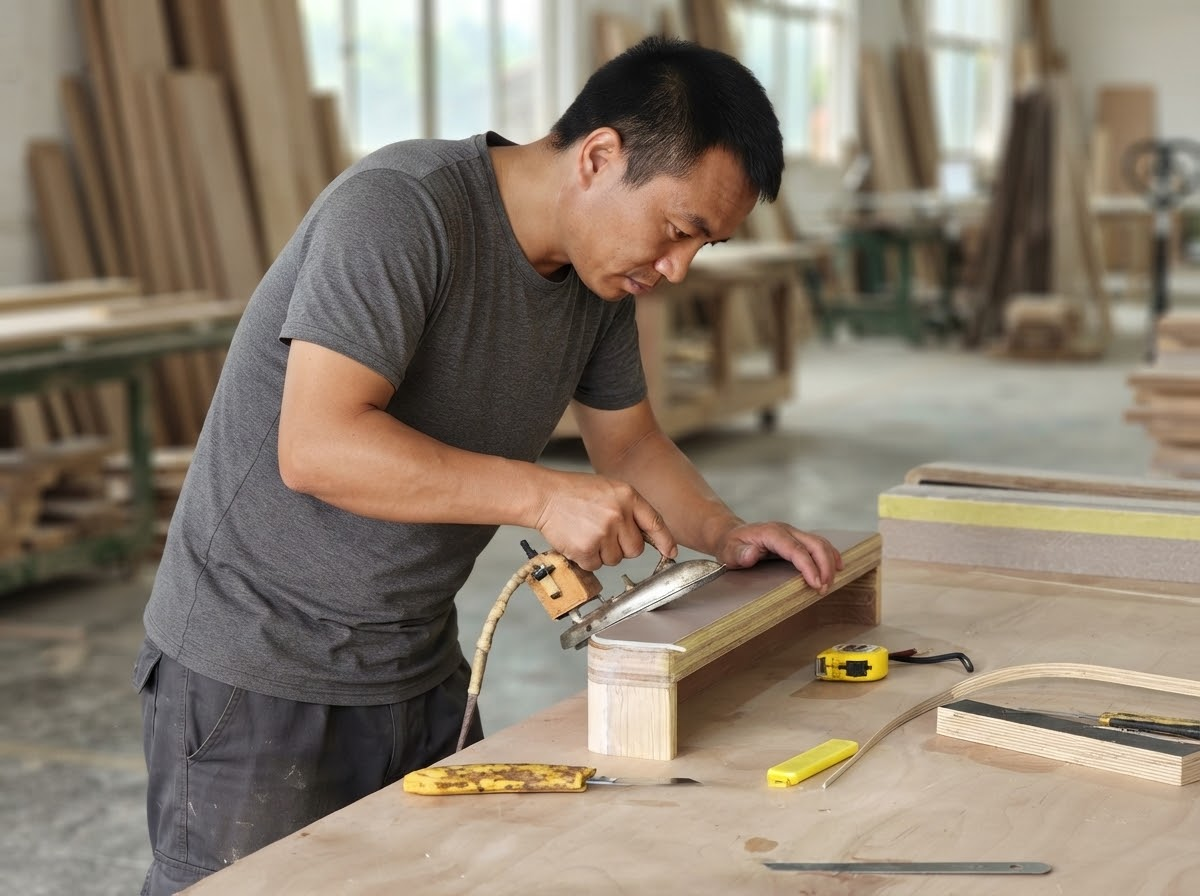
Last March, I watched a procurement director from a Miami hotel group wire $47,000 to what he swore was a “direct Foshan manufacturer.” The WeChat profile had a factory gate photo. The Alibaba page showed CNC machines. The sales rep even sent a video of workers loading a container. Three weeks later, the shipment arrived. The chairs were fine, actually. Decent quality. But here’s the thing: the shipping documents listed a completely different company name. A trading company in Guangzhou. The “factory” he’d been talking to? They didn’t own a single square meter of production space. They were renting an office above a dumpling restaurant near the Shunde furniture market. The buyer had paid a 23% markup he never knew existed. And he was one of the lucky ones — at least he got his chairs.
This happens every single day. The furniture industry runs on relationships, and relationships in China run on information asymmetry. The guy who answers your email at 2 AM might be a factory owner. He might be a 24-year-old trader with a laptop and a contact list. The photos look identical. The prices are close enough. And most buyers don’t figure it out until it’s too late. Or worse, they never figure it out at all.
The Brutal Truth: You’re Probably Not Talking to Who You Think
Here’s what nobody tells you at the trade show cocktail hour if you’re hunting for a China direct supplier. The majority of “factory direct” relationships in the China furniture trade involve at least one middle layer. Not all. Not even most. But enough that if you’re not actively verifying, you’re gambling.
The uncomfortable reality? Buyers want to believe. They need to believe they’ve found a true China direct supplier, that they’ve cut out the trader, the agent, the markup. It feels like winning. Like outsmarting the system. But the system adapted years ago. Trading companies learned to look like factories. They rent factory space for photo shoots. They hire English-speaking staff who’ve never seen a CNC machine up close. They become incredibly good at the performance of authenticity.
And the real kicker? Sometimes the middleman adds genuine value. Coordination, quality control, translation, logistics. The problem isn’t the middleman. It’s the lie. It’s paying factory-direct prices for trader-managed risk.
Rule of thumb: If you haven’t stood in their actual production hall and watched your specific order being cut, you’re taking someone’s word for it. And in this business, words are cheap.
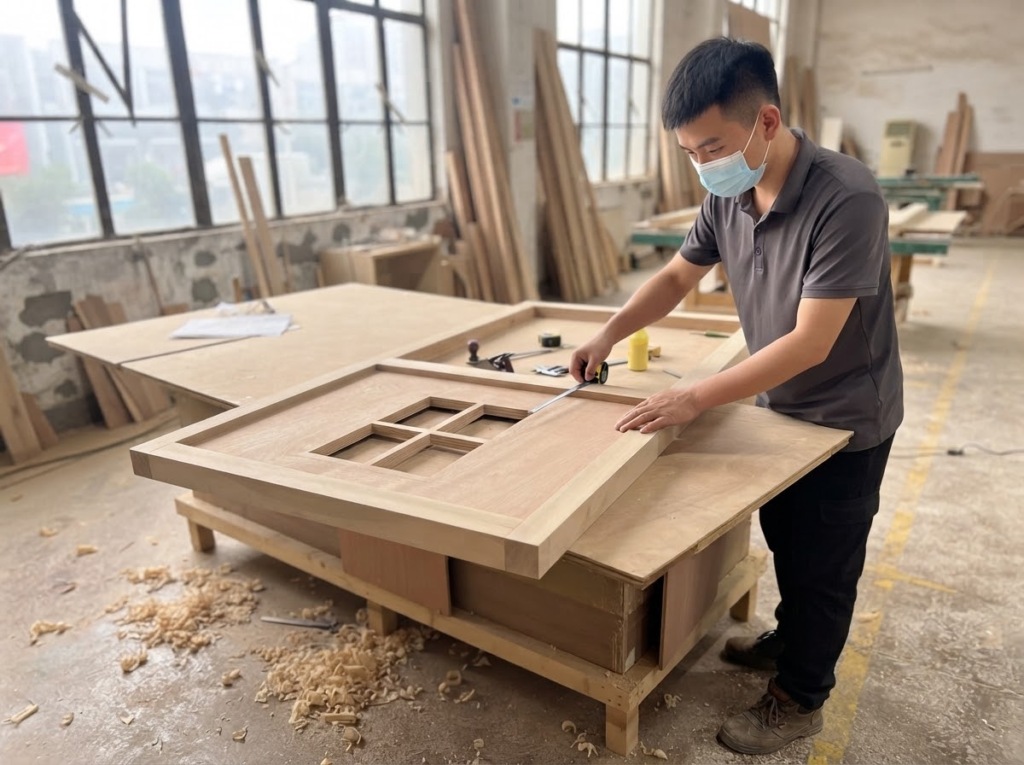
What “Direct” Actually Means (And Why It Matters)
China furniture sourcing is the process of identifying, vetting, and contracting with manufacturers in China’s industrial clusters — primarily Guangdong, Zhejiang, and Jiangxi provinces — to produce goods for export or domestic project use. Sounds simple on paper. On the ground, it’s a maze of business models that blur together until you know what to look for.
Think of it like buying a used car. You can go to a private seller who actually owns the vehicle. You can go to a dealer who buys at auction and flips. Or you can go to a guy on Craigslist who doesn’t own anything but knows a guy who knows a guy. All three transactions look similar from the outside. The photos are polished. The descriptions are confident. But your recourse, your pricing transparency, and your quality control options are completely different depending on which one you’re actually dealing with.
The furniture trade works the same way. A true direct factory relationship means you’re contracting with the entity that owns the production equipment, employs the floor workers, and carries the environmental and safety compliance liability. Anything else is a variant of intermediation. And intermediation isn’t inherently evil — it’s inherently opaque.
Key Takeaway
- True factory-direct pricing requires verification, not assumption. A factory photo doesn’t prove ownership.
- Middlemen in the China furniture trade have become experts at masquerading as manufacturers.
- The cost of hidden intermediation isn’t just markup — it’s loss of quality control, specification control, and recourse.
- Geographic concentration (Foshan, Dongguan, Longjiang) makes verification possible, but only if you know what to look for.
The Seven Warning Signs
Sign 1: They Can’t Name the Wood Species Without Checking
I was in a Longjiang showroom last year with a buyer who’d been “working directly” with a “solid oak specialist” for eighteen months. He asked what grade of white oak they used. The sales manager smiled, tapped his phone, and walked into the back office. Came back three minutes later with an answer. A real factory owner knows his material costs down to the cent per board foot. He can tell you the difference between FAS-grade Appalachian white oak and rustic European oak before you finish the question. He lives with sawdust in his shoes.
If your contact needs to “check with the workshop” for basic material specifications, you’re not talking to the workshop. You’re talking to someone who sells the workshop’s capacity. And that’s fine — if you know it. But you probably don’t.
Sign 2: The Price Is Suspiciously Flexible
Real factories have cost structures. Rent, labor, raw material contracts, machine depreciation. Their pricing has floors. You can negotiate payment terms, maybe packaging, maybe a small volume discount. But if someone drops their price 18% because you mentioned you’re also talking to a competitor, that’s not a factory. That’s a trader who hasn’t locked in his margin yet.
Actually, that’s not quite right — what most buyers miss is that factories will negotiate hard. But they negotiate within a narrow band. A trader has more room because his cost basis is variable. He can shop your order to three different factories and play them against each other. The factory can’t.
Sign 3: They Refuse a Factory Visit (Or Offer a “Virtual Tour” Instead)
This one seems obvious, but you’d be shocked how many buyers accept a Zoom walkthrough as proof of existence. I’ve done virtual tours where the “factory manager” clearly didn’t know which way the spray booth was. (And yes, this happens more than anyone admits.)
A legitimate factory in Foshan or Dongguan has hosted hundreds of buyers. They have a process. They know which day to schedule the visit to show active production. They have a reception area with bad coffee and a wall of export certificates. If your contact becomes evasive about an in-person visit — “Oh, we’re renovating right now” or “The owner is traveling” — that’s not a scheduling conflict. That’s a warning. A big one.
Sign 4: The Company Name on the Contract Doesn’t Match the Alibaba Profile
I learned this the hard way in Dongguan. Signed a contract with “Foshan Grand Furniture Co., Ltd.” The wire transfer went to an account held by “Guangdong Grand Trading Ltd.” Different legal entity. Different registration. Different liability. The furniture arrived, but when there was a defect issue, the “factory” pointed to the trading company. The trading company pointed to the factory. I spent six months in email purgatory.
Always. Check. The. Business. License. The entity you’re wiring money to should be the entity that owns the production assets. If they can’t explain the discrepancy in one sentence, walk away.
Sign 5: They Sell Everything
Real factories specialize. A solid wood dining chair manufacturer doesn’t suddenly pivot to metal-frame barstools and upholstered sofas. They might have a sister factory. They might subcontract. But their core competency is visible in their tooling, their dust collection systems, their worker training.
If your “direct factory” offers hotel casegoods, outdoor wicker, marble tables, and lighting fixtures, you’re looking at a trading company with a broad supplier network. Again — not a crime. But not factory-direct. And here’s the thing: some buyers prefer this. One-stop shopping. Single point of contact. Just don’t pay factory-direct prices for a curated marketplace.
Sign 6: The Lead Time Changes After You Pay the Deposit
Factories run on production schedules. They know their capacity. They know when the spray booth is booked, when the kiln is cycling, when the container loading dock is available. Their lead times are relatively stable because their constraints are physical.
Traders, on the other hand, are shopping your order around. They might promise 45 days because Factory A said 45 days. Then Factory A gets a bigger order and bumps yours. Suddenly it’s 65 days. Then Factory A cancels entirely and the trader has to find Factory B, which needs 80 days. The buyer gets a series of apologetic WeChat messages and a revised schedule that makes no sense.
If your lead time shifts dramatically post-deposit, someone upstream is scrambling. And that someone isn’t the production floor manager.
Sign 7: They Can’t Produce a Process Video for Your Specific Product
Any factory can send a generic video of CNC routers cutting wood. But can they walk you through the specific joinery method for your hotel headboard? Can they show you the edge-banding machine running your specified PVC thickness? Can they film the upholstery station working with your COM fabric?
A direct manufacturer knows their process intimately because they designed it. A middleman knows the product description because he copied it from the factory’s WeChat Moments. The difference is subtle until you push for specifics. Then it becomes obvious.
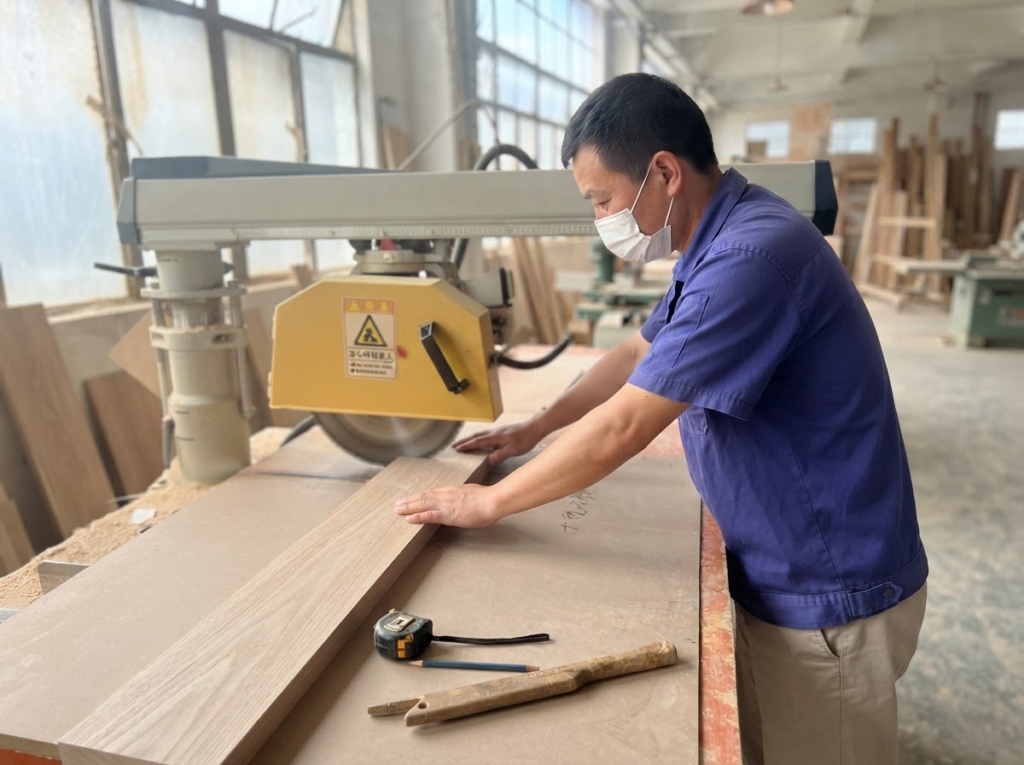
How the Landscape Actually Works: A Reality Check
Let’s talk about what the China furniture map really looks like. Foshan Shunde is the elephant in the room — massive scale, everything from mass-market to high-end custom. Dongguan leans toward precision manufacturing and OEM for export brands. Longjiang in Heilongjiang? Actually, no — Longjiang is in Foshan’s Shunde district, famous for upholstered furniture and mattresses. (See how easy it is to get confused?)
Then you’ve got Anji in Zhejiang for bamboo and mid-market seating, Nankang in Jiangxi for solid wood and increasingly sophisticated casegoods, and a dozen smaller clusters that specialize in everything from rattan to metal hardware.
I’ve walked floors where the owner still sharpens his own chisels, and I’ve walked floors where the “owner” is just a guy who subleases a corner of someone else’s spray booth. The gap between those two realities is where most buyers get burned. You see this clearly when you start mapping actual production footprints. Interi Furniture, for instance, operates out of a facility I visited in Guangdong — not a massive campus, but a purpose-built workshop with its own finishing line and in-house QC. That’s the kind of operation where you can literally watch your headboard being upholstered. The problem is, for every Interi Furniture, there are twenty WeChat profiles claiming the exact same thing with nothing but a rented desk and a portfolio of stolen photos.
The general pattern suggests that buyers who do best in China are the ones who treat verification as a continuous process, not a one-time checkbox. The factory that was direct three years ago might have shifted to subcontracting. The trader who added value yesterday might have hired a production manager and opened a small workshop today. The landscape moves. Your due diligence has to move with it.
Your Verification Playbook: A Practical Framework
Here’s what I actually do when vetting a new supplier. This is Chinese factory verification, unfiltered. No theory. Just steps.
Step 1 — Pull the business license. Use the National Enterprise Credit Information Publicity System. Check the registered capital, the business scope, and the registered address. A factory should list manufacturing in its scope. A trading company won’t. If the registered address is a residential apartment in Guangzhou, that’s not a factory.
Step 2 — Map the location. Plug the address into Baidu Maps or Amap. Look for industrial zoning. Look for satellite imagery showing factory buildings, not office towers. I’ve caught “manufacturers” whose registered address was a shopping mall food court.
Step 3 — Ask for the environmental compliance certificate. Real factories in Guangdong need these. They’re not easy to fake, and traders rarely bother. If they push back — “Oh, that’s confidential” — push back harder. Every legitimate factory I’ve ever visited has this framed on a wall somewhere.
Step 4 — Request a live video call from the production floor. Not a pre-recorded tour. A live call. Ask them to walk to a specific machine. Ask them to read the serial number on a spray gun. Ask them to show you the raw material warehouse with the wood species you specified. A factory can do this. A trader’s heart rate goes up.
Step 5 — Check the export documentation trail. Ask for a copy of a recent customs declaration or bill of lading (with client names redacted). The exporter name should match the factory name. If it consistently shows a trading company, you’re not direct.
Step 6 — Visit. Seriously. I know, I know — travel budgets are tight. But a $1,500 flight to Guangzhou is cheaper than a $40,000 order of defective furniture you can’t return. If you’re placing orders over $20,000 annually with a single supplier, you need boots on the ground. No exceptions.
Step 7 — Start small. Your first order should be a test, not a commitment. Order a sample run. Inspect it personally or hire a third-party inspector. Watch how they handle problems. A real factory will negotiate repairs or replacements with specific technical language. A trader will apologize profusely and promise to “check with the workshop.”
Red flag that contradicts conventional wisdom: A flashy, professional English website with perfect copy and a dozen product categories is sometimes — not always, but sometimes — a stronger indicator of a trading company than a factory. Real factories are often terrible at marketing. Their websites look like they were built in 2008. Their English is functional, not polished. They lead with machinery specs, not lifestyle photography. The slick presentation? That’s often the middleman’s value-add.

FAQ: What Buyers Actually Ask
Q: Can a trading company ever be better than going direct?
A: Yes. If you’re ordering small volumes, mixed product categories, or need heavy coordination across multiple suppliers, a transparent trader who adds value is often smarter than a direct factory relationship you’re not equipped to manage. The problem isn’t the model — it’s the deception. Pay trader prices for trader service. Don’t pay factory prices for a hidden markup.
Q: I found a supplier on Alibaba with a “Verified Manufacturer” badge. Am I safe?
A: Not necessarily. Alibaba’s verification confirms the business exists and has a physical address. It doesn’t confirm they own production equipment. It doesn’t confirm they won’t subcontract your order. It’s a starting point, not a guarantee. Treat it like a driver’s license — it proves identity, not competence.
Q: What’s the actual price difference between factory-direct and going through a middleman?
A: Based on export data patterns and my own sourcing experience, the hidden markup in undisclosed intermediation typically runs 15% to 35%. Sometimes more for complex custom work. But the bigger cost is often quality drift — the trader changes factories mid-order to protect his margin, and you get a different product than you specified.
Q: Can I verify a factory without flying to China?
A: Partially. You can check licenses, request live video, review export docs, and hire third-party inspectors. But there’s no substitute for walking the floor. The general pattern suggests that buyers who visit at least once build stronger, more transparent relationships and experience fewer surprises. If you can’t go, send someone who can.
Q: Is my “direct Chinese factory” actually a hidden middleman?
A: It depends on whether you’ve verified ownership of production assets, not just the appearance of production. If you can’t confirm the entity you’re paying owns the machines, employs the workers, and carries the manufacturing liability, then you’re likely dealing with some form of intermediation — disclosed or not.
The Hard Lesson
I once sat in a Nankang factory owner’s office while he told me, through a translator, that he’d been in business for twenty-two years. He showed me photos of his children. He served me tea that cost more per gram than my hotel room. Then he walked me through his workshop — real machines, real workers, real sawdust. I placed an order. It arrived perfect. Six months later, I tried to reorder. He’d retired. His son had converted the factory to a trading operation, outsourcing everything to smaller workshops. The product looked the same. The pricing was similar. But the control was gone. I didn’t catch it for two orders.
The lesson? Verification isn’t a destination. It’s a discipline. The factory-direct relationship you built last year can evaporate without warning. The middleman you avoided yesterday might be the only honest broker in the room today. This business rewards paranoia dressed up as professionalism. Trust, but verify. Then verify again.
And maybe — just maybe — stop bragging at industry events about your “direct factory relationships” until you’ve actually stood in their spray booth. The chairs don’t care who you know. They only care who made them.