

You probably met them at the Shanghai CIFF. Their exhibition booth was an absolute magnet—perfect lighting, flawless joinery on the credenzas, smiling reps handing out glossy catalogs. So now, a few days later, you’re sitting in their air-conditioned VIP showroom in Houjie, Dongguan. You’re sipping premium Tieguanyin tea.
Right in front of you sits a stunning, curved-back velvet lounge chair. It looks like it was yanked straight from a high-end Milan boutique. They hand you a beautifully bound commercial catalog of marble swatches. Everything is meticulously numbered and organized (you know the drill, swapping Sample No.A015 to Sample No.A029 just to keep the product matrix clean). You look at a custom coffee table base on display. The three legs are perfectly aligned, the inner edge is painted a sleek black while the outer edge remains a light natural veneer, exactly to spec. The factory boss is beaming. He slides a proforma invoice across the glass table for a massive $250,000 hospitality order. The whole thing feels entirely dialed in.
But then you push your teacup aside. You ask to walk across the alley to physically inspect the raw materials warehouse. You want to see the dust extraction setup in the woodshop. Watch what happens next. The boss’s smile freezes. Suddenly, the production manager gets an “urgent phone call.” The keys to that specific warehouse are mysteriously missing. The guy with the keys? He supposedly just went on his lunch break.
I’ve watched this exact song and dance play out more times than I can count over the last fifteen years. Every time you plan to visit a Chinese factory in the furniture sector, you need to understand one thing: you are stepping onto a theater stage. The first act has been meticulously choreographed specifically for your arrival. The showroom is the marketing fantasy. The actual factory floor? That’s reality. Navigating the treacherous space between those two worlds is exactly what separates successful, long-term procurement from a massive, career-destroying disaster.
The Brutal Truth About Your Factory Tour
Let’s just rip the band-aid off right now. Most buyers—especially those new to the game—absolutely hate hearing this.
The furniture sitting in that gorgeous factory showroom was probably built by a completely different set of hands than the workers who will actually manufacture your mass-production order.
Those pristine showroom models? We call them “golden samples.” They aren’t pulled from the active production line. They are painstakingly assembled at a snail’s pace by the factory’s top master craftsmen. Their only job is to engineer a piece that closes the deal. Hell, in some cases, the factory didn’t even make the sample. (And yes, this happens constantly, though nobody admits it). I’ve seen factory bosses buy a competitor’s premium piece from the Lecong wholesale market just to put it on a pedestal and claim, “Look what we can do.”
When you strip away the slick catalogs and the tea ceremonies, a true China furniture audit is about one thing. It’s the gritty process of identifying a manufacturing partner’s actual production floor capabilities, their real supply chain leverage, and their internal quality control systems. It has absolutely zero to do with what sits in their glossy showroom.
My golden rule of thumb for anyone doing this? Assume the showroom is a complete lie until the factory floor physically proves it true.
Key Takeaway: The Core Tenets of a Real Furniture Audit
- Showrooms sell; production lines deliver. Never sign a PO based purely on a showroom sample. It’s financial suicide.
- Sub-contracting is the silent margin-killer. The massive factory you are currently auditing might just be a glorified final assembly and packing point.
- Moisture and packaging dictate your survival. If you aren’t personally checking wood kiln records and drop-test carton standards, you aren’t doing an audit. You’re just taking a walking tour.
The Illusion of Scale and the Sub-Contracting Shuffle
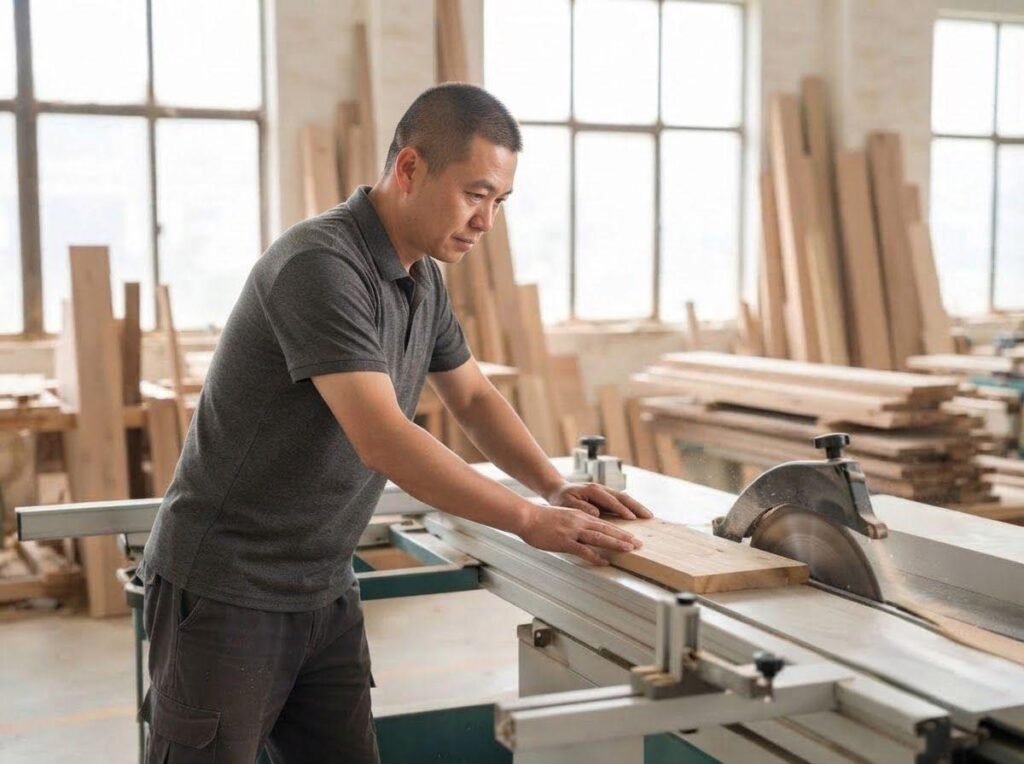
You walk out of the office block and into the main production area. It looks massive. The footprint is staggering. Hundreds of people are buzzing around. There are sparks flying in the metal welding shop, and you can hear the loud, rhythmic hum of CNC machines in the woodworking bay. It feels safe, right? It feels like they have endless capacity.
Judging a manufacturer strictly by its physical footprint is like judging the structural integrity of a skyscraper by looking at the lobby wallpaper. It tells you absolutely nothing about the foundation.
Are you auditing the manufacturer, or just an assembly hub?
The most dangerous—and most expensive—assumption a buyer can make during a China furniture audit is believing that everything actually happens under one roof.
When you are sourcing for high-stakes, multi-material projects—like providing turn-key custom configurations for the Emerald Maldives Resort or outfitting an executive layout for the Golden Tower 322 in Phnom Penh—you cannot afford blind spots. In major production hubs like Foshan or Anji, the furniture supply chain is hyper-fragmented. It’s a massive web. Factory A welds the inner metal frames. Factory B handles the powder coating. Factory C cuts and glues the high-density foam. And the massive facility you are currently standing in? They might merely staple the fabric, screw on the legs, and shove it into a cardboard box.
If that powder coating starts flaking off six months after the grand opening of your client’s resort, auditing this final assembly factory won’t save you. You needed to be auditing their sub-suppliers. This is why I always demand to see the incoming quality control (IQC) logs for raw materials. If a factory boss swears up and down they do everything in-house, but you don’t see a single piece of heavy metal-bending equipment on the property… you’ve just caught them lying. It’s all smoke and mirrors.
The Worker “Tell” (And Why Uniforms Matter)
When you are walking the floor, stop staring at the shiny machines and look at the actual people. The workforce tells you the truth about the factory’s health.
Here is a trick I learned the hard way. In a genuinely active, healthy factory grinding out real volume, you will see a dynamic workforce. You’ll see younger workers. They are moving fast, sweating, and getting the job done. They wear their own clothes—usually bright, breathable stuff like reds, yellows, or whites.
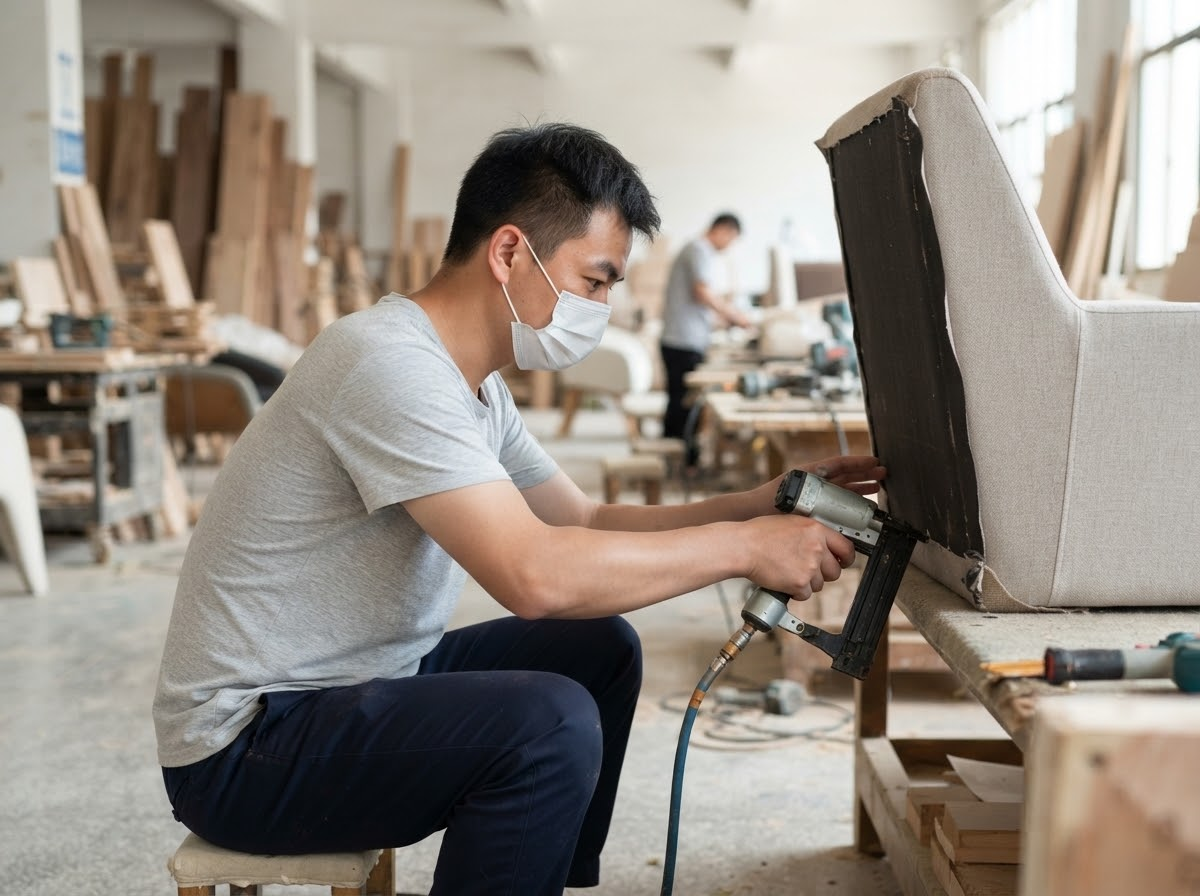
If you walk onto a floor and see a sea of older workers, all wearing brand-new, stiff, matching uniforms plastered with huge company logos—and the clothes are suspiciously pristine, usually in standard-issue blue, black, or grey—you are being played. That’s a staged show for the foreign buyer. Oh, and the face masks. Unless they are actively in the chemical spraying zone or sanding booths, real workers on a fast-paced assembly line aren’t all wearing identical, perfectly clean face masks. If everyone is masked up and moving at a snail’s pace sweeping the floor while wearing matching grey logo shirts… they handed those clothes out ten minutes before your car pulled up.
A spotless, completely quiet factory during peak season isn’t a sign of efficiency. It’s a massive, glaring red flag. It means they are dead out of orders. Or worse, they actually shut down their normal, chaotic, messy production line just so it wouldn’t fail your visual inspection.
Where the Margin is Actually Clawed Back
Let’s head over to the hardware depot and the raw materials room. This is the exact spot where factory bosses cut corners to claw back their margin.
In the showroom, you probably loved the smooth glide of the Austrian Blum hinges on the cabinetry. But when you poke your head into the parts depot on the second floor, what do you see? Bins full of unbranded, lightweight zinc alloy hinges that feel like they’d snap under pressure. If a specific component isn’t explicitly defined, down to the brand and part number, in your Bill of Materials (BOM), the factory will immediately default to the absolute cheapest local equivalent the second your plane takes off.
Worse still, look at the timber. If you are buying upholstered pieces, demand to use their moisture meter on the inner frame wood. Often, factories will use green, un-kilned wood for sofa frames because it’s cheaper and heavier. The weight gives the buyer the illusion of high quality. But that wet wood is a ticking time bomb. The moment those frames hit the dry, climate-controlled air of a hotel room in Nevada or a luxury villa, they will warp, squeak, and snap.
The Scale vs. Specialization Ecosystem
The Chinese furniture manufacturing landscape is not some giant monolith. It’s a highly tiered, complex ecosystem, and you need to know where you fit in it.
While some inexperienced buyers instinctively gravitate toward the massive, 100,000-square-meter mega-factories because they think size equals safety, veterans know better. Many of us find that mid-sized specialists offer a significantly better risk-reward equation. Take operations like Interi Furniture, for example. They focus deeply on targeted project execution—like boutique hospitality and high-end residential segments—rather than pumping out a million cheap dining chairs for discount retailers.
With a mid-sized specialist, you aren’t just a rounding error on their monthly spreadsheet. They usually retain much tighter in-house control over the tricky, high-skill processes. Think complex upholstery tensioning or custom veneer matching. They don’t just farm it out to the lowest bidder in the industrial park to save a few cents.
And here’s the real kicker. A mega-factory will bump your production schedule to the back of the line the second a massive big-box retailer drops a $5 million container order. A specialized, mid-sized factory won’t do that. They will actually protect your lead times because your business is material to their survival and their reputation.
| Factory Type | Mega-Factory (100k+ sqm) | Mid-Sized Specialist | The “Showroom Only” Trading Co. |
|---|---|---|---|
| Primary Advantage | Massive volume capacity, highly automated lines | Superior customization, extremely tight QC loops | Endless catalog of highly trendy designs |
| Biggest Risk | You are a low priority; rigid and inflexible terms | Can hit capacity caps during peak holiday seasons | Zero actual control over the production timeline |
| Best Fit For | Big-box retail, massive standard global rollouts | Boutique hospitality, high-end residential projects | Small initial test orders, e-commerce dropshipping |
| Audit Focus | Uncovering sub-contractors, checking line priority | Raw material sourcing origins, financial stability | Proving they actually own a real production line |
The Actionable Factory Floor Framework
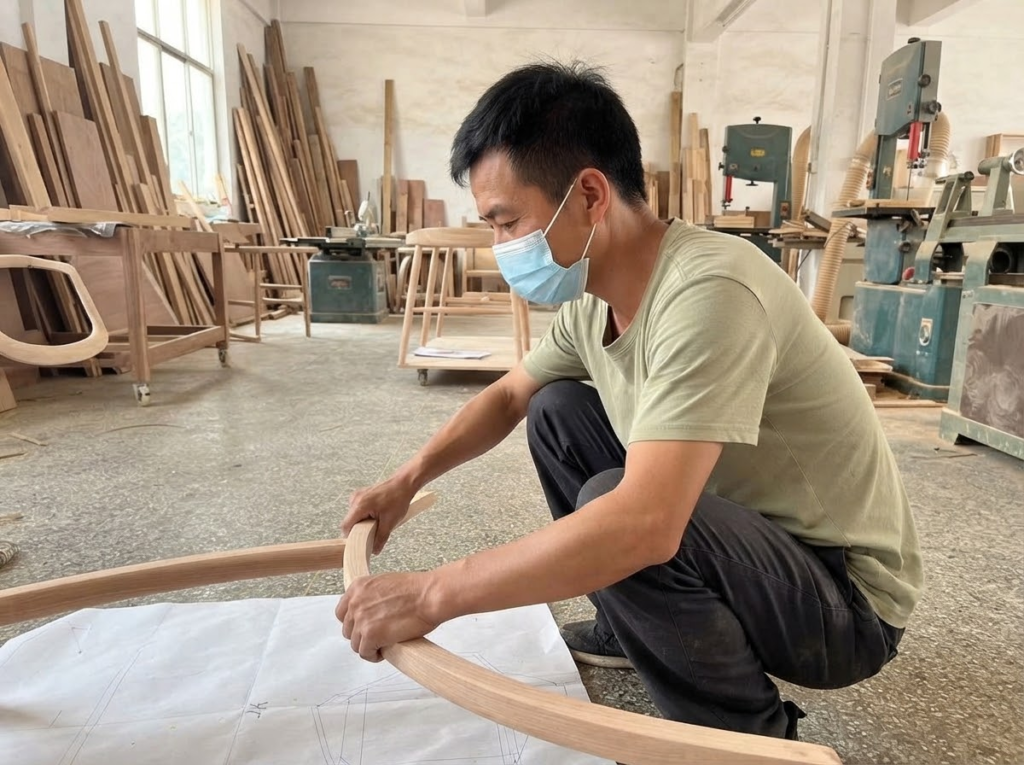
Listen, if you are going to spend the thousands of dollars and the jet lag to visit a Chinese factory, you need to be clinical about it. Leave the fancy showroom after twenty minutes. Max. Spend the next four hours in the actual dust, the deafening noise, and the chemical smells of the active production floor.
Here is the exact, step-by-step framework I use when conducting a China furniture audit. Forget the clipboard checklists you download off the internet; this is how it actually works on the ground.
1. The “Follow the Product” Walkthrough
Do not—under any circumstances—let the factory management guide you on their preferred, cleaned-up path. You take control. Start at the loading bay where they receive raw materials and physically trace the flow of production all the way to the final shipping docks.
- Look at the incoming lumber and boards. Are the rejected materials clearly quarantined with red tags, or are they mixed right in with the good stuff?
- Find the sanding department. Is there a massive bottleneck of half-finished chairs waiting there? That explains exactly why their lead times are always slipping by three weeks.
- Check the floor right around the spray booths. If it’s coated in an inch of highly flammable lacquer dust, their safety protocols are completely nonexistent. That’s a fire waiting to happen, which means your deposit could literally go up in smoke.
2. The Packaging Line Interrogation
This is where I see the most heartbreak. The most beautiful furniture in the world means absolutely nothing if it arrives at your job site in splinters.
- I dig into their packing materials. I want to see thick foam corner protectors. I want to see double-corrugated export cartons. I want to see proper, high-quality moisture-absorbing silica packets tied to the frames, not those cheap, tiny paper ones that burst and leak chemical powder on velvet.
- When you’re standing on the packing line, point to a boxed chair and ask them to perform a carton drop test right then and there. If the production manager suddenly looks terrified and starts making excuses, you have your answer. They know their packaging is garbage.
3. The Worker Retention Reality Check
Making furniture—especially the upholstery, the stitching, and the finishing touches—is not fully automated. It relies heavily on human skill and muscle memory.
- Casually ask the factory manager about their worker retention rate immediately following the Chinese New Year holiday. (This is when everyone goes home, and many decide not to come back to bad employers).
- Factories that treat and pay their skilled labor poorly suffer massive turnover every spring, which results in wild, unpredictable quality swings from batch to batch because you constantly have rookies working on your complex designs.
4. The Counter-Intuitive Red Flag
Beware the completely empty finished-goods warehouse. Conventional business school wisdom tells you that lean manufacturing is great—just-in-time inventory! But out here in the Chinese furniture industry, an empty finished-goods warehouse usually means one thing: severe cash flow problems. It means they are buying materials strictly hand-to-mouth, only after your deposit clears. A healthy, robust factory has a steady, predictable flow of staged, ready-to-ship inventory waiting in bays for container loading.

Frequently Asked Questions from the Trenches
Buyers ask me the same questions every time we get off the plane in Guangzhou. Here are the real answers.
Q: Do I really need to hire a third-party QC inspector if I’ve already visited the factory, drank the tea, and approved the golden sample myself?
A: Yes, absolutely, without question; approving a sample is just setting a baseline, but third-party QC ensures that the 500th piece matches the first. Think of it this way. The factory visit validates their capability to make the product. The pre-shipment inspection (PSI) validates their willingness to actually do it consistently on a Tuesday afternoon when nobody is watching. Never, ever skip the PSI.
Q: If the factory boss refuses to let me take photos of the production line, does that mean they are hiding something shady?
A: It honestly depends on context. Sometimes they are legitimately protecting a proprietary mold, or a custom design they are running for a major global brand. That is actually a great sign—it shows they respect Intellectual Property. But, if they won’t let you snap a quick photo of generic processes—like their foam-cutting machines or how their workers tape up a standard box at the packaging station—they are almost certainly trying to hide safety violations or the use of sub-standard filler materials.
Q: Is it considered insulting to ask a factory boss to legally prove they aren’t just a middleman trading company?
A: Not at all. Legitimate manufacturers expect this exact question. They will proudly whip out their business license. They will show you their environmental impact permits for the spray booths. They might even show you their capital equipment leases. If they get defensive, start stammering, or claim the paperwork is “at another office,” you have your answer. Walk away.
Q: Can I use the flaws I find during the audit to negotiate the unit price down?
A: You definitely can, but you really shouldn’t. In China, you get exactly what you pay for; if you aggressively force the price down unnaturally, the factory will just smile, say yes, and then quietly recover their margin by secretly degrading the internal, hidden materials. If you genuinely need a cheaper price point to make your margins work, collaborate with them to actually re-engineer the product. Swap a solid oak inner frame for a high-grade engineered plywood. Change the density of the base foam. Do it transparently.
Q: So, at the end of the day, does a pristine, passing factory audit guarantee I’m going to get a perfect production run?
A: No. It simply doesn’t. A great audit significantly reduces your risk profile. It eliminates the outright scammers and the bad actors. But it does not—and cannot—replace the need for an airtight, bilingual contract, crystal clear BOMs, and relentless, ongoing pre-shipment quality control.
Beyond the Gloss
Sourcing commercial furniture in China is a high-stakes game of risk mitigation. That’s the reality. The showrooms are purposefully designed to make you fall in love with the product. The factory floor is designed to actually make you money.
If you aren’t willing to get sawdust on your shoes, if you aren’t willing to crawl under a half-assembled sofa frame on the assembly line to check the corner blocks, and if you’re too polite to ask the highly uncomfortable questions about moisture content and sub-contracting… you are flying blind.
The very next time you find yourself sitting on a velvet chair in a beautifully lit Dongguan showroom, holding a cup of tea and looking at a proforma invoice, ask yourself one question: Are you buying the reality of what this factory can do, or are you just buying the illusion they’ve built for you?
Trust the factory. But verify the woodshop.