

My shirt was completely ruined by 3 PM. Stuck to my back like wet paper.
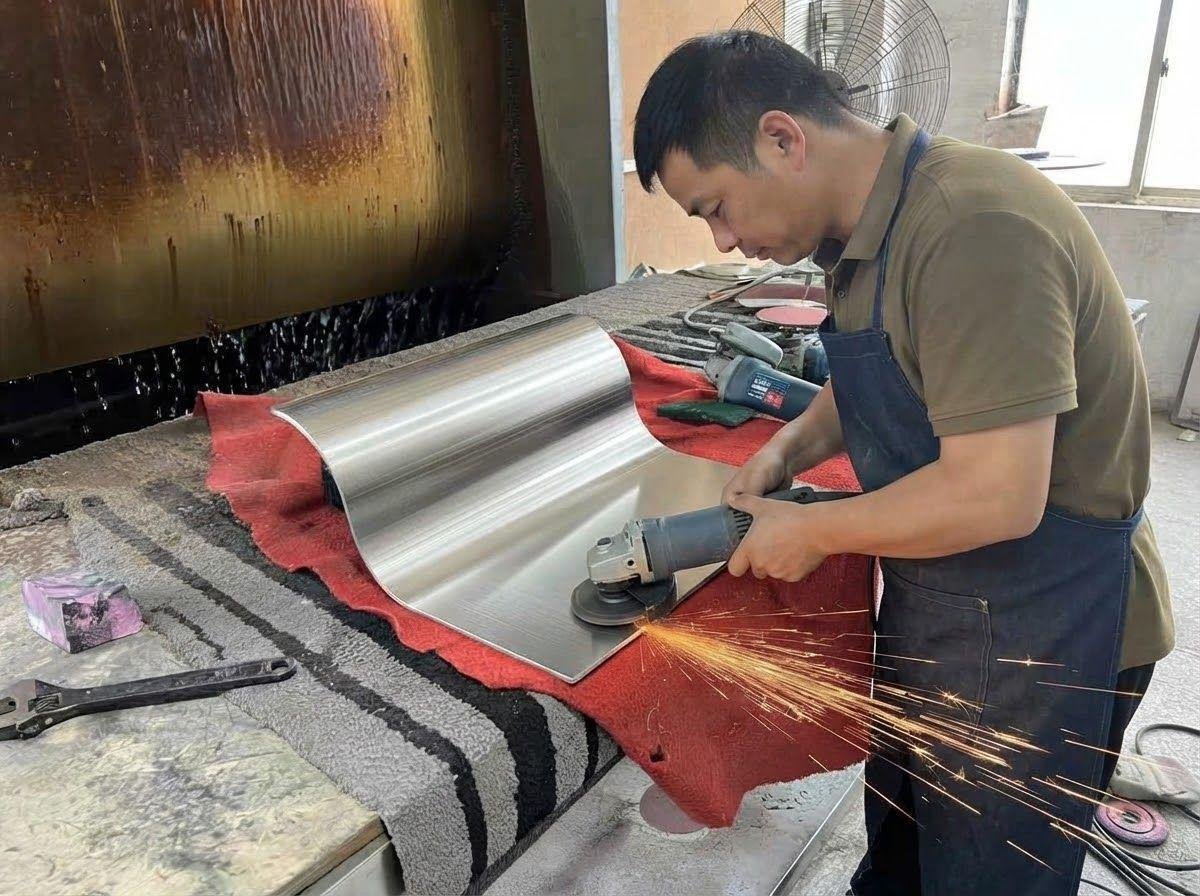
Building C of a metal shop down in Dongguan. You don’t really breathe the air in these polishing bays, honestly. You chew it. It tastes like dirty argon gas mixed with vaporized aluminum, and it camps out in your sinuses until you fly home.
Standing next to me was a guy handling a $20 million FF&E budget for a hospitality group. You’ve definitely overpaid for a martini in one of their lobbies. Right then? He looked like he was at a funeral.
He was white-knuckling a $250 lounge chair prototype. Raw, unpolished 304-grade stainless tube steel. Looked like it survived a car crash. Zero sweeping, effortless grace. It looked nothing like the $3,000 Minotti original glowing on his iPad.
He keeps rubbing this lumpy, jagged weld joint with his thumb. Just rubbing it, looking desperate. He asks the factory boss—through a terrified 22-year-old translator—why the frame doesn’t match the red-lined CAD drawing.
The boss didn’t even glance at the screen. Guy is wearing a fake Supreme t-shirt, probably ships twelve million bucks in containers a year, and has absolutely zero patience for naive questions. He just points a nicotine-stained finger toward the loudest corner of the shop.
Back there, a worker in a heavy 3M respirator is hunched over a workbench, aggressively hogging out a weld on a similar frame with a pneumatic grinder. Millimeter by painful millimeter. Sparks bouncing off his leather apron.
“You want the Italian curve?” the translator relays, wincing at the noise. “Boss says you have to pay for the Italian time.”
Buyers do this every single day. They land at Baiyun Airport clutching Pinterest boards full of fluid, sculptural brass. They expect local foundries to just spit out masterpieces for pennies. Because, hey, it’s China. Everything is automated, right?
Wrong. Bending cold steel into organic, seamless shapes isn’t like injection molding plastic. It’s a violent, stubborn fight. You are literally wrestling raw metallurgy into submission. Successfully pulling off high-end China metal furniture takes way more than firing off a 3D file and wiring a 30% deposit. You have to understand how the material fights back.
The Brutal Truth About the Bill of Materials
Let’s get this out of the way. CFOs hate hearing this. But it’s the reality of the floor.
If your target price is built purely around the commodity weight of the steel—rather than the agonizing human labor hours required to finish it—you aren’t buying luxury furniture. You’re buying scaffolding. You just happen to be putting a cushion on top of it.
Proper sourcing here boils down to one unavoidable fact. You must identify manufacturers who actually grasp that 80% of a product’s visual value comes entirely from the last 20% of surface finishing.
People think the magic happens inside those million-dollar CNC tube bending machines. Nope. A machine can bend a pipe to 45 degrees. Big deal. The real magic? That happens when a 50-year-old technician named Lao Chen spends three straight hours chasing a TIG weld with an abrasive belt until the joint simply ceases to exist to the naked eye.
Here is my rule of thumb. Write it on your hand before your next factory tour. If you pay by the kilo, you get construction materials. If you pay by the hour, you get art.
The “Don’t Kid Yourself” Reality Check
- Polishing is a hidden tax: Flawless curves require intense, manual hand-finishing long after the welding torch shuts off. You aren’t buying steel. You are buying a guy’s entire Tuesday afternoon.
- Shiny finishes expose everything: A mirror PVD coating aggressively highlights every single micro-dent, wavy weld, and scratch underneath. It hides absolutely nothing. It is ruthless.
- Metal memory is a nightmare: Italian brands engineer their pieces knowing exactly how metal springs back. Cheap knockoffs just force the bend in a jig, giving you warped, dog-tracking chairs that rock back and forth on flat hotel floors.

Anatomy of a Ruined Prototype
Everyone loves dropping the phrase Chinese luxury craftsmanship when they’re staring at a finished product in a showroom. Nobody talks about the scrap bin out back where the actual craftsmanship is forged.
Because your first prototype? It will fail.
Actually, wait—that’s not entirely accurate. The bending process usually goes fine. What most buyers completely miss is that the prototype destroys itself during the cooling phase.
Why Your Welds Are Bleeding Through the Plating
Think of a thick stainless steel tube like an incredibly tight, stubborn rubber band. You can heat it up. You can stretch it using a 50-ton hydraulic press. But it desperately wants to snap back to its original shape. Engineers call it yield strength; floor managers just call it a massive headache.
When a foundry attempts a complex, multi-radius curve, they heat the tube, bend it, lock it violently into a heavy steel jig, and hit it with the welder to attach the adjoining leg.
Then the metal cools. And it shrinks. The stress points pull violently at those fresh welds. If the factory rushes the annealing process—that crucial, controlled cooling period meant to relieve internal tensile stress—the frame warps. Not by a lot. We’re talking maybe three or four millimeters.
But guess what? When your upholstery partner down the street tries to attach a tightly tailored leather seat cushion to a steel frame that is four millimeters out of square… the whole chair suddenly looks like a cheap knockoff from a discount catalog.
It happens every single day.
And then there’s the welding itself. The Italians are famous for their invisible, ghost-like joints. To replicate that in Anji or Dongguan, you need slow, methodical argon arc welding. That has to be followed by grinding with progressively finer abrasive belts. If a floor manager gets lazy—or gets squeezed on price—and lets his guys use a cheap, 60-grit belt to grind a weld, and then immediately throws that frame into the plating bath?
Those tiny micro-scratches act like magnifying glasses for flaws once the gold finish goes on.
The “Orange Peel” Disaster Under Hotel Spotlights
I learned this the hard way in a Longjiang hotel lobby a few years back. It still gives me heartburn to think about it.
I was inspecting a massive batch of custom brass-plated bar stools for a Vegas lounge project. We were severely behind schedule. Under the factory’s awful, dying fluorescent tubes? They looked flawless. I signed off. Container loaded.
A month later, under the casino’s warm, highly directional 3000K architectural spotlighting? Complete disaster. Every single stool looked like it was covered in cellulite.
We call this the “orange peel” effect. It happens when the base metal isn’t obsessively leveled and buffed before electroplating or PVD coating. You cannot hide bad metalwork under a thick layer of shiny brass. The coating doesn’t cover up the sins of the welder. It spotlights them for the whole world to see.
Ecosystem Spotlight: Stop Buying Bread from a Butcher
The manufacturing landscape in Southern China is fiercely segmented. You absolutely cannot treat it like a monolith.
Walk into a massive, 100,000-square-meter facility in Foshan that pumps out forty thousand identical banquet chairs every thirty days. Go ahead. But for the love of God, do not ask them to execute a limited-edition sculptural dining table. Their entire business model is built on speed. Standardized tooling. Pushing shipping containers out the door before Friday afternoon. If you force them to do custom artisanal work, they will ruin your piece because it breaks their rhythm.
Some procurement guys love those mega-factories for the sheer scale and cheap unit costs. They see a low BOM and get giddy.
But guys who have been doing this for a decade usually find that mid-sized specialists offer a much, much better risk-reward equation. Take operations like Interi Furniture, for example. They are heavily wired for high-end project seating and bespoke hospitality casegoods. These mid-sized guys have the cash flow to buy top-tier PVD vacuum chambers and German Trumpf laser pipe-cutters. Yet, they aren’t so massive and bloated that they refuse to dedicate their senior technicians to the tedious, mind-numbing hand-polishing required for bespoke work.
You have to match your design’s DNA to the factory’s DNA. Here is how the tiers actually break down on the ground:
- The Mega-Foundries (Foshan): High volume, fast stamping. 25 to 35-day lead times. Unbeatable for basic banquet seating. Absolutely terrible at manual finishing on complex, multi-axis curves. Do not take bespoke work here.
- The Mid-Sized Specialists: Think hospitality and mixed materials. Perfect for luxury hotel lobbies and high-end residential. Usually 40 to 50 days out. The trade-off? Higher MOQ requirements because they have to pause their standard mass production to run your custom finishes.
- The Boutique Workshops (Dongguan): Bespoke artisanal fabrication. Incredible, jaw-dropping quality for flagship retail displays or art furniture. But they have astronomical unit costs, take 60+ days, and are painfully, agonizingly slow to scale up if you suddenly need a thousand pieces for a rollout.

A Sourcing Director’s Survival Guide
If your boss drops a rendering of a highly curved, Italian-style metal chair on your desk and tells you to “go get it made in China for a quarter of the price,” hope cannot be your quality control strategy.
You need a defensive playbook. The factory is going to test you the second you walk through the roll-up doors.
— First things first. Skip the espresso in the showroom. Go straight to the polishing room. Look up. Is there a proper dust extraction system? Look at the workers. Are they wearing heavy respirators, or just cheap blue surgical masks? If a factory cuts corners on worker safety in the polishing room, they are 100% cutting corners on your welds.
- Stop spec’ing cheap electroplate. Standard electroplating flakes off when someone looks at it wrong. If you are buying for a commercial space, specify Physical Vapor Deposition (PVD) coating for anything shoes, rings, or hands will hit. Yes, it costs 20% more. Pay it. Cry about the budget later when your furniture isn’t rusting in year two.
— Check the gauge yourself. Never just give the factory the outer diameter of the steel tube. Specify the wall thickness—say, 1.5mm or 2.0mm—right on the PO. If you leave it blank, they will quietly default to 1.0mm to save a few bucks on raw material. Your chair will literally buckle under a heavy guest. Bring digital calipers to your inspections and prove you know how to use them.
Watch out for the Radius Trap. This is a classic. Send a CAD file with an impossibly tight bend radius for a thick steel tube. It’s a test. If the factory boss says “Yes, no problem, sir” without warning you that the metal will crimp or tear at that specific radius… walk away immediately. A real metalworker pushes back on bad engineering. A yes-man will just ruin your product and blame your drawing later.
— Don’t let packaging kill the product. I’ve seen gorgeous metal ruined in transit because the factory used cheap PE foam that rubbed against the PVD coating for three weeks at sea, dulling the finish via micro-abrasions. Mandate thick pearl cotton wrapping. Double-layered. Tape on the outside only.
(And yeah, that radius trap thing? It happens constantly. Factories will nod, smile, pour you tea, and just quietly alter your design dimensions to fit their existing bending molds without telling you. Finding that out during final inspection is a uniquely terrible feeling.)

Late Night WhatsApp Messages (The Real FAQ)
Q: Client is furious. The brass bases in the Miami property are spotting green after three months. What happened? A: You bought poorly lacquered electroplated steel, not solid brass. You went cheap. Humidity and salt air aggressively attack the micro-pores in cheap plating. For coastal areas or humid climates, you must mandate marine-grade 316 stainless steel as the base, sealed with a high-grade titanium PVD coating. No exceptions. Stop buying cheap electroplate for Florida.
Q: Can I just take a screenshot of a B&B Italia piece, send it to a supplier on Alibaba, and ask them to copy the metal base? A: Sure. If you want a clunky caricature of the original. Italian brands drop hundreds of thousands of dollars on proprietary casting molds to achieve those liquid, seamless transitions where the legs meet the floor. Chinese factories will try to fake it by welding standard, off-the-shelf tubes together and grinding the joints flat. It always looks heavy and clumsy unless you step up and pay for a custom die.
Q: Factory is demanding $1,500 for tooling up front just to make one prototype. Am I getting scammed? A: No. That’s just how complex metalwork actually functions. If your curve can’t be hit with off-the-shelf pipe benders, they have to physically machine a custom steel die block to bend your prototype. If a factory offers to absorb this $1,500 cost, be terrified. They aren’t doing it out of the kindness of their hearts. They are hiding it by downgrading your material quality somewhere else in the bill of materials.
The Hard Lesson
At the end of the day, metal doesn’t lie.
You can hide cheap, formaldehyde-soaked plywood under gorgeous Italian leather. You can hide garbage, recycled foam under a brilliantly tailored upholstery job. But a polished stainless steel curve? That is a literal mirror. It reflects exactly how much time, money, and respect you were willing to invest on the factory floor.
So ask yourself next time you’re reviewing a quote on your laptop: Are you just buying metal by the pound, or are you buying actual craftsmanship? Because you can easily find both here. You just have to decide which invoice you actually have the stomach to pay.