


Sweat was practically cementing this poor guy’s linen shirt to his shoulder blades. Hall 11.2 at Pazhou does that to a person. The humidity is a killer, sure, but mostly it’s the sheer panic setting in around day three.
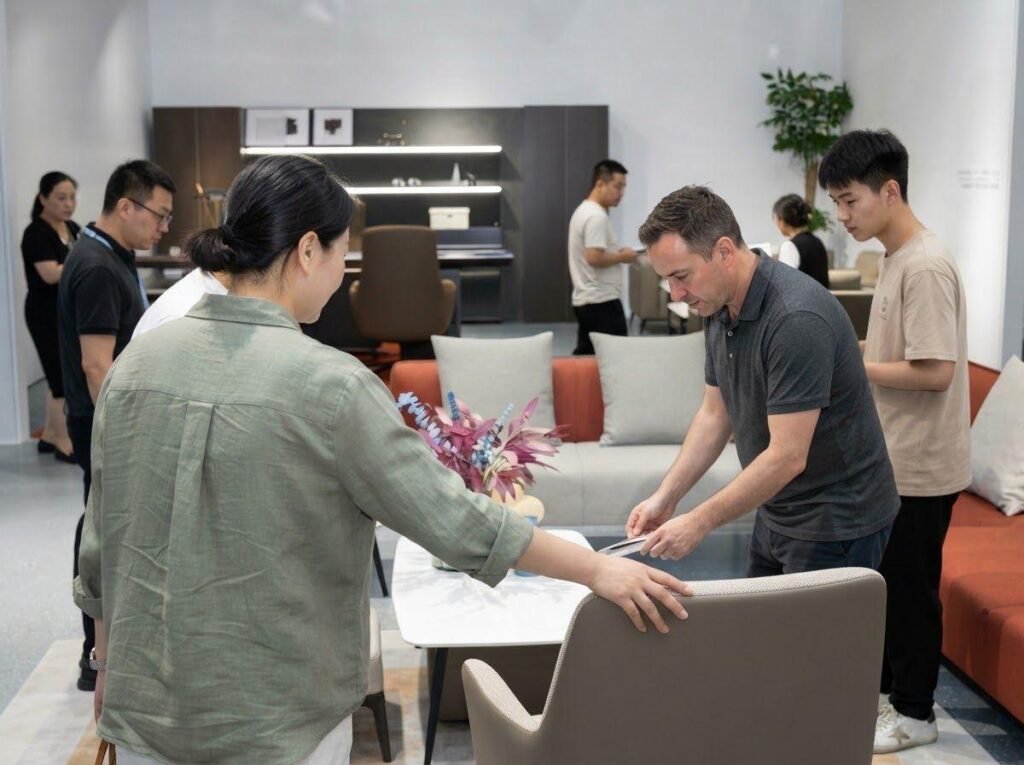
It was late October. I was nursing a terrible Nescafé out of a paper cup near one of those aggressively massive booths, eavesdropping on a procurement VP from Miami who was totally losing his grip over a veneer mismatch. The guy was pacing inside a 400-square-meter temporary buildout that looked exactly like a Milanese showroom. His immediate crisis? He was desperately trying to pin down a perfectly coordinated matching living room set right alongside a 250-key hotel dining package.
All from this exact same vendor.
He swallowed the pitch hook, line, and sinker. The rep, smiling and tapping away on an iPad, had him completely convinced that this single operation would manufacture his entire full house furniture program and drop it at a Florida cross-dock by mid-February. No delays. One clean transaction.
I kept my mouth shut. Not my client. If you interrupt every rookie mistake on the Canton Fair floor, you’ll never get your own EXW terms negotiated.
But seriously. If you’re enduring a 15-hour flight to Guangzhou expecting to point at a pretty trade-show vignette and buy a fully integrated, multi-room collection on one clean purchase order… you are literally begging for a logistics nightmare. The factory isn’t necessarily scamming you. The physical architecture of Chinese manufacturing just violently rejects the way Western buyers want to shop.
Down here, factories specialize by raw material. Period. Wood shops cut wood. Upholstery shops staple fabric. Metal guys run welding lines.
Nobody does it all under one roof. I don’t care what their brochure says.
The “One-Stop Shop” Delusion
Let’s just get the ugly part out of the way.
Your boss wants a turnkey operation. One wire transfer. One quality control inspector. A single 40-foot container packed to the ceiling. It looks beautiful on a spreadsheet.
But the Canton Fair isn’t a B2B catalog. It is a wildly fragmented matchmaking event hiding behind temporary drywall and expensive track lighting.
Here is the only rule you actually need: An upholstery factory knocking out your sectional sofas has zero business touching your solid oak dining tables.
When a booth manager hands you a catalog thicker than a phone book and swears they make both? They’re sub-contracting. You are paying a phantom 20% markup for a highly inefficient middleman. Worse yet, you just handed over your quality control to a secondary shadow factory you aren’t legally allowed to audit.
The Floor Walker’s Cheat Sheet
- Sourcing in China means navigating hyper-specialized manufacturing zip codes. The “everything factory” is a myth.
- True turnkey suppliers don’t exist. Most Pazhou “one-stop shops” are well-funded trading companies farming out your casegoods to the lowest bidder.
- Material specialization beats room categorization every single time. Buy couches from the fabric guys. Buy tables from the wood guys.
- Trying to pull off a matching living room set across two different supply chains? Courier physical, signed finish samples. Relying on digital Pantone codes will get you fired.

Showroom Smoke and Mirrors
Sourcing at this scale is basically swiping on Tinder. Everything is aggressively filtered.
The halogen lighting hides sloppy joinery. You fall in love with the prototype. But the actual product that gets violently forklifted onto your loading dock six months later? Totally different animal.
A few years back, I walked a sprawling showroom in Longjiang with a notoriously stubborn client. He demanded a full house furniture package from one vendor because their booth “just had the right vibe.” The floor samples were flawless. I forced him into a Didi to see the actual factory three days later.
The illusion died the second we opened the car doors.
That sharp, sickly-sweet stench of fresh nitrocellulose (NC) lacquer hung heavy in the air. Dead giveaway. Mature, well-run production lines don’t smell like that. They were rushing finish jobs in a poorly ventilated, plastic-sheeted spray tent just to prep floor samples before opening day. Trade show samples are handmade prototypes. They tell you exactly zero about a factory’s daily assembly-line discipline.
Are You Buying a Factory or Funding a Trading Company?
If this doesn’t keep you awake at night, you haven’t been doing this long enough. Based on shipping data and my own floor walks, I’d bet heavy money that over half the “comprehensive” furniture booths you see at these mega-exhibitions are trading companies masquerading as manufacturers.
Trading companies aren’t the devil, by the way. They handle messy customs paperwork. Their English doesn’t require Google Translate. But if your project margins are razor-thin, or your custom engineering specs are unforgiving, wedging a middleman between you and the guy operating the CNC router is a terrible idea.
Think about the workflow. Demand a custom brass-framed coffee table, a performance-fabric sectional, and a fluted ash-wood media console. A trading company just pours you more tea and says “No problem, boss.” A real factory? They’ll tell you exactly which of those three items they actually make. Then they’ll politely tell you to find someone else in town for the other two.
The Geographic Mess of Your Living Room
To grasp why true turnkey sourcing is nearly impossible, look at the physical manufacturing map of South China.
There is no “living room district.” There are metal towns. Wood towns. Upholstery towns.
Buy a velvet accent chair and a sintered stone end table from the exact same vendor. One of those items is riding in on a flatbed truck from a completely different zip code. The upholstery might be stitched flawlessly in Shunde. But that stone top? Coming down the highway from Yunfu.
Why That Wood Finish Looks Like Cheap Plastic in Miami
Let me save you a quick fifty grand and a brutal Zoom call with your stakeholders.
Say you actually listen to me. You split your dining and living room order across two factories to get the best raw quality for each category. Smart move. But now your wood finishes will drift.
Factory A sprays a PU (polyurethane) coating on their dining chairs. Factory B insists on a UV-cured finish for their sideboards because it dries faster and clears their floor space. Under the harsh fluorescent glare of the exhibition center, they look like identical twins.
Put them under natural sunlight in a luxury residential build? One looks like warm, open-grain walnut. The other looks like a cheap, shiny plastic dashboard from a 1998 Honda Civic.
The secret to building a cohesive collection isn’t finding a magical factory. It’s acting as your own general contractor.
Decoding the Guangdong Web (And the Mid-Tier Advantage)
If you want to survive this gauntlet without bleeding cash, you have to decode the local ecosystem. Foshan is the heavyweight champion of furniture, sure. But it’s not a single entity. It’s a sprawling web of hyper-specialized alleyways.
Watch the seasoned procurement directors. Rookie buyers gravitate toward stadium-sized general manufacturers in Dongguan, praying for a turnkey miracle. Veterans take a surgical route.
They know that mid-sized specialists—operations like Interi Furniture, for example, which carve out a specific niche in design-forward, export-ready pieces. Mid-tier players maintain tighter in-house QC over their specific lane. Working with them means you have to source your patio loungers from a totally different guy down the road. But you trade the lazy convenience of a single PO for the actual security of knowing whose hands are gluing your dowels.
The Dark Art of Container Tetris
There is a hidden geometry to shipping furniture. This is where the turnkey dream dies a very expensive death.
You hustle. You find three fantastic, specialized factories. Sofas from Longjiang. Tables from Yunfu. Outdoor gear from Anji. Now you have to shove all of it into a metal box and float it across the Pacific.
Inexperienced buyers hemorrhage money right here. Factories optimize loading for their own specific products. A sofa factory knows how to tetris a 40-foot HQ full of sectionals to maximize cubic meters (CBM). Ask them to consolidate soft sofas with heavy glass-front cabinets? Total chaos.
I once watched a loading crew drop solid-oak credenzas directly onto loosely boxed dining chairs just to save 2 CBMs of space. By the time that container popped open in LA, those chairs were expensive kindling.
Who Owns the Logistics Problem?
Actually, wait—it’s not even the factory’s fault. A manufacturer’s liability ends the second the truck leaves their loading dock. Period.
If you are building a coordinated set from multiple vendors, you absolutely must hire a third-party logistics (3PL) inspector to oversee the consolidation at a neutral warehouse.
Does it add a fraction to your landed cost? Yes. But paying a 3PL a few hundred bucks to stand there with a clipboard and supervise a multi-factory load will save you tens of thousands in smashed freight.
The Floor Walker’s Survival Framework
So how do you walk out of the Canton Fair with a cohesive collection without getting taken to the cleaners?
You need a ruthless filtering process. Try this exact approach next time you’re walking the aisles:
- The “Core Competency” Trap: Walk into a massive booth. Point to a complex sofa, then point to a complex wooden casegood. Ask, “Which do you actually make?” If they claim both, call the bluff. Ask to see a live WeChat video of the line right then. Real reps love showing off. Liars suddenly get bad cell reception.
- The Finish Sample Hostage Situation: Never approve a wood color from an iPhone photo or a Pantone chip. Have the factory cut a physical piece of wood in half. Sign both with a Sharpie. Date it. Leave one there. Put the other in your carry-on luggage. (I once had a factory swap solid brass pulls for cheap zinc alloy because they thought I wouldn’t notice. I noticed.)
- — Pay for mid-line QC. Not at the end before shipping. In the middle. I learned this back in ’16 when 400 chairs were completely upholstered before anyone bothered to check if the internal foam density was correct. Eating that cost was rough.
- The Red Flag of the Instant “Yes.” If a supplier eagerly agrees to match a Pinterest screenshot without asking you a single question about Martindale rub counts or fire retardant compliance, walk away immediately. They aren’t reverse-engineering. They’re just making a cheap knockoff.

Emails I Get From Panicked Buyers
Q: Can’t I just find one factory to produce my entire full house furniture collection?
A: For high-end goods? Basically impossible. China’s furniture manufacturing is structurally divided by raw material; true factories specialize in either wood, metal, or upholstery. Very rarely all three. Budget MDF flat-pack? Sure, you can find a mega-factory. Premium hospitality? Expect to juggle specialized vendors.
Q: What if I need my matching living room set to actually match, but I’m forced to use two different suppliers?
A: Implement a rigid “master sample” protocol. Send the exact same physical fabric swatch and wood chip via SF Express to both factories. Never rely on digital codes. Materials absorb stains unpredictably.
Q: Are those Canton Fair booth prices final?
A: Not even close. That scribbled price on a business card is a temperature check based on your perceived buying power. Real negotiation happens post-audit, once you lock down the BOM and volumes.
Q: What’s the smartest way to consolidate shipments from three factories?
A: Don’t let a factory do it. Hire a 3PL provider in Shenzhen or Guangzhou. Pay individual factories FOB to deliver to a neutral warehouse. Your 3PL loads the container. It completely insulates you from relying on random factory workers for complex logistics.
Q: Should I skip the fair entirely and just drive around Foshan?
A: Depends on your ground game. The fair is an unbeatable aggregator for leads and trends. But the actual business—verifying if a factory can hit your specs—happens on the dusty factory floor.
I’ve spent fifteen years watching brilliant designers and sharp procurement heads lose their minds over delayed shipments and mismatched veneers.
Turnkey sourcing. Everyone wants the easy button. But next time you’re standing in a perfectly lit booth in Guangzhou, clutching a bottle of water and staring at a gorgeous 10-piece dining set, force yourself to ask the hard question.
Are you buying an actual manufacturing reality, or are you just buying a really expensive marketing pitch?
Trust your gut. Go see the production lines yourself. And never let a sales rep tell you that matching wood finishes across three different provinces is “no problem.”