

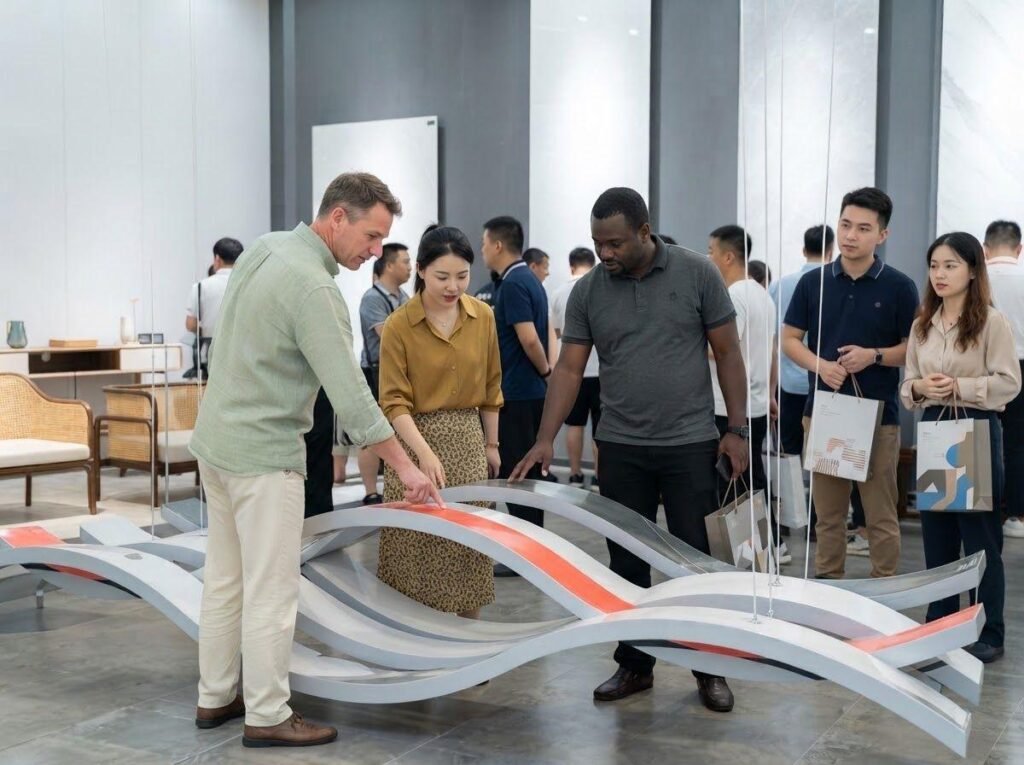
So, picture this. You’re sweating through a poplin shirt in an un-airconditioned, 30,000-square-meter showroom in Foshan. Trying desperately to lock down North American rights to a killer boucle sectional. The Oolong is poured. Hands are shaken. The factory boss swears blind—via his 23-year-old nephew acting as translator—that this design? It’s yours. Entire US Midwest. Locked up tight.
Ninety days later. Your container finally hits Chicago. You crack the doors feeling like the smartest guy in procurement, only to scroll Instagram that night and spot the exact same sofa. Same brass feet. Same density foam. Sitting on a competitor’s feed three states over. Oh, and they’re pricing it 20% cheaper than you.
Welcome to the absolute myth of the Chinese exclusive. (And yeah, we all pretend this doesn’t happen, but it does. Weekly.)
I’ve spent fifteen years walking factory floors from Dongguan to Anji, drinking enough lukewarm green tea to float a cargo ship. And I’ve watched brilliant procurement directors lose their shirts because they misunderstood what a handshake actually means across the Pacific. Protecting a territory takes a hell of a lot more than a smile and a purchase order.
The Ugly Reality About “Your” Territory
Let’s stop kidding ourselves. When you corner a Guangdong supplier about exclusivity, you’re actually having two completely separate conversations.
You think you’re buying a geographic fortress. The factory? They think you’re temporarily renting that specific, hyper-narrow SKU code. At least until a bigger buyer walks in.
Actually, scratch that—most buyers fundamentally misunderstand the mindset here. A factory owner doesn’t see your territory as a sacred space to protect. They see an empty production quota. If your POs aren’t maxing out their line capacity, somebody else is going to fill that void. A quiet factory line is a bleeding factory line. Period.
Here is the only rule you need in this business: If you aren’t eating up the factory’s entire monthly output for a given frame, your “exclusivity” is basically a polite suggestion.
Factories run on volume, and loyalty doesn’t keep the lights on when the injection molding machines go quiet.
Key Takeaway Box: The Exclusivity Reality Check
- The Core Myth: Thinking a handshake secures geographic rights. It doesn’t.
- The Loophole: Exclusivity usually only covers your exact spec. One tweaked stitch? It’s a “new” product they can sell to your rival.
- The Fix: A western NDA is garbage here. You need a localized NNN agreement enforced locally.
- The Real Protection: Own your physical tooling. That’s the only thing they respect.
Dissecting the Phantom Exclusive
Locking down a territory out here is like lending your sports car to a teenager and expecting them not to speed. You might feel in control, but you have zero visibility once they turn the corner.
Look at how R&D actually works for most China furniture brands and white-label shops. The factory drops their own cash on a new sofa frame, the foam molds, the custom brackets. That’s their baby. Their intellectual property. So when you point at a chair in their booth and demand sole rights for Texas, you’re literally asking them to cap their own ROI on their own invention.
I got burned on this in Longjiang around 2012. We thought we had a lock on a gorgeous mid-century dining chair. Blew thousands on a marketing rollout. But the factory? They just flipped the backrest stitching from a diamond quilt to a vertical channel, swapped the fabric grade, and shipped 40-footers to our biggest competitor in Dallas.
One minor cosmetic shift. Boom. Your exclusive is dead.
To a local boss, tweaking a single hardware detail births a completely new item that totally bypasses your agreement.
You bought the label, not the chair
And honestly? You can’t even be mad at them. Export margins are brutal right now, mostly single digits. If they land on a hot silhouette, their survival depends on milking it across as many shipping lanes as physically possible.
Want real protection? Control the damn tooling. If you pay for the CNC programming or the proprietary extrusion dies, you shift from buying off-the-shelf to legitimate OEM. The steel belongs to you. If they run a ghost shift on your molds at 3 AM for a rival, that’s straight-up theft. But if you’re just buying out of their standard ODM catalog? You’re just renting the design.
Why Your Expensive Lawyer’s Boilerplate is Garbage
It never fails. Every month, some buyer flashes a 50-page Non-Disclosure Agreement drafted by their hotshot corporate lawyer in New York. They slide it across the tea table. The owner smiles, signs it, stamps it.
The buyer feels bulletproof. The factory owner feels nothing. Why? Because that paper is functionally useless.
A Chinese legal contract only has teeth if it’s enforceable in a local People’s Court. If your US-drafted agreement says disputes go to arbitration in Delaware, the factory knows they are untouchable. Even if you somehow win a default judgment back home, enforcing it against physical assets in mainland China is basically impossible. It’s a complete joke.
You need a bilingual NNN agreement (Non-Disclosure, Non-Use, Non-Circumvention) that explicitly names the factory’s local jurisdiction as the exclusive battleground.
The “Secret” isn’t the problem
Western contracts obsess over protecting “secrets.” But in this game, the design isn’t a secret the second it hits a tradeshow floor in Guangzhou. The actual threat is the factory bypassing you.
You need a contract stating: “You cannot use our custom molds for anyone else, and you cannot sell direct to our client list.”
Plus, make sure it’s executed right. It needs the signature of the actual legal rep listed on their business license. Not your buddy in sales. And it needs the official red corporate chop registered with the Public Security Bureau. No red chop? You just got yourself an expensive piece of calligraphy.

Reading the Factory Ecosystem
Look, not every supplier is out to screw you. The manufacturing base is hyper-fragmented. Your exposure to these distribution traps hinges entirely on who you get in bed with.
A lot of newer buyers immediately run to the mega-factories in Foshan—they see a huge facility and equate size with safety. But those massive lines require relentless volume to survive. They will cannibalize your territory in a heartbeat to hit quotas. On the flip side, some veteran buyers find that mid-sized, specialized shops—take operations like Interi Furniture, which leans hard into custom hospitality and high-end residential. Mid-tier setups generally offer a more collaborative R&D environment simply because they aren’t chained to the soul-crushing, mass-market volume requirements of the behemoths. They actually have the breathing room to respect your geographic fences.
But trust is still earned through POs and verified by local paperwork.
A factory’s sheer size dictates its hunger for volume, which directly correlates to how fast they’ll ditch your exclusivity deal to get more.
The Real-World Territory Defense Protocol
So how do you actually defend your turf without pitching a tent on the factory floor? Leverage. Uncomfortable, financial leverage.
Here is the exact gauntlet I make my clients run before they wire a dime for a 30% deposit:
- Weaponize local law: Get that China-centric NNN agreement. And stuff it with a terrifying liquidated damages clause. Meaning? The contract dictates exactly what they owe you per breach (say, 1,000,000 RMB) without you needing to prove specific lost profits. Make the penalty a hard, scary number.
- Shrink the map: Asking for “North America” is a joke unless you’re shipping thousands of containers a year. Narrow it down. Define the exact states. Specify the retail channels. Tie the timeline to strict, quarterly minimum order volumes.
- Buy the steel: Pay for your own molds. Physically stamp your logo into the injection-molded base or the inner frame. It is exponentially harder for a factory to sneak a ghost run for your rival when your brand is literally baked into the product’s skeleton.
- Check the chop: Audit that red seal. If the English name on your contract doesn’t perfectly match the Chinese characters on their business license, you have zero legal standing.
- The glaring red flag: If the sales manager agrees to your exclusivity demands instantly, without fighting you tooth and nail for a massive Minimum Order Quantity (MOQ)… walk away.
I know that sounds crazy. You want them to say yes easily. But a factory that hands over a territory without a fight is a factory that doesn’t respect territories to begin with. If they aren’t sweating you over MOQs, they’re lying just to snag your deposit.
The Stuff Buyers Actually Ask Behind Closed Doors
Q: Can I actually sue a supplier if they ship my custom chair to a competitor?
A: Yes, but only if your paperwork isn’t trash. If you have a localized NNN with a liquidated damages clause pointing to a Chinese court, they will freeze factory assets shockingly fast. If you’re relying on a western NDA and some angry WeChat messages? You’re toast.
Q: The factory claims my rival bought a “different” chair because they swapped the matte legs for brushed brass. Are they legally clear?
A: Usually, yes. Unless your agreement explicitly defines what makes a “derivative” or “substantially similar” design, they found a legal loophole. You have to lock down the core silhouette and structural bones in the contract, not just the finish options.
Q: Will a factory seriously walk away from my competitor’s cash just to honor our gentleman’s agreement?
A: Depends entirely on your PO history. Keep their assembly line jammed with your orders, and they won’t risk pissing you off. Drop down to one container every six months, and they’ll take that competitor’s cash the second you get on a plane home.
The Price of Playing Pretend
You can draft the tightest local contracts in the world and own all your tooling. But down in the trenches, Asian sourcing is a contact sport governed by cold, ruthless economics. You can never lawyer your way out of a fundamentally bad partnership.
I’ve watched massive retail players blow fifty grand on legal fees, only to get gutted because a rogue production manager quietly flipped a CAD file to his cousin’s trading company. The paperwork is there for when the wheels fall off, but consistent, mutual profitability is the only thing that keeps the car on the road. You want the factory to guard your yard? You better be feeding them.
So ask yourself: Are you actually moving enough volume to command an exclusive pond, or are you just playing pretend? Figure that out before you sit down for the tea.