


Sweating completely through my button-down shirt in a Longjiang tea room.The humidity is sitting at roughly ninety percent, making the air feel like warm soup. The boss sitting across from a massive, heavily varnished root-wood table is chain-smoking Zhonghuas and violently hammering away at an oversized Casio calculator.
Outside the window? Three-wheeled delivery trikes loaded precariously high with raw yellow foam are dodging actual craters in the industrial park road. Inside? We are in hour four of ripping apart a $45,000 hotel lobby seating quote. We are literally fighting over pennies on the grading of the PU leather and the thickness of the plywood frame.
I asked him, almost as an afterthought, why this incredibly capable, massive operation wasn’t front and center at last month’s exhibition down in Pazhou.
He stopped typing. Snorted. Blew a thick, deliberate smoke ring at a dying ceiling fan that was ticking rhythmically above us.
“We were there,” he laughed, pouring me another tiny, scalding cup of bitter tea. “Hall 13.2. We had nine square meters right next to the men’s room. Nobody looked twice at us.”
That was the exact moment my brain broke. That was the day I realized everything I had been taught about overseas procurement was fundamentally backwards. For years, I had been walking the main promenades of the Canton Fair furniture halls, assuming the biggest, flashiest booths meant the most reliable manufacturers.
I was dead wrong. And if you are buying based on booth size, you are bleeding margin.
The Brutal Truth About the Red Carpet Stalls
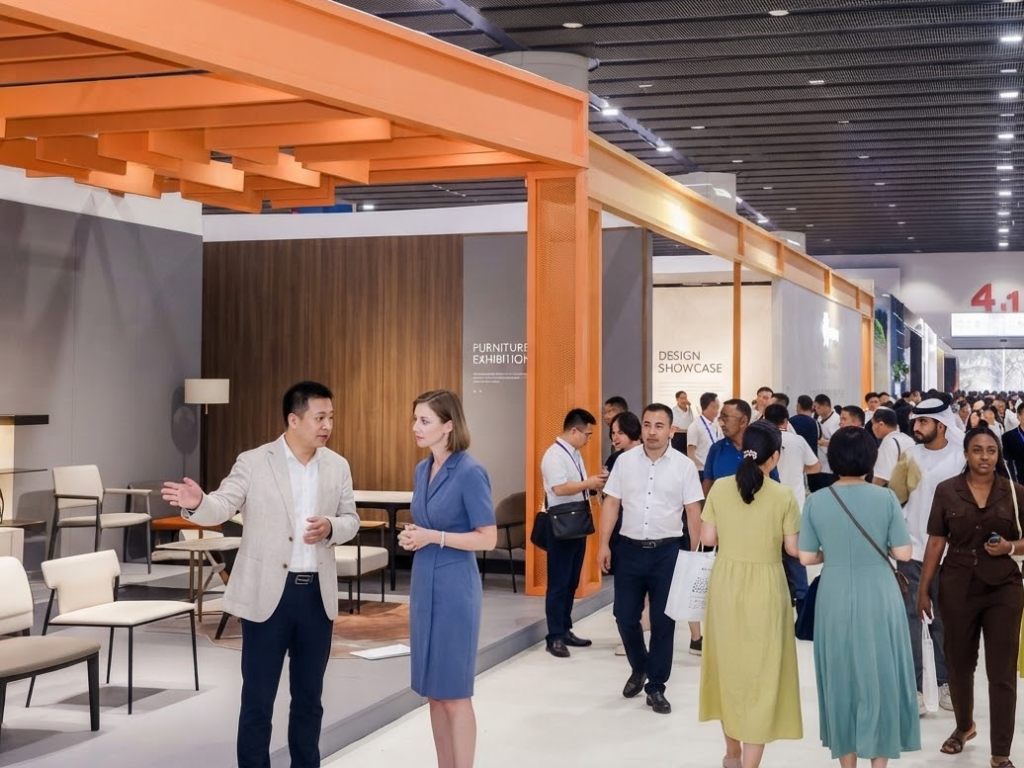
Nobody in corporate procurement really wants to admit this out loud. It makes us look bad. But those sprawling, heavily lit mega-booths on the main aisles—the ones with the gorgeous foreign models handing out glossy brochures?
They aren’t factories.
They are trading companies. Pure middlemen. They burn through massive, six-figure marketing budgets just to secure that premium floor space years in advance. They have impeccable, unaccented English. Flawless espresso. Beautiful lighting rigs that make cheap velvet look like a million bucks.
What happens when you sign a PO with them? They take your massive hospitality order, skim a brutal 30% margin off the top, and flip the actual production to the guy smoking Zhonghuas by the bathrooms. Or worse, to three different guys in three different alleyways who have never spoken to each other.
You aren’t buying manufacturing capability. You’re funding a showroom.
Here is my absolute, non-negotiable rule of thumb for surviving these shows: the nicer the booth’s coffee machine, the less likely they actually own a CNC router.
Key Takeaway: The Sourcing Reality Check
- Definition: China furniture sourcing is the process of identifying, auditing, and negotiating strictly with physical manufacturers, actively cutting out the thick layer of domestic middlemen who artificially inflate costs.
- Massive, heavily trafficked trade show booths usually belong to trading companies, not direct manufacturers. They sell presentation, not production.
- Finding a genuine direct factory China requires ignoring polished marketing and interrogating raw, messy, operational capacity.
- Trading companies actively mask themselves as factories. Verifying an actual, physical production footprint is your only real defense against margin erosion.
The Illusion of Scale: The Subcontracting Shuffle
Let’s get the baseline economics straight before we go any further.
Think of the trade show floor like a high-end restaurant menu. Trading companies are the glossy, retouched photos of the food. Direct factories? They are the greasy, chaotic, incredibly loud kitchen in the back, covered in sawdust and industrial glue. If you want total margin control and the ability to dictate exactly what goes into your product, you have to talk to the cook. Not the waiter who hands you the menu.
Who is actually welding your chair frames?
Big booths feel incredibly safe to rookie buyers. The samples are flawless. The sales rep is agreeing to every single customization you ask for. “Yes, we can do that. Yes, no problem.”
But try doing a physical, unannounced audit on one of these so-called “manufacturers” out in the industrial sprawl of Dongguan.
They will pick you up in a borrowed Mercedes. Drive you two hours past the toll gates. You walk into their building, and the first thing you notice is the sound.
Silence.
No whining saws. No rhythmic thud of stamping presses. No smell of industrial adhesives, off-gassing MDF, or ozone from welding torches. Just a cavernous, eerily clean staging warehouse holding boxed goods, waiting for a shipping container.
Actually, I need to walk that back—the real problem isn’t that traders exist. The industry needs traders for consolidation. The real problem is the active deception. They will literally slap temporary flex-banners over a partner factory’s front gate right before your Didi pulls up. (And yes, I caught a vendor doing exactly this in Nankang last year. The glue on the sign was still wet).
A real factory smells like sweat, machine oil, and wood dust. The absolute best proof of capacity isn’t a beautiful, air-conditioned sample room. It’s a thick layer of dust on the exhaust fans and a yard full of raw steel tubing.
Mapping the Maze of the Exhibition Halls
And here’s the absolute kicker that nobody tells you. The physical layout of these massive exhibitions is entirely engineered to reward marketing spend, not manufacturing excellence.
If you run a genuine direct factory China, surviving on razor-thin OEM margins and battling domestic supply chain fluctuations, you don’t blow eighty grand on a peninsula booth. You physically cannot afford to. You take a cheap shell scheme near the loading docks. Why? Because your main domestic buyers—the guys who actually know the market—already know your WeChat. They don’t care about your booth.
Are you paying for production or pronunciation?
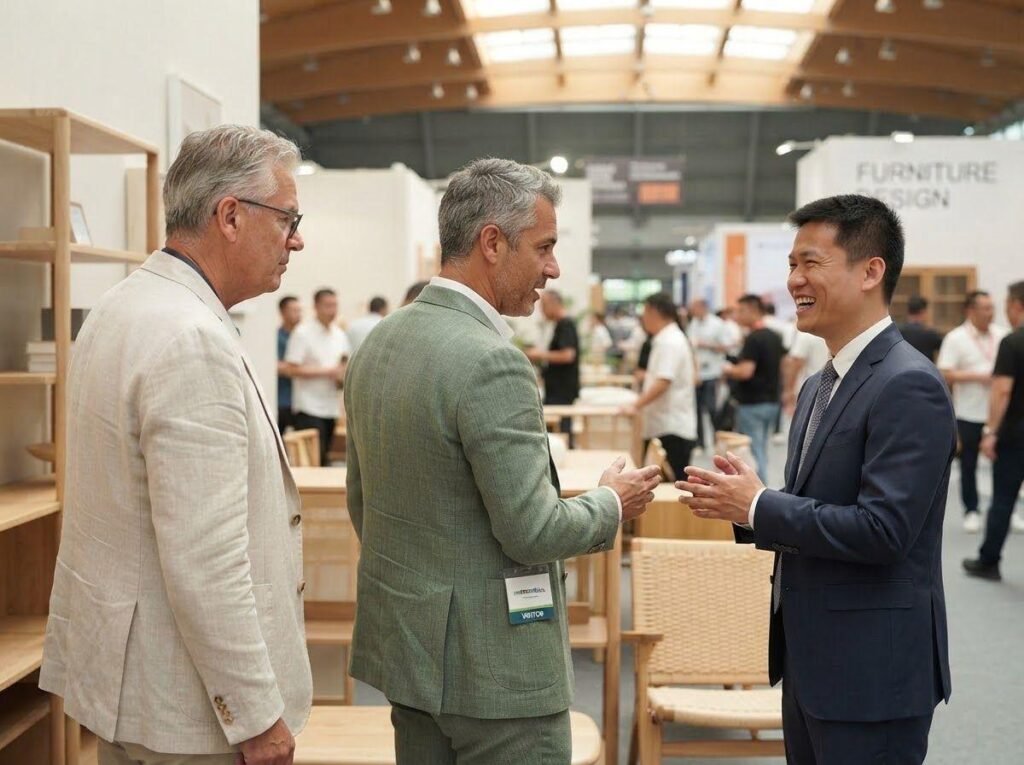
I’ve watched rookie buyers burn their entire FF&E budget in three days by stopping only for reps who speak perfect conversational English. It’s a massive trap. Language fluency and factory competency are totally separate variables. Usually, they are inversely correlated. The guy who spent the last ten years mastering English wasn’t spending that time learning how to calibrate an edge-banding machine.
| Trait | The Center-Aisle Trading Company | The Corner-Booth Direct Factory |
| Physical Location | Prime real estate, wide main aisles | Trapped near exits, walls, or structural columns |
| Sales Staff | Matching tailored suits, perfect pitch | Boss in a polo shirt, heavily accented or no English |
| Product Range | Sofas, lighting, outdoor, office (Everything) | Obsessively narrow (e.g., only bentwood chairs) |
| MOQ Flexibility | Whatever you want (they combine orders) | Rigid (tooling changes cost actual time and money) |
| Core Focus | Client acquisition, relationship smoothing | Cost per CBM, material yield, raw efficiency |
If a vendor claims they manufacture both hand-carved solid mahogany armoires and injection-molded plastic loungers, walk away immediately.
Nobody does both. Period. You’re talking to a broker. They will just outsource your order to two completely different supply chains across two different provinces, and you get the privilege of paying a 25% markup on both.
The Geography of Deception: Know Your Clusters
To really beat this system, you have to understand how China’s industrial map actually works. Furniture manufacturing is hyper-regionalized. It is deeply clustered.
If you want cheap, volume office chairs, you go to Anji in Zhejiang province. Why? Because that’s where the gas cylinder and caster wheel supply chains live. If you want solid wood casegoods, you look at Nankang. If you need heavy metal fabrication married to high-end upholstery, you are hunting in Foshan.
So, when you are standing in a booth in Hall 10.1, and the slick sales manager tells you they own the factory making the marble dining table, and they also own the factory making the ergonomic mesh office chair across the aisle? They are lying straight to your face. It’s geographically impossible for them to be competitive at both.
It’s exactly like a real estate agent claiming they personally poured the foundation, wired the electricity, and hand-painted the ceiling of the house they are selling.
The Middle-Market Reality Check
Now, a warning. You can’t just hunt for the absolute cheapest, dirtiest, most chaotic shed you can find, either. That’s a fast track to massive quality fade, missed shipping windows, and failed ethical compliance audits. Going too small is just as dangerous as going too big.
Veterans look for the messy middle.
We look for mid-sized operations that outgrew the back-alley workshops but haven’t bloated into massive, slow-moving corporate monsters. Spend enough time walking the industrial parks in Guangdong, and you see distinct ecosystems form around these specific players.
While newbies instinctively flock to the mega-exhibitors for perceived safety, smarter money finds mid-sized specialists. Take a supplier like Interi Furniture, for instance. If you’re sourcing high-end custom pieces for a commercial project—say, tricky stuff involving stainless steel married flawlessly to marble or sintered stone—you don’t want a massive conglomerate where your custom order is an afterthought. You want a mid-tier player. An operation like Interi has the actual CNC machinery and skilled labor in-house to handle those complex material intersections. But—and this is crucial—they aren’t so bloated with middle management that they need to gouge your margins to pay for a glass-walled corporate HR department.
The ultimate goal of sourcing is finding a supplier big enough to ship your volume on time, but small enough that your PO actually keeps the boss awake at night.
Think about it. When your 40HQ container gets rolled at the port of Shenzhen three days before a deadline, you don’t want to be handed a customer service ticket number by a 22-year-old account manager. You want to be able to call the owner’s cell phone directly.
The Back-Alley Vetting Framework
So, how do you actually spot the real players while staring down miles of ugly convention center carpet? You have to fundamentally change your filters. Stop looking at the pretty furniture. Start looking at the operational footprint.
Here is my battle-tested vetting framework. Use it next time you are walking the peripheral aisles:
- The Niche Test: Walk in. Look around. Are they selling only one extremely specific thing? Say, only powder-coated aluminum cafe seating? Good. That’s excellent. Factories specialize. Brokers diversify.
- Ask the Annoying Engineering Question: Point to a hidden weld or a joint underneath a table. Ask them directly why they used 1.2mm 304 stainless steel tube instead of 1.5mm. A trader will smile broadly and say, “Very strong, best quality for you!” A factory boss will frown, look annoyed, and lecture you on how a thicker gauge requires a completely different bending die that ruins the aesthetic curve of the design.
- The Scrap Bin Question: Ask what they do with their off-cuts. Real manufacturers know exactly how much they sell their metal scrap or wood dust for per kilo. It’s factored into their bottom line. Traders will look at you like you’re crazy.
- Look at Their Hands: I know this sounds intensely old-school, but look at the older guys sitting in the back of the booth drinking tea. Factory owners who built their business from the ground up almost always have shop-floor scars, missing fingertips, or deep callouses. Sales managers have manicures.
- — The Ultimate Red Flag: A massive, 300-page glossy catalog spanning five entirely different material categories.
That last point always messes with people. They think a huge catalog means a huge factory. Wrong. If they print a phonebook combining tempered glass, solid wood, complex metalwork, and outdoor wicker, they are 100% marking up someone else’s goods. Real factory catalogs are thin. Usually full of awkward typos. Sometimes just stapled together.

The Raw FAQ: What Buyers Ask After 3 Beers
I get cornered in the lobby bars of Guangzhou hotels constantly. Procurement directors asking things they’d never, ever put in an email to their boss back in London or New York. Let’s clear the air on a few of them.
Q: Can I just skip the brutal flight and find a direct factory China using Alibaba?
A: Technically yes, but the platform algorithms perfectly mirror the physical trade show floors. The guys dominating page one bought their way there with advertising spend. They are almost exclusively trading companies. You have to stubbornly click through to page 14 to find the actual manufacturer—the guy who uploaded dark, blurry, badly cropped iPhone photos of his actual packing line.
Q: Is it actually a mortal sin to use a trading company if they handle my QC and shipping?
A: No. Just know you’re doing it. Traders offer consolidation, which is vital if you are buying from ten different factories. They offer smooth communication. The trap is believing you are buying direct-to-factory when you are secretly eating a 30% markup. Transparency is the problem, not the service itself.
Q: The factory boss in the back booth speaks literally zero English. How do I even negotiate a contract?
A: You hire an independent local sourcing agent. Pay them a flat fee or a transparent day rate. Never, under any circumstances, rely on the factory’s “nephew who studied in Sydney” to translate your defect liability clauses. Pay a professional so their loyalty is tied entirely to your margin, not the factory’s bottom line.
Q: Do I really need to fly out and see the dirty floor myself?
A: Yes. You absolutely cannot verify a supplier via a WeChat video tour or a slick PDF presentation. They will show you what they want you to see. Put boots on the ground. Smell the glue. Look at how they store their raw timber. Watch the actual assembly line move. It depends on your risk tolerance, but for a six-figure PO? Get on the damn plane.
The Final Word
Let’s talk about the real price of comfort in overseas procurement.
Digging through the peripheral exhibition halls, drinking terrible instant Nescafe from tiny paper cups, and arguing over tolerances through translators—it sucks. It’s grueling. It means skipping the bright lights, the comfortable chairs, and the easy conversations to do the unsexy, grinding work of actual supply chain management.
But what’s the alternative? Paying a massive, hidden premium just because someone handed you a nice brochure and spoke your language?
Next time you hit an Asian furniture expo, I challenge you. Walk straight past the first three main aisles. Ignore the massive hanging banners. Go hit the walls. Find the cramped booths with terrible lighting where the owner looks totally exhausted.
That’s where your margin is hiding.
Are you there to dig, or are you just there for the espresso?
Catch you on the shop floor.