

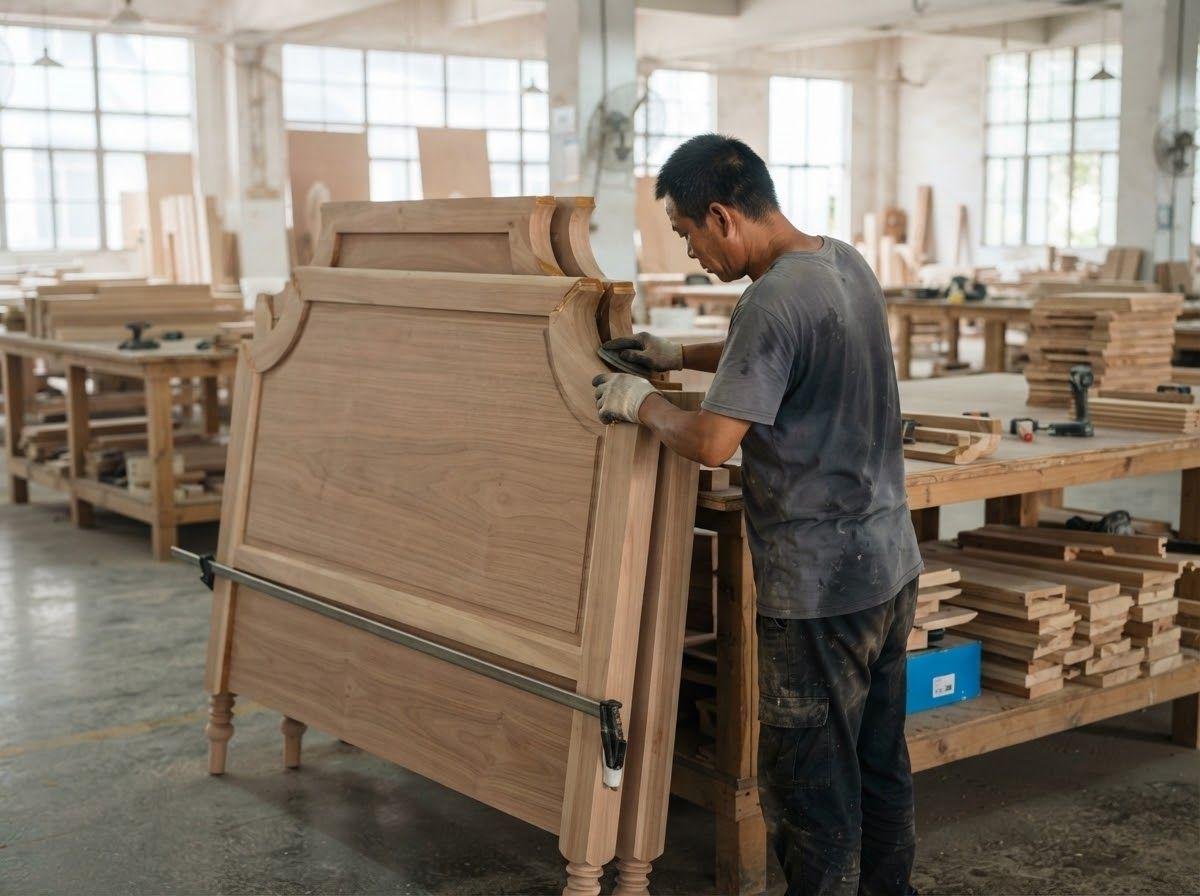
Third week of October, Miami. A procurement director I know cracked open a container she’d been waiting six weeks for — 300 solid oak nightstands out of a factory near Longjiang, in Shunde’s furniture belt. Price was $47 a unit, FOB Shenzhen. She’d beaten the quote down hard and felt good about it. Inspection passed. Paperwork clean.
The smell hit her first. Musty-sweet, like a gym bag left in a trunk.
Then she looked down. Hairline cracks running across the tops of maybe two dozen units, jagged as dry creek beds. Another sixty had drawers jammed halfway out — joints shifted, rails twisted. Standing in that warehouse heat, she did the arithmetic nobody wants to do next to a full container: call it 40% unsellable. Fourteen thousand dollars of oak, split open like kindling.
The weird part? The factory didn’t technically do anything wrong. Moisture tested in spec when the furniture left Guangdong. But somewhere between a humid Pearl River Delta loading dock and a Florida warehouse holding 80% humidity, the wood threw a fit. Nobody — not the inspector, not the forwarder, not her own warehouse crew — let the stuff sit and acclimatize.
And that’s the story nobody tells at trade shows. It happens constantly. It costs buyers a fortune. Nobody writes it up because moisture is boring and there’s no bad guy to point at. It doesn’t photograph. It just quietly eats your margin and mails you the bill a month later.
The Brutal Truth: Paper Doesn’t Mean Anything to a Tree
Say the quiet part out loud. Wood doesn’t care what’s written in your purchase order.
Wood is hygroscopic — a fancy way of saying it breathes. It soaks up moisture or bleeds it out until it matches the air around it. Furniture people call the endpoint EMC, equilibrium moisture content. An oak nightstand born in Longjiang is fat and happy at 12-14% moisture, because that’s what southern China’s air carries. The same piece lands in Phoenix and suddenly it wants to be 6-8%. Miami wants 10-12% — but if you rush it there, it arrives ugly and cracked.
It gets what it wants. Always. The only variable is speed.
Fifteen years of walking factory floors, and my rule of thumb hasn’t budged: moisture content within roughly 2% of your destination climate, or the piece cracks — not “might crack,” cracks. Physics doesn’t do refunds.
Buyers obsess over joinery, over which hinge brand is in the box, over whether the finish passes a crosshatch test. All fine. But sit me down to mediate a “quality dispute” between a Western buyer and a Chinese factory, and seven times out of ten it boils down to moisture. Joint failed? Wood shrank. Veneer bubbled? Core swelled overnight. Door won’t square up? Panel grew, and the factory built it flush-tight in summer.
Blame the factory if it makes you feel better. You’ll lose the argument and the reorder.
KEY TAKEAWAY — the part to screenshot
- Your China furniture moisture headache usually didn’t start at the factory. It started when Guangdia-humid wood met Arizona air.
- “Kiln-dried” is half a sentence. You need kiln-dried to what number, for which climate.
- A container crossing the Pacific is basically a sauna. Three weeks of it.
- Wood cracking in Chinese furniture is a logistics failure dressed up as a manufacturing defect. Chase the cause or keep paying tuition.
Doesn’t kiln-drying fix all this?
Actually, no — and I’ll admit I believed it myself for longer than I should have. Sure, a factory can pull lumber down to 8% in the kiln. Great. Then that same lumber lounges for three weeks in a tin-roofed warehouse in Foshan where the humidity sits at 85% half the year, and it drinks every bit of that moisture right back in.
Seen it with my own eyes in Dongguan. This place had serious money in drying gear — German kilns, calibrated meters all over the walls. Then you walk to the finished-goods warehouse: roll-up doors propped open, Pearl River Delta air rolling through like soup. The meter read one number at the kiln and a totally different number forty meters away at the loading bay. Same lumber. Same week. Two different products.
Hold onto this, because most spec sheets dance around it: the number that matters is the moisture reading at packing — not at the mill. Everything between those two points is where orders go to die.

Why the South China Belt Is Stacked Against You
Pull up a weather map. Foshan, Shunde, Longjiang, Dongguan — the entire furniture corridor — sits in a subtropical steam bath. For months on end, relative humidity parks between 70% and 90%. Typhoon season cranks it higher. The general pattern: wood that lives its whole life in that air carries 12-16% moisture, sometimes more in July and August.
Quick physics, no textbook. Warm air holds more water than cold air. Drag a swollen panel from 90% humidity into a 30% room and the surface dries and shrinks first while the core’s still fat with water. Surface tightens. Core resists. Something has to give — a glue line, a tenon cut a hair snug, a crack right down a $400 table top.
Ever leave wet leather boots by a radiator overnight? The leather stiffens and splits along the stress lines. Wood is the same animal. Dry it too fast and it tears itself apart doing it.
Do factories know? Of course they know. The good ones engineer around it. The middle-tier ones behave for the week the inspector’s in town and coast the rest of the year. And testing isn’t some dark art — a forty-dollar pin meter from a hardware store does the job. So why the gaps? Incentives. Factories optimize whatever buyers check. Buyers check finish and dimensions. Guess what gets optimized. (If you’re sure your supplier’s the exception, ask to see their warehouse meters on your next visit. Watch the body language.)
The wet-market fish rule
Here’s how I explain it to rookies. Sourcing wood furniture from southern China is like buying a live fish at a wet market and expecting it to survive the flight home in a plastic bag. The fish was healthy when you bought it. The bag killed it. Nobody blames the fishmonger for the water temperature — yet furniture buyers blame the factory for what happened inside a steel box the factory never controlled.
The insider detail worth stealing: the sharpest operations I’ve stood on in Longjiang don’t stop at kiln-drying. They run dehumidifiers in finished-goods storage and they wrap every wide panel in foil-laminated film before crating. One floor manager — honestly, this is a composite of half a dozen similar conversations over the years — told me his crack claims dropped by half after they started wrapping tops. Cost him under a dollar a unit. His buyers never noticed the wrap. They just stopped calling to complain.
Sit with that. Eighty cents of foil outperformed an entire QC overhaul. The boring fixes almost always do.
Three Weeks in a Steel Sauna
Even a perfectly dried piece walks into an ambush the moment the container doors seal. Picture the box. Hot days at sea, cold nights. Condensation forming on the steel ceiling, beading, gathering, dripping down on your cartons. Freight people call it container rain, and it shows up in a meaningful slice of moisture-damage claims every year. Furniture is near the top of the victim list.
Same physics again. Daytime heats the box, moisture evaporates off the wood and cardboard into the air. Night cools the steel fast, the moisture condenses on the walls and ceiling, gravity takes over. Your nightstands get rained on. Slowly. For three straight weeks.
Okay, so what actually works?
Desiccants — but the real kind, in real doses. Those pathetic silica packets stapled to a furniture leg? Decoration. Calcium chloride hanging bags, sized to your cube, will pull a shocking amount of water out of a container. Based on export patterns I’ve tracked over the years, loads with proper desiccant counts show noticeably fewer moisture claims than ones relying on ventilation. And ventilation, frankly, is cargo-cult thinking. Container vents do nearly nothing when the ocean air outside is basically saturated.
Add vapor-barrier film or foil-laminated paper around every flat panel and table top. Zero glamour. Real results.
Buyers ask me all the time who’s actually good at this stuff. Fair question. My honest read: it’s about the type of operation, not the size. The big Foshan players have the muscle, no doubt. But mid-sized specialists — operations in the vein of Interi Furniture, built into Guangdong’s export ecosystem and working the project and hospitality side — often treat moisture control like engineering instead of paperwork, because a single rejected hotel shipment can wipe out a quarter’s margin. Not a law of nature. Just a pattern I’ve noticed walking these floors. Follow the incentive and you’ll find out who actually measures things.
The Destination Mismatch — Where You Blow It Yourself
Now the part that stings, because it’s on you, not the factory.
Container clears customs. Warehouse door rolls up. Your crew wheels everything straight inside — or worse, straight to a client install — and then everyone stands around acting shocked when cracks bloom weeks later.
The furniture needs time to breathe. Full stop. Kiln-dried to 8% is a waste of money if the piece then camps for a month in a Houston warehouse at 75% humidity. It drinks the moisture back in, joints stress, veneers pop. Flip the script: Denver, January, heated indoor air dry enough to chap your lips. The wood dumps moisture fast, panels shrink, and that drawer that glided in the factory now rattles in its slot with a gap you can see from across the showroom.
Moisture content, by the way — MC, in case a supplier throws the abbreviation at you — is just the weight of water in a piece of wood, as a percentage of its dry weight. That’s the whole definition. Everything in this article hangs off that one number.
Your destination climate is the spec. Everything upstream gets reverse-engineered from that. Most programs run it backwards, then argue about whose fault it is.
Here’s the rough map I sketch for buyers on a napkin:
| Where it’s going | Target MC | What goes wrong | What to demand at origin |
|---|---|---|---|
| Southwest US — Phoenix, Vegas | 6-8% | Cracking, blown joints | Longer kiln cycle, dry storage |
| Southeast US — Miami, Houston | 10-12% | Swelling, mold, veneer lift | Sealed packing, desiccants |
| Northern Europe, heated winters | 8-10% | Winter shrink, gappy joints | Barrier wrap, staged delivery |
| Middle East, heavy AC | 7-9% | Fast indoor drying | Looser joinery tolerance |
| Humid coastal markets | 11-13% | Mold, rusty hardware | Anti-mold treatment, breathable pack |
Pattern’s consistent: buyers who write destination-matched MC into the PO — verified at packing — simply don’t have these fights. Buyers who accept “kiln-dried” as a complete sentence keep having them. Obvious? Sure. Almost nobody does it.
The Checklist I Actually Run
Steal it. I’ve stopped being precious about it.
Before you sign anything:
- Kill the phrase, get the number. “Kiln-dried” is marketing. “8-10% MC at packing, destination-matched, measured and logged” is a spec. If it’s not in the purchase order, it doesn’t exist.
- Ask about warehouse humidity. Flat out. A factory running dehumidified storage will show you proudly — they always do. One that hedges? You’ve got your answer.
Mid-production:
- Carry your own pin meter to the factory. Lumber at intake, panels pre-assembly, finished goods pre-crating. Three readings, one visit, ten minutes.
- One red flag that flips the usual advice: be wary of factories with zero moisture complaints on record. Perfection is a tell. Either nobody’s measuring or the failures get smoothed over. The factory that shows you an occasional problem and the corrective action? That’s a system. That’s the one.
Before the doors close:
- Desiccant type and quantity go in the loading checklist. Calcium chloride, sized to the cube. Refuse the freebie packets.
- Vapor-barrier wrap on every wide panel and top. Photograph it before sealing, timestamp and all.
After landing:
- Stage the goods. 48-72 hours in destination conditions before unpacking or install. Not negotiable.
- Re-measure MC on an arrival sample and compare it against the packing number. That delta is your real report card — better intel than any audit slideshow.

Questions Buyers Actually Ask
Q: The factory keeps saying “kiln-dried to export standard.” Should I accept that?
A: No. “Export standard” is a sentence, not a measurement — there’s no universal export number, and the right MC depends entirely on where the furniture’s headed. Get a percentage range matched to your market, verified at packing with a calibrated meter, and logged. A factory that won’t commit to that has told you everything about its quality system.
Q: If it cracks, does that mean they used bad wood?
A: Rarely. Green lumber and sloppy drying do crack — but that’s the minority case. Timing is your detective. Bad lumber fails fast, within days of unpacking. Climate mismatch is patient: it shows up weeks or months later, after the wood finishes equilibrating. Check the calendar before you check the lumber.
Q: Is solid wood worse than veneer or engineered board for this?
A: For cracking, yes — solid moves as one piece, and wide panels move a lot. But engineered materials fail differently: swelling cores blow veneers clean off, and particleboard edges swell permanently and never recover. Different failure modes. Pick your poison.
Q: Honest answer — should I just quit sourcing solid wood from the South China belt?
A: Depends on two things: your destination and your discipline. Dry Southwest, no moisture spec, no staging? Yes, quit — you’re funding your own losses. But build the spec, desiccants, wrap, and staging into the program, and this region’s solid wood manufacturing competes with anywhere on earth. The factories were rarely the weak link. The process around them was.
The Lesson That Cost Somebody Two Million Dollars
Full disclosure: I watched a hospitality program worth roughly two million dollars nearly buckle over cracked nightstands. Not joinery. Not finish. A container crossing in August, a bone-dry Las Vegas warehouse, and a spec sheet containing zero moisture language. The factory performed. The freight performed. The specification failed — because there wasn’t one.
So here’s the principle I hand every buyer who’ll stand still for it: you’re not buying furniture from China — you’re buying a moisture management system that furniture happens to ride in. Respect the journey and the product takes care of itself.
Ignore it, and the wood teaches you personally.
It always collects.