

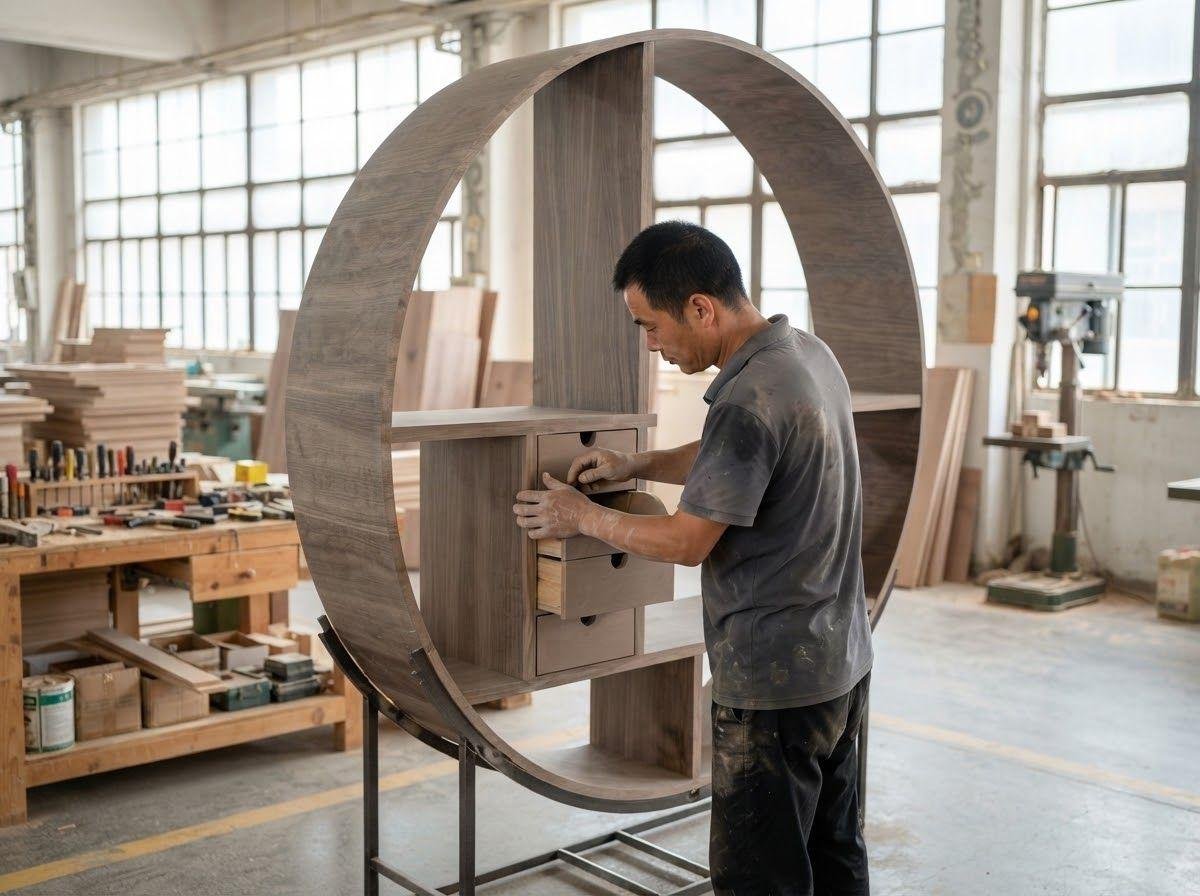
Chengdu, March. A procurement director in a hotel suite, laptop open, side-by-side images on screen. Left: the render. Warm walnut, joints so tight you’d need a feeler gauge. Right: the photos. Cam-lock holes where dowels were specified. A drawer gap you could drop a room key through. And the finish — let’s just say it looked sprayed during a rainstorm. Contract value? Around $380k in guestroom casegoods. Gap between the pretty picture and the container? Total. Systematic. Nobody was surprised except him.
He turned to me and said it plainly: “Drawing said one thing. Container said another.”
Fifteen years of factory floors in Guangdong, and I’ve had this exact conversation more times than the trade magazines will print. Here’s what nobody wants to say out loud: the gap between render and reality isn’t a failure of the Chinese OEM model. Half the time, it’s how the model is designed to work.
The Part Buyers Don’t Want to Hear
Your drawing was never the blueprint. Not really.
A Chinese OEM factory doesn’t build what you drew. It builds what its production line can build — and your drawing gets treated as raw material for that, a conversation opener. One that starts after your deposit clears.
Is that cynical? Maybe. The good factories — the ones with real in-house engineering — will actually call you. They’ll flag the conflicts, propose fixes, hold tolerances. But they’re a minority, and the rest of the pack? Based on what I’ve seen across export orders, most mid-market shops quietly convert customer drawings into their own shop drawings, optimized around their materials, their tooling, their schedule. Not out of malice. Out of habit.
One rule I give every buyer: if a change saves the factory money and you didn’t ban it in writing, it’s already been made.
The 2mm reveal becomes 4mm because that’s how the edgebander was set. The Blum hinges become “compatible equivalents” from a supplier you’ve never heard of. Did anyone lie? Technically no. They just didn’t mention it.
Key Takeaways — read this before you send your next RFQ:
- Drawings are negotiation tools, not instructions. The factory will rework them around its own capabilities no matter what you intend.
- The 3D render is a sales asset. Production runs off the factory’s internal shop drawings — which you must see, review, and sign.
- Deviations bunch up in three places: hardware swaps, joinery shortcuts, finish drift. Audit those three specifically, because nobody else will.
- Custom furniture from China lives or dies at the engineering handoff. Not the quote. The handoff.
Let’s Define the Thing, Because the Definition Explains Everything
China furniture sourcing is the process of moving your cabinetry design through an OEM manufacturer whose production logic is set by its own machines, its own material stock, and its own labor skills — so every drawing you send gets translated, never just copied. The translation step. That’s where things go sideways.
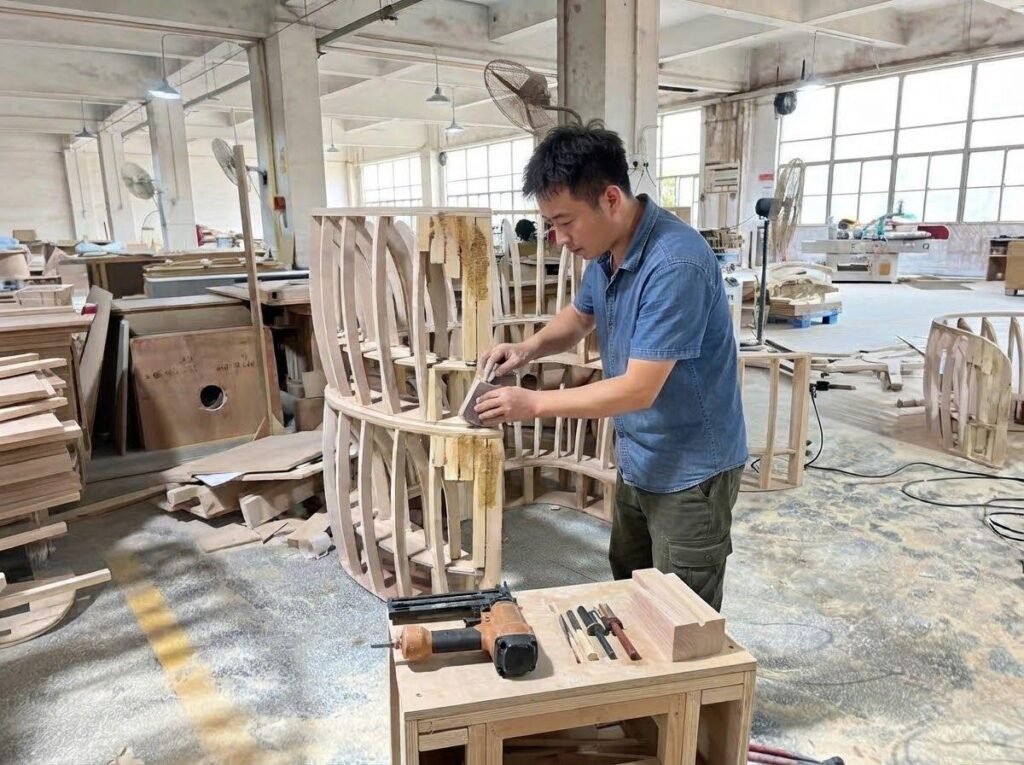
Why Your Drawing Gets Rewritten — and Why Nobody Calls You
Ever ordered a bespoke suit through a tailor you’ve never met, in a language you don’t speak, whose shop happens to be overstocked with fabric that’s close to what you wanted? You’ll get a suit. It’ll fit somebody. Whether it fits you depends on one thing: did the tailor pick up the phone and ask.
Most factories don’t pick up the phone.
Why? Structure. A mid-size shop in Longjiang or Shunde might juggle forty live orders at once. Your “project manager” is a coordinator drowning in WeChat threads from ten different buyers. Your drawing says doweled carcass; the doweling station is booked solid on a better-margin job. So a cam-and-dowel hybrid quietly happens. Path of least resistance. Resistance costs money.
I watched this in Dongguan once — decent factory, not a bottom feeder. Within an hour of the deposit, an engineer opened the buyer’s CAD file and started “normalizing” it. That meant deleting the rabbet joints the buyer had carefully specified and swapping in standard dowel-and-glue construction on 18mm board. I asked him why. He looked genuinely confused. “This is better,” he said. And from where he stood — faster, proven, no setup cost — he was right.
It just wasn’t what was drawn.
Who Actually Reads Your Spec?
Something the sourcing guides never tell you: the person who reads your technical package most carefully is the salesperson building the quote. After that, the package goes through a blender. Twenty pages of tolerances, hardware brands, finish codes — compressed to an A4 summary of “key dimensions and materials” by the time cutting starts. Sometimes it just vanishes between departments.
What survives? Only the drawings that physically can’t be ignored: dimensioned shop drawings with exploded views, generated by the factory, stamped and signed by you. Everything upstream of that document is window dressing.
Where the Deviations Actually Hide
Ask any QC veteran where render-to-reality fails cluster and you’ll hear the same three answers, every time. And yet buyers keep auditing the wrong stuff — panel thickness, mostly, which every factory nails because the cutting optimization software enforces it automatically. It’s the one dimension they can’t get wrong.
Hardware is where the substitutions live. Spec says Blum or Salice; the box shows up with runners and hinges wearing suspiciously similar logos. Sometimes the equivalents honestly perform. Sometimes they’re why every drawer in a 200-room hotel needs service calls inside six months. My inspection experience across mid-range orders: about a third involve at least one hardware swap that nobody disclosed.
Joinery is second. That gorgeous inset-door detail in your render — flush, shadow-gapped, milled within a hair — needs jigs the factory might not own. What shows up is a proud-overlay door with a gap that’s been “managed” and a story about production optimization. Actually, let me correct myself — it’s not always capability. Sometimes it’s sequencing. The jigs exist. They were just allocated to a repeat client who spends more.
Worse: finishes. You approved matte lacquer. Production ships semi-gloss because the shop mixed a big batch for another order and folded yours in. From what I can tell, finish drift is the most common deviation of all — and the easiest to catch, if you’re checking against a physical master sample instead of a photo on a spec sheet.
| Where It Goes Wrong | What the Render Promises | What Lands in the Container | Your Countermove |
|---|---|---|---|
| Hardware | Name-brand runners and hinges | Unbranded “equivalents” | Demand stamping photos before packing |
| Joinery | Doweled or dovetailed carcasses | Cam-lock simplifications | Sign off on exploded shop drawings |
| Finish | Exact sheen and color | Batch-adjusted “close enough” | Physical golden sample at factory + pre-shipment check |
| Dimensions | ±0.5mm tolerances | Whatever the line runs that week | Third-party measurement audit on site |
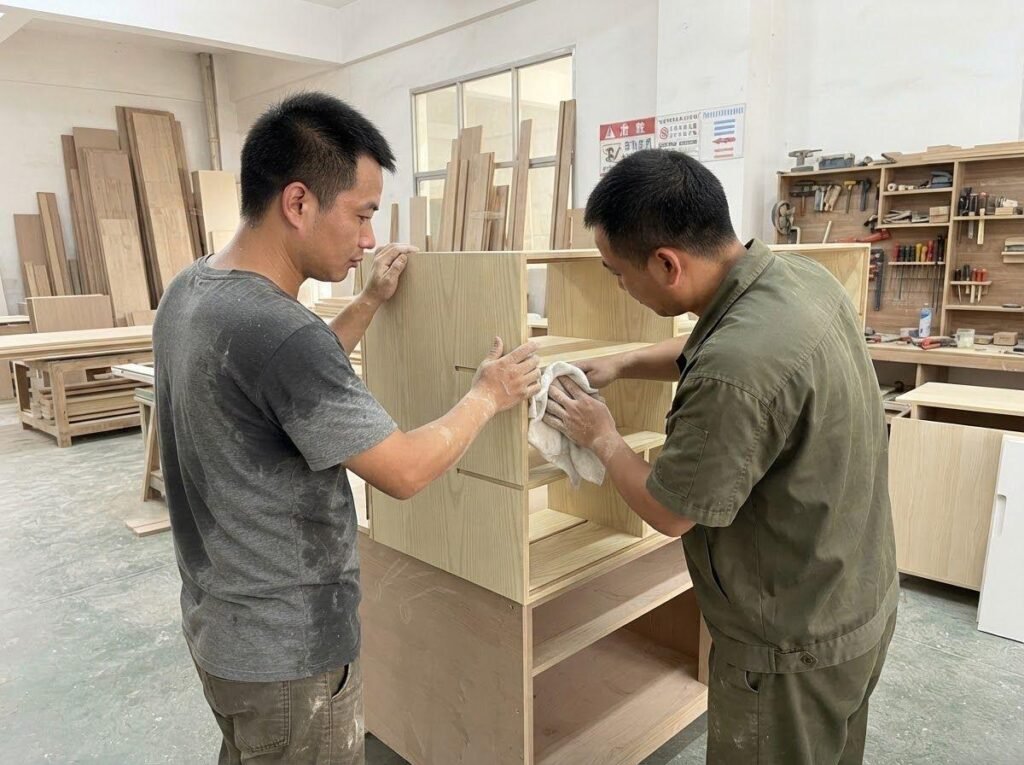
The Case for the Mid-Sized Factory (Sometimes)
Buyers fall for the big names. Foshan’s mega-shops with showroom floors like airport hangars feel safe. Sometimes they are. But scale has a dark side: a factory shipping hundreds of containers monthly wants to hammer your custom order into something close to its catalog, because custom work costs them margin.
Some buyers head straight for the giants in Foshan. Others have better luck with mid-sized specialists — the Interi Furniture type, if you know the Guangdong landscape: export-focused, project and hospitality oriented, the kind of operation that treats engineering as its product rather than a cost center. Smaller order books mean actual attention on your drawings. A narrower niche often means the joinery capability and finishing lines on your spec genuinely exist in-house instead of being farmed out. That’s not a blanket endorsement — every factory type needs the same verification — but it’s worth knowing before you default to whoever built the biggest showroom.
Deviation rates drop when the factory has engineering skin in your specific project. Giants dilute attention across volume. Specialists concentrate it. Choose your poison with your eyes open.
The Framework That Actually Holds
Forget finding a “trustworthy” factory. Trust is irrelevant — process is everything. Build something that catches deviations where they’re cheap: on paper, before a single panel gets cut.
Work it in order:
- Retire the render as an approval tool. — The render exists for your client’s boardroom back home. Nothing gets approved against an image. If your own team signs off renders, the battle was lost before it started.
- Get the factory’s shop drawings. Yours is not enough. Exploded views, hardware callouts, joinery details. Review line by line. Boring? Absolutely. It’s also the highest-leverage hour of the entire project.
- Here’s the red flag nobody warns you about: a factory that accepts your spec too easily. No questions, no pushback, instant “no problem.” That’s usually your drawing going straight into a drawer. The ones asking annoying questions about hinge brands and humidity ratings? Those are engineering your order. Annoying is good.
- Make a golden sample, then chain it. One physical, signed, dated master stays at the factory. One travels with your inspector. Photos of it sit in the PO as an annex. Anything arriving differently is a rejection — no debate, no “we can adjust on site.”
- Tie payments to gates. Deposit. Shop-drawing approval. Pre-shipment inspection pass. Final payment after inspection, never before. Post-payment, your entire leverage is a politely worded WeChat message.
- Write substitution clauses as breaches. Kill the phrase “or equivalent” — it’s a signed blank check. Name exact brands and SKUs. State that any swap voids warranty obligations. Factories respect contract language. They ignore vibes.
And one more: visit if you can. Not for the tour — they’ll walk you past the good line. Go for the tea afterward, when the sales manager relaxes, and ask what happens when the shop gets overloaded. Listen to the silence.

FAQ
Q: Is the 3D render from my Chinese OEM factory legally binding in any way?
A: No. And treating it as binding is the most common buyer mistake I see. A render carries no tolerances, no material callouts, no hardware specs. Your enforceable documents are the signed shop drawings, the PO with technical annexes, and the physical golden sample. If your contract cites renders as approval evidence, fix it today.
Q: They swapped my hinges for “equivalent quality” hardware after shipment. Any recourse?
A: Some — if you documented properly. If the PO named specific hardware brands and required written approval for substitutions, the swap is a breach, and you can pursue compensation backed by the inspection report. If your spec said “or equivalent,” you have close to nothing. Vague language costs buyers serious money, every single year.
Q: Does custom furniture from China always mean fighting the factory over drawings?
A: No. Buyers with real technical packages — dimensioned shop drawings, hardware SKUs, finish codes, tolerances — plus staged verification gates report near-zero deviations. The fight isn’t Chinese manufacturing. It’s underspecified manufacturing, anywhere on earth. Weak drawings get rewritten in Dongguan, in Poland, in North Carolina. Guangdong’s mid-market OEM sector just does it faster.
Q: Can I trust the factory’s in-house render to show what I’ll actually receive?
A: Treat it as a sketch with an optimism bias. Sales-team designers build renders from idealized materials and lighting. Proportions and layout? Usually reliable. Grain match, sheen, joint quality, edge treatment? Don’t bet on it. Check those against physical samples. Always.
Q: Fine — so does the render always betray you?
A: It depends on how you use it. Betrays buyers who treat it as an approval document. Harmless for buyers who treat it as a conversation opener and anchor everything to shop drawings and physical samples. The betrayal is optional. Most buyers opt in without noticing.
One question to sit with: if your factory vanished tomorrow and you re-tendered the project, would your documentation be solid enough that another factory could rebuild the identical product? If the answer is no — if the real knowledge lives in WeChat threads and render files — the deviation problem was never really the factory’s. It was the paperwork you handed them.
I’ve watched solid projects get quietly cheapened by substitutions everyone saw coming except the buyer. The factories aren’t hiding anything. They’re just betting you won’t look.
Next time? Look.