

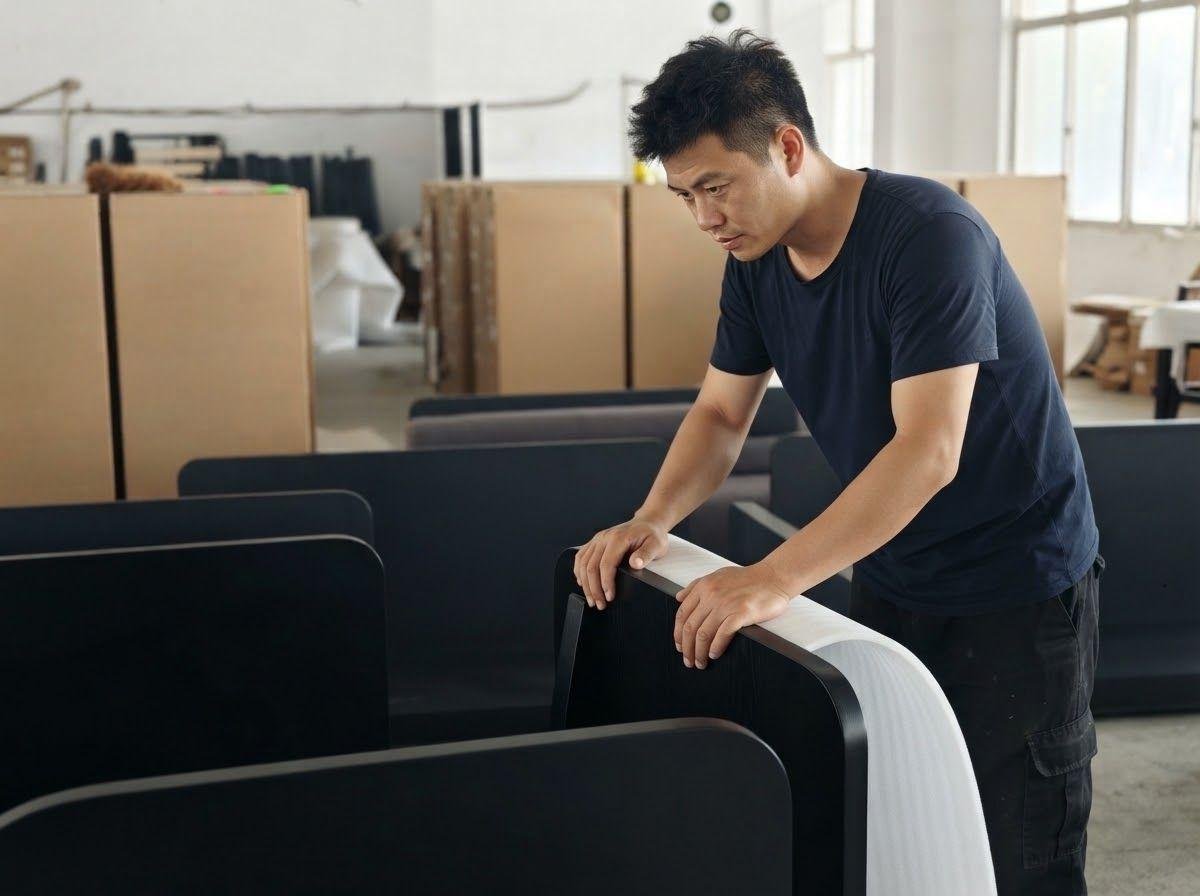
Six-thirty in the morning, a 3PL warehouse outside Reno, and a founder I’ll call Dave is cutting open the first of 212 cartons with a box cutter. Nightstands. His first-ever furniture container from China, $27,800 landed, three months of his savings riding on a TikTok-friendly unboxing idea. Carton one: crushed corner, cracked drawer front. Carton nine: fine. Carton fourteen: the whole side stove in. By the time his team finished, thirty-one units were unsellable. Not scratched. Unsellable.
I flew out to look at the wreckage a week later. The factory hadn’t sabotaged him. They’d done something more ordinary — they’d shipped his nightstands in cartons spec’d for palletized wholesale freight, then FedEx’d them one by one to suburban doorsteps. Dave never asked about the box. Neither does almost anyone, until the box becomes the story.
Chinese furniture packaging is the single cheapest insurance you can buy in this industry, and it’s the line item buyers spend the least time on. That gap? It’s where margins go to die.
Your Product Doesn’t Break. Your Cardboard Does.
Nobody wants to hear this, so I’ll just say it: most transit damage in this trade is a paperwork failure, not a craftsmanship failure. The factory built the thing fine. The carton failed.
Watch how the negotiation actually goes. Three days on unit price. Twenty minutes on fabric grade. And then someone says “standard export packing, okay?” — and everyone nods because it’s 11 PM Guangzhou time and everyone wants bed. Standard export packing. Say it out loud. It’s not a spec. It’s a mood.
Rule of thumb I drill into every buyer I train: if your packaging description wouldn’t let a stranger on another continent rebuild it, you don’t have packaging. You have a prayer.
Actually, let me correct myself — the problem usually isn’t even the factory. It’s that buyers assume protection is included in the price, like a warranty. It isn’t. In my experience, roughly 2–4% of a unit’s FOB price, spent deliberately, kills most transit damage. The average buyer spends under 1%, then writes angry emails. To the wrong person. About the wrong thing.
Key Takeaway
- Packaging is the highest-leverage money in the whole deal — cheapest to fix, costliest to ignore.
- “Standard export packaging” protects the factory’s liability, not your goods. Nothing more.
- For DTC sellers, the China mail order box is the storefront. Customers meet it before they meet your product.
- Customization done right moves risk off your P&L and onto the factory floor, where it belongs.
Where the Damage Really Comes From
A parachute analogy works here, but only halfway. Yes, nobody checks the stitching on the way up. The difference is that a parachute fails once. A bad carton fails two hundred times in a row, at $120 a pop.
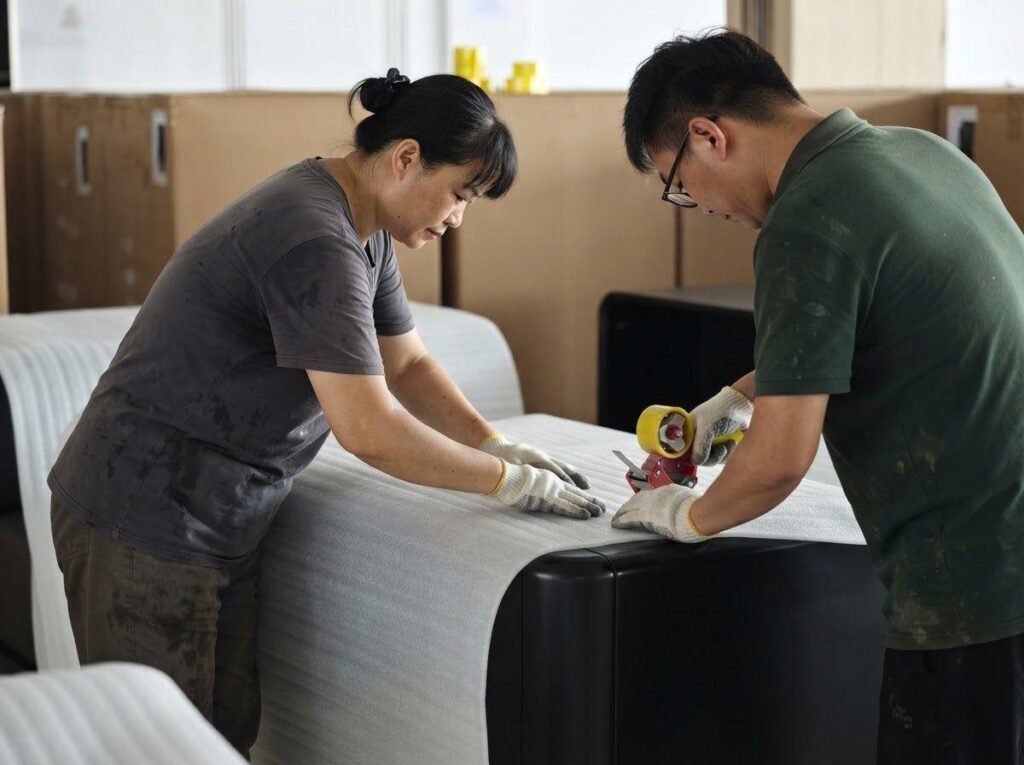
I was walking a production line in Longjiang, Shunde’s furniture district, when I saw a worker wrap a sintered-stone tabletop — retail $700 — in a single pass of bubble wrap and slide it into a box. I asked the floor manager about corner boards. He grinned: “Customer never ask.” Six weeks later, a freight forwarder in Hamburg sent photos of that same tabletop in three pieces. I keep those photos. New buyers don’t believe me otherwise.
Why does the factory’s “standard” box keep failing you?
Because “standard” floats. Factories buy cartons the way you buy milk — whatever’s available that week. You agreed on honeycomb board; production ran double-wall corrugated because the purchasing agent saved a few cents a unit. You were promised 10mm foam corners; you got 5mm offcuts folded into triangles. This isn’t villainy. It’s Tuesday.
But flip it around and the same factories become excellent. Write “5-ply BC-flute, 10mm EPE, V-boards on all corners, drop-tested to ISTA 3A” into the purchase contract, and watch the nod change. Same workers. Same machines. Different buyer. The box improves the moment you stop speaking in adjectives and start speaking in millimeters.
And — this part stings — the best packaging conversations I’ve had happened at small factories, not big ones. A mid-size operation will sit you down with the carton supplier over tea. A giant will hand you a catalog.
It’s not always impact. Sometimes it’s sweat.
Container rain is real. Temperature swings turn sealed containers into slow saunas, and “slightly damp” cardboard warps solid oak from Nankang or rusts every hinge in a flat-pack kitchen shipment. Based on what I’ve seen across project files, moisture quietly destroys more solid-wood cargo than drops do. The fix is almost insultingly cheap: VCI bags on hardware, desiccant sized to carton volume, and components stored indoors — which you’d think is obvious until you’ve seen lumber stacked under a tarp behind a Longjiang workshop. It happens more than anyone admits.
The Mail Order Box Rewrote the Whole Game
Here’s the shift most sourcing advice hasn’t caught up with. Ten years ago, your box needed to survive exactly one journey: factory, container, warehouse, retail shelf. Today a huge share of China-made furniture goes factory, container, fulfillment center — then a courier hurls it over someone’s fence in Ohio.
That China mail order box lives a completely different life. It gets grabbed, dropped, restacked, rained on, and judged at the doorstep by someone holding a phone. Compression ratings stop being theory. Drop tests stop being marketing. And the printing? The printing is now your brand’s handshake.
I spent a morning at an Anji facility — chair country — where two lines ran ten meters apart. One cranked plain brown shipping cartons for a wholesaler. The other ran full-color mailer boxes with QR-coded assembly guides and molded pulp inserts, brand color matched across three print stations. Same chairs inside. Cartons cost maybe 40% more. The owner’s tracking sheet showed the printed line’s damage complaints running at less than a quarter of the other. Run your own return-rate math on that.
So why do buyers still spec for a journey their goods never take?
Because the sourcing playbook they learned was written for retail containers, and habits outlive conditions. Fair enough. But if your last mile is a parcel network, a pallet-spec carton isn’t saving you money — it’s a slow leak. A snug, engineered mail order box also dodges dimensional-weight surcharges, which is real money nobody prices in.
Quick grounding definition, since this trips people up: China furniture sourcing is the process of specifying, producing, and shipping furniture from Chinese manufacturing clusters — and for e-commerce sellers, that “specifying” part now includes the carton, the insert, the print, and the protection as one system. Treat them separately and they fail separately.
| Factor | Off-the-shelf carton | Customized mail order box | Full bespoke system |
|---|---|---|---|
| Unit cost | Lowest | Moderate lift (+15–40%) | Highest |
| Damage exposure | High | Low | Lowest |
| Brand impression | None | Solid | Standout |
| MOQ flexibility | Easy | Medium | Demanding |
| Lead time impact | None | Days | Weeks |
| Fit for parcel last-mile | Poor | Good | Built for it |
Customization Is Where the Margin Hides
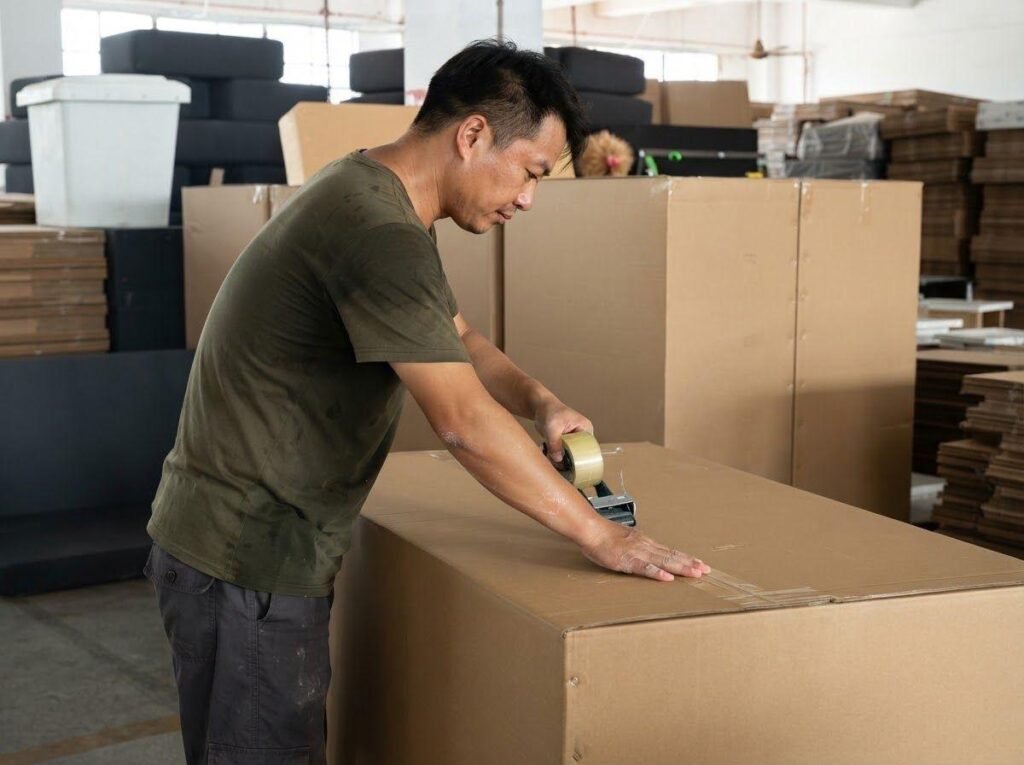
Buyers keep framing customization as lipstick. Wrong frame. The kind of customization that pays for itself is structural — the die-cut foam cradle, the divider that stops parts rubbing, carton dimensions tuned to parcel pricing. One factory owner in Dongguan told me, half-laughing, that his customers negotiate the frame down to the penny and then accept “free” packaging. Free. From a man who sells things for a living. Chew on that.
Think of it like tailoring. The cloth was always going to be decent — Guangdong doesn’t lack for decent cloth. The tailoring is what makes a suit yours, and what makes it survive the flight. A logo is a monogram; the internal structure is the actual tailoring. Monograms are optional. Tailoring is not.
What tends to work, order after order: one-color print for identity (cheap, low MOQ), real internal engineering (non-negotiable), plus one small delight — a printed assembly card, a QR link to a two-minute setup video. Total spend on mid-volume runs, in my experience: under 3% of landed cost. Often way under.
The Factory Ecosystem Nobody Maps Honestly
Who controls your carton quality depends on who’s making your furniture, and the landscape has three rough layers. The Foshan giants serving big-box retail have packaging engineers and proper test labs — genuinely impressive, if you’re ordering 5,000 units and accept their terms. Down at the other end, the small Longjiang and Anji workshops will build literally anything you sketch on a napkin, with consistency that swings week to week.
The middle layer is where most project buyers actually live. Take a Guangdong-based manufacturer like Interi Furniture — the sort of mid-sized, export-oriented operation serving hospitality and project buyers you meet constantly at CIFF. Big enough to enforce carton consistency across a production run, small enough that you negotiate specs with someone who owns the outcome, not an agent relaying notes. Different risk-reward equation than the giants, not a lesser one. Buyers who learn to use this tier — getting carton drawings and material specs attached to the contract the way they’d treat joinery — stop having Dave’s Reno morning. Mostly.
A mid-size factory that treats the carton as engineering will outperform a giant that treats it as an afterthought. Every time I’ve bet on that, I’ve collected.
Before You Wire the Deposit, Do This
Not after. Deposits have a way of ending conversations.
Kill “standard export packing” in writing. Replace it with flute type, board grade, foam density, corner protection, strapping, desiccant count. If they won’t document it, that’s your answer about everything else.
Ask for the report, not the promise. “Do you drop test?” gets a smile. “Send me your latest ISTA 3A or GB/T 4857 report for this carton” gets a PDF or a very interesting silence.
Put packaging on the quote as its own priced line — because once it has a price, it has an owner. Free packaging has no owner. That’s the whole trick.
Print late, engineer early. Branding and colors can move close to production; the internal structure must be frozen at sampling. Reversing those two timelines is how disasters get scheduled.
Match the box to the true last mile. Parcels, pallets, or both — decide in advance, and know that “both” means two specs, not one compromise.
⚠️ The red flag that goes against conventional wisdom: be wary of the factory offering a free packaging upgrade. Everyone loves free. But a free upgrade usually means the original quote was padded — or the “upgrade” is a nicer print on the same hollow structure. A factory that prices the carton honestly is one you can audit. A factory giving it away is pricing something you can’t see.
One more, and I mean this: deviation clause in the contract, with teeth. Verbal agreements in Shunde evaporate the moment cheaper board shows up. I’ve watched it happen. Twice, same buyer. He learned.

The Questions Buyers Actually Ask Me
Q: First trial order, small quantity — is custom packaging even worth it?
A: Yes, but shrink the ambition. On a 200-unit trial, skip the full-color print entirely and pour everything into protection — foam, dividers, corner boards. You’re buying data about survival, not a pretty box. Brand it once the supplier proves out.
Q: What should packaging realistically add to my unit cost?
A: In my experience, 2–4% of FOB price for proper protective packaging. Under 1% and something got skipped. Over 6% on a standard item, you’re either buying luxury presentation or being overcharged — and the general pattern suggests buyers get overcharged far more often than they realize.
Q: Can I get my logo printed on a mail order box without a huge MOQ?
A: Usually, yes — with one nuance. Carton specialists across Guangdong will run one- or two-color flexo at 500–1,000 units without blinking. Full CMYK needs higher volumes. The nuance: some factories quietly absorb print costs if you commit to reorders. Fine, but get it itemized so you know what you’re actually paying and what you’re promising.
Q: Is drop testing real at these factories, or brochure talk?
A: Both exist, side by side. Established exporters in Foshan, Dongguan, and Anji increasingly run ISTA or GB/T 4857 protocols — but they run them when the buyer’s paperwork demands it. No test standard in your contract means the only drop test is the one happening at the doorstep.
Q: Fine — but does packaging customization genuinely make or break a China furniture business?
A: It depends on exactly one variable: how your product reaches its end buyer. Pallets to a distributor? Packaging is a cost to manage, full stop. Parcels to doorsteps? Then it depends on nothing — packaging is the business, and it will make or break you.
Last Thought
Fifteen years of walking factory floors, and it comes down to this: the carton is the only thing in your entire order that touches every stage of the journey — workshop, truck, port, container, warehouse, courier, doorstep — while your product just sits inside, trusting you completely.
So before your next PO, sit with one question. A stranger in another country opens your box, sees the fit, the print, the care — or the absence of all three — and judges your entire company in four seconds. Would you sign your name to that box? Or are you, like Dave in Reno, about to find out what “standard export packing” really meant?
Get the carton drawings. Pay for the foam. Sign your name. Then sleep well on container day — I never do, but I’ve earned the right to worry about smarter things.