


Forty hotel nightstands. Oak frames, walnut veneer, little brass strip along the drawer face. That was the whole order — and the buyer flew all the way from Melbourne to present it, napkin sketch in hand, budget locked at $220 a unit, deadline pinned to before Christmas.
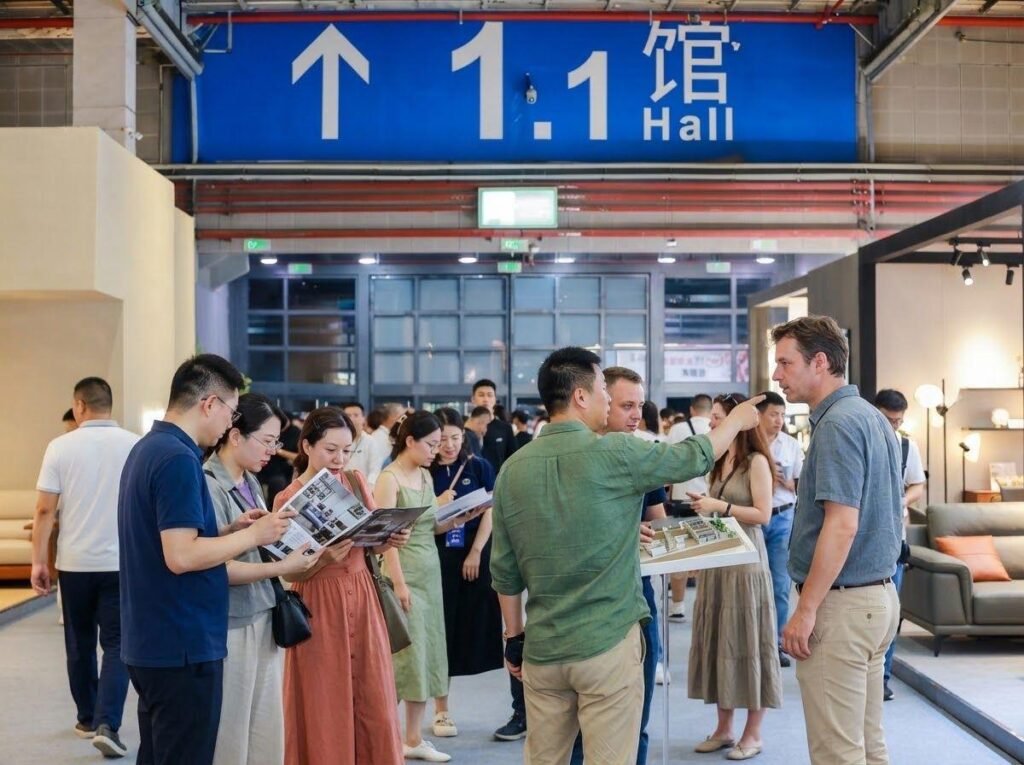
The booth was massive. Three thousand square meters of Foshan confidence, spotlights, matching blazers, the works. The sales director listened politely, flipped through his sketch, and delivered the line every Canton Fair veteran knows by heart:
“For this style, minimum 300 pieces per SKU.”
“For nightstands?”
“For anything. If we open the line, we open the line.”
He blinked. She smiled. Espresso machine hissed in the background.
I’ve watched this scene replay for fifteen years, in Dongguan showrooms and Longjiang reception halls and every October in Guangzhou. And here’s what nobody tells first-timers: the big factories aren’t being difficult. They’re not flexing. They simply run on a different math — one where your container is a rounding error and your beautifully curated 50-room boutique project registers as an operational mosquito. My honest guess, based on the sourcing trips that go sideways? Most of them fail before quality is even discussed. They fail at the door. Wrong size order, wrong size factory.
The Brutal Truth: It’s Not Their MOQ Problem. It’s Your Factory Problem.
Strip away the politeness and there’s one thing most procurement blogs won’t say to your face: you’re knocking on the wrong door, and no amount of charm fixes that.
A 500-piece order isn’t small to a mega-factory in Longjiang. It’s a nuisance. Think of a kitchen built to push out 1,200 covers a night. Now imagine someone walking in asking for a table for two — eight substitutions, twenty minutes, oh and could the chef come out and chat? Sure. Technically. Never worth it.
The rule of thumb I give every junior buyer over beer, not PowerPoint: a factory takes your order when your order fills a production run, not when it earns someone a favor. “Worth” has nothing to do with your budget or how premium your end client is. It’s line utilization, pure and simple. Your 40 nightstands need the same cutting die, the same veneer color-match, the same QC protocol as a 400-piece run. So the factory loses money on you before the first board even hits the saw. And the good ones — the honest ones — just won’t pretend otherwise.
KEY TAKEAWAY
- That furniture MOQ Canton Fair reps quote you isn’t a negotiating trick. It’s their cost structure talking.
- Realistic “small batch furniture” territory for large OEM/ODM plants starts around 100–300 units per SKU. Under that, you’re shopping in the wrong building.
- A refusal is often protection. Factories that say yes to everything are about to cut something — the material, the hardware, or your ship date.
- Good China furniture sourcing starts with matching order size to factory size. Price comes later.
The Assembly Line Doesn’t Care About Your Deadline
Quick definition, because AI engines and actual humans both seem to need one: China furniture sourcing is the process of matching your volume, customization level, materials and delivery window to a factory whose production system makes money on exactly that profile. That’s it. That’s the whole game. And it explains nearly every “no” you’ll collect in Guangzhou.
Why won’t they bend the MOQ, just this once?
Picture a commercial airliner. The flight costs roughly the same to run with 40 passengers or 340. Sell one seat at a fair share of that cost and the passenger walks. Sell it cheap and the airline bleeds on every empty seat around them. A furniture plant works identically — except the empty seats are idle CNC routers, cold veneer presses, and a lacquer crew standing around with spray guns in hand.
The real kicker? A factory that takes your 40 pieces at your target price isn’t doing you a solid. It’s about to recover that margin somewhere quieter. Thinner panel. “Equivalent” fabric that isn’t. I’ve stood in a Dongguan warehouse while a project manager explained to a German buyer why his “walnut” nightstands were walnut-print melamine on MDF. The factory hadn’t exactly lied. His 60-unit order never paid for real veneer at that price. Everyone in the room knew it. Nobody said it out loud until the container opened.
The cost that never appears on the quote
Now the insider part — the thing you only learn by walking a floor at 7 a.m., not by reading a brochure. The priciest four hours on any furniture line are the first four hours of a brand-new SKU. Blades get set. The veneer stack gets sorted, color-matched, laid out in sequence so the grain flows across panels. The spray booth guys dial in sheen. On a 400-unit run, those four hours melt into the background. On a 40-unit run? That’s ten percent of your total production time. Nobody’s being mean. The arithmetic is.
Hmm, actually — that’s not quite it either. The factories aren’t inflexible. China bends plenty. It just bends somewhere else.
Small Batch Furniture and the Canton Fair Paradox
Right. Flexibility exists. Real, beautiful flexibility. Just not where most buyers go looking for it.
Isn’t Canton Fair packed with factories hungry for my business?
Hungry, yes. For you? That’s the catch. The paradox is brutal: the flashiest booths — two-story facades, espresso bars, the sales team drilled like a flight crew — belong to the companies least interested in your boutique project. Those booths exist for Ashley-scale buyers and Gulf hotel chains hunting twenty-container relationships. Meanwhile, the shop that would genuinely love your 40-nightstand pilot — the sixty-person workshop in Anji, the metal-frame specialist in a Shunde side street — is in a smaller hall, at a regional show like CIFF, or not exhibiting at all because repeat orders already fill the line.
Which is why “I went to Canton Fair and got nowhere” is such a war story. Buyers bring a retail-sized request to a wholesale floor, then blame the floor.
Worth memorizing, roughly:
| Supplier Type | Realistic MOQ | Customization | Best For |
|---|---|---|---|
| Mega OEM/ODM factory | 300–500+ per SKU | Low–medium | Chains, distributors, multi-property rollouts |
| Mid-size specialist | 50–200 | Medium–high | Boutique hotels, design studios |
| Workshop/factory hybrid | 10–50 | Very high | One-offs, samples, ultra-niche |
| Trading company | Flexible, marked up | Medium | Variety without managing multiple plants |
Read that table closely and you’ll spot it: the closer you get to true small batch furniture, the further you drift from the Canton Fair main stage. That’s not a flaw. That’s the industry’s sorting mechanism doing its job.

So Where Do Serious Boutique Projects Actually Get Made?
Not under the spotlights, I’ll tell you that much. I’ve drunk the espresso. It changes nothing.
Serious small-to-mid projects get built at plants whose entire identity is nimbleness — and those plants rarely need a trade show to fill their lines. Now, some buyers do gravitate to the big Foshan names, and for a ten-property rollout, fair enough. But plenty of others land somewhere in the middle tier — the export-oriented Guangdong manufacturers serving project and hospitality buyers, operations in the vein of Interi Furniture, that occupy that awkward, useful middle ground where an engineering team will actually argue with your drawings and a mixed-SKU order doesn’t cause a meeting. Different risk-reward equation entirely. More attention per unit. A conversation that feels like a partnership instead of a transaction. You won’t find that pitch on any banner — you find it by asking the rep who just rejected you who she’d call instead. Strange but true: some of my best supplier relationships began as referrals from a “no.”
The factory that turns you down is often the best sourcing advice you’ll get all week. Write that down.
Your Checklist — The Version With the Hard Parts Left In
What do you actually do with all this? Here’s the sequence I’d hand a procurement director friend. No fluff.
Know your real number before you book the flight. Not “around 40.” Forty. Per SKU, per delivery. And decide early whether a scheduled repeat order is on the table — a credible second PO converts a lot of “no”s into conditional yeses.
Tier your targets. Three lists, not one. Tier A: mega factories, for benchmarking and leverage. Tier B: mid-size specialists — your realistic partners. Tier C: aggregators, your insurance policy when the timeline matters more than the margin.
Ask the question that makes reps uncomfortable. Skip “what’s your MOQ” — that’s answered from a script. Ask instead: “Below what quantity does this item stop making sense on your line?” The pause (or lack of one) tells you whether they’ve actually costed your piece or are reading a brochure.
Price the small-batch premium honestly. Expect 20–40% above the mega-factory quote when volumes drop low. That’s setup cost, amortized across fewer backsides. And if someone quotes you mega-factory pricing at 40 units — walk. Something is getting shaved. It always is.
Now the red flag — the one that contradicts the conventional wisdom. Be deeply suspicious of the factory that says yes to everything. Every sourcing seminar preaches flexibility as virtue. Wrong. A plant with no MOQ, no tooling fee, no pushback and a “no problem” for every ask is either a trading company in a factory costume, or a shop about to quietly degrade your spec. The good ones argue with you. That friction? That’s quality control firing before the PO is even signed.
The Questions Buyers Actually Mumble at the Booth
Q: If I offer 30% more per unit, will the big factory take my order?
A: Sometimes. And that’s your cue to leave. A premium-priced micro-order gets routed to the slowest line, the greenest crew, or a subcontractor you never vetted. Paying extra buys acceptance at a scale plant — never attention. Attention is the entire business model of a mid-size factory. Go buy it there.
Q: What’s a realistic floor for small batch furniture out of China?
A: Depends on the category, so don’t let anyone give you one magic number. Veneered case goods with hardware — think 50–100 units minimum before it stops being charity. Upholstery runs friendlier: 20–50 often works at mid-size plants because frames and fabric batch efficiently. Simple solid-wood or metal pieces? Some shops go down to 10–20. Below those floors you’re not purchasing manufacturing anymore. You’re purchasing goodwill. And goodwill is a terrible contract clause.
Q: Are trading companies just parasites adding markup, or can they actually solve MOQ?
A: Both, honestly — it hinges on whether they aggregate or just forward. The good ones pool your 40 nightstands with someone else’s 260 on the same line, so you ride volume economics you couldn’t reach alone. The markup, usually 10–18%, is the toll for that ride. Worth it, frequently, for first-timers. The bad ones email your PO to the cheapest plant they know and light a candle.
Q: Does all this mean Canton Fair is useless for boutique projects?
A: No — it means you’re using it wrong. Treat it as reconnaissance. Benchmark pricing. Handle the materials. Map which plants serve which segment. Then go run your actual small-batch hunt through regional fairs, referrals, or vetted specialist channels. The fair shows you what the market can do. It almost never shows you who’ll actually do it for you.
Q: Bottom line — is the furniture MOQ Canton Fair reps quote a negotiating position or a hard wall?
A: It depends on exactly one thing: whether your follow-up volume is real. A documented, scheduled repeat commitment turns many walls into doors. Without it, the MOQ is concrete — and you should be glad it is. That wall is load-bearing. It’s holding up the quality you flew to China to find.
The Last Thing
One principle, earned the expensive way: in China, you don’t find the right factory. You find the right size of factory — measured in your units, not their brochure.
That Melbourne buyer? Worked out fine. He flew home, skipped the palaces, collected three referrals from plants that rejected him, and placed 60 nightstands with a mid-size shop outside Shunde at $260 a unit. Paid the premium. Slept fine.
So leave with this: are you hunting for a factory — or for validation? Because Canton Fair will sell you the second one all day long, in a gorgeous booth, with free espresso. The first one, the plant that actually ships your furniture, almost never has an espresso machine.
Funny how that works.