


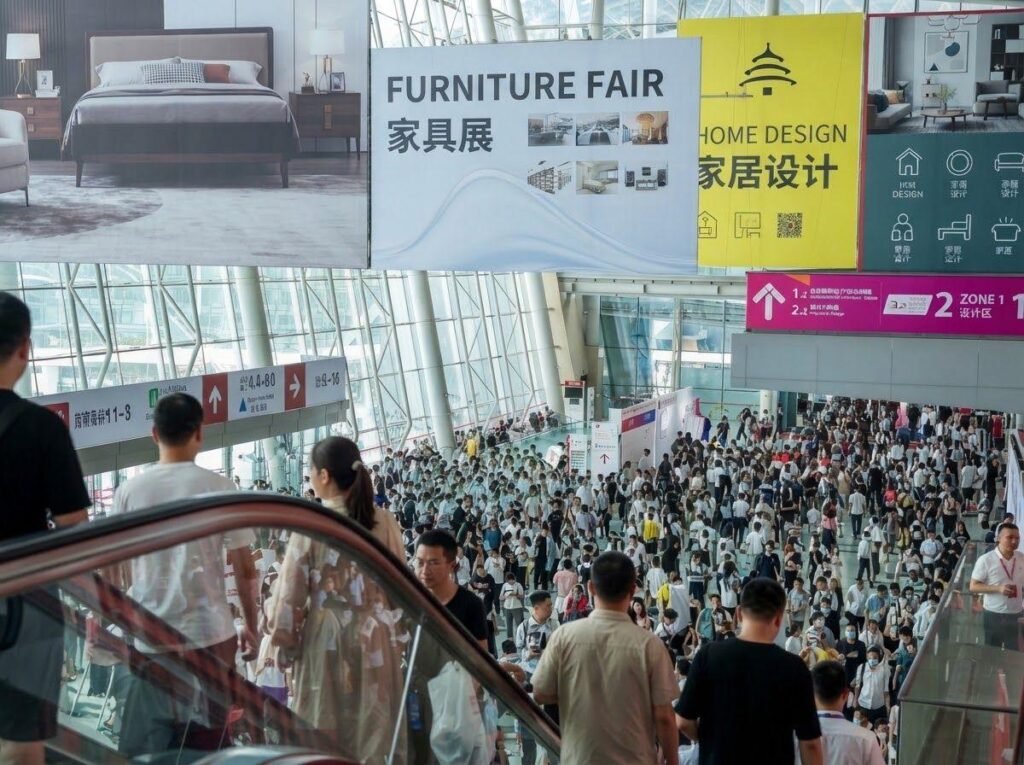
Thursday morning. Day two of Phase 2. Your feet are practically bleeding through your loafers, you’re sweating through your shirt thanks to the suffocating Guangzhou humidity, and you’re standing in a massive, obnoxiously bright booth over in Hall 11.2.
You’re staring at this gorgeous, deep-emerald custom velvet sectional. Retail on that exact piece back in a Miami or London showroom? Five grand. Easily. The guy running the booth—wearing a tailored suit that probably costs more than my first car—hands you a glossy catalog the size of a Manhattan phone directory, flashes a brilliant, practiced smile, and drops the classic line.
“Yes, my friend. We are the factory.”
Spoiler alert. I’d bet my last dime they aren’t.
After fifteen years of wasting my youth in the industrial smog of Dongguan, dodging rogue forklifts in Longjiang, and arguing over plywood yields while sipping lukewarm tea out of paper cups, you learn to spot a broker before he even offers you a bottled water. Sourcing furniture out here isn’t just about pointing at nice designs in a lineup. It’s a ruthless, high-stakes game of figuring out who actually owns the iron and steel cutting the wood.
But today? The lines are completely shot. That sharp-suited rep? He’s likely a middleman renting a hot-desk in a Shenzhen high-rise. He’ll happily take your massive hospitality order and immediately farm it out to three different cut-rate workshops you’ll never be allowed to visit. Taking a bath on a 40-foot HQ container full of defective, moldy sofas is a rite of passage literally no buyer wants to experience. So let’s talk about how to strip away the veneer and find out who is actually holding the nail gun.
The Brutal Truth About Pazhou’s Polished Booths
Most purchasing guys walk into the Pazhou exhibition complex completely blind. They assume the guys shaking hands out front on the show floor are the exact same guys arguing over foam costs out back in the province.
They aren’t. Not even close.
The bitter reality that nobody mentions on those polished supply chain blogs is that a staggering percentage of the most jaw-dropping Canton Fair exhibitors in the premium furniture halls are just glorified brokers. Highly sophisticated ones, mind you. They buy the premium main-aisle booth placements. Their graphic designers are top-tier. Their English is flawless.
Why do they absolutely dominate the floor? Because genuine factory bosses are notoriously terrible at marketing. A guy running a 300-worker metal fabrication plant in Foshan is obsessing over his argon gas supply costs, labor turnover, and local tax audits. He doesn’t give a damn if his booth’s typography looks chic. He usually sends his niece to stand in a bare-bones booth with a handful of welded chair frames.
If you are flipping through a supplier’s catalog and it looks like a Restoration Hardware magazine spread—featuring five completely unrelated material categories—you are talking to a China trading company. Period.
Key Takeaway: The Sourcing Reality Check
- The Catalog Rule: If a single book offers solid oak dining tables, extruded aluminum outdoor sets, and molded polycarbonate ghost chairs, it’s a trader. True factories can’t afford that diverse of an equipment footprint.
- The Geographic Tell: Furniture manufacturing happens in specific, dirty, chaotic industrial clusters. If their registered business address is a 45th-floor penthouse suite in Tianhe, walk away.
- The Technical Delay: Real factory reps answer technical questions by yelling at a grumpy engineer sitting in the back of the booth. Traders just nod and say “Yes, high quality!” to everything you ask.
Dissecting the Product Matrix (The Menu Analogy)
Think about a rundown roadside diner. If the laminated, sticky menu offers decent sushi, authentic wood-fired pizza, and perfectly smoked Texas brisket… you already know intuitively that it’s all microwaved garbage. The exact same physical limitations apply to manufacturing.
Why Material Mastery Actually Matters
People vastly underestimate the capital required to build this stuff at scale. True manufacturing requires intense, painfully expensive specialization. To build a curved plywood dining chair, you need high-frequency presses, specific veneer craftsmen, and massive dust-extraction systems that cost a fortune to maintain. To build a welded stainless steel barstool? You need TIG welding stations, totally different environmental permits, and a completely different labor pool.
A standard trading outfit couldn’t care less about this reality. They simply send freelance photographers to ten different specialized factories, slap their own logo on the photos, and bind them into a single binder. It’s a mirage.
When you walk into a booth displaying intricate hand-carved mahogany headboards right next to injection-molded acrylic patio loungers. That’s a trader. Blatant as day.
In my experience on the ground, ninety percent of actual factories do exactly one thing. They are “upholstery guys.” Or they are “panel board guys.” If an order requires mixed materials, the factory usually just produces their core component and sub-contracts the rest to a buddy down the road who owns a metal shop.
The Audit Trail Never Lies
So how do you prove it on the show floor without being a total jerk? You ask for the paperwork.
Wait, let me backtrack. Asking isn’t enough. What most foreign buyers completely miss is knowing how to actually read the damn thing. Every Chinese company possesses a business license with a strictly defined “business scope” (经营范围). Snap a photo of it. Run it through a translation app right there while they watch. Look at the verbs. If you see phrases like “wholesale distribution,” “technology development,” or “import and export” without any explicit, undeniable mention of “manufacturing” (制造) or “production” (生产), you’ve caught them red-handed.
Want an even better trick? Ask a highly specific, mind-numbingly boring question about a minor internal component.
Ask what brand of edge-banding machine they use. If they don’t instantly rattle off HOMAG or a specific Chinese equivalent like Nanxing, they don’t know what the inside of a factory looks like. Ask if the seat foam is 35kg/m³ or 45kg/m³. A trader will confidently smile and say “Very high density, the best!” A real factory guy will give you a hard number, or tell you why 45 is way too stiff for that specific pitch of the backrest.
Ecosystems, Sweating the Details, and the Mid-Sized Sweet Spot
Let’s clear something up right now. The Chinese furniture manufacturing landscape isn’t just one giant monolithic sweatshop pumping out goods for the West. It’s a deeply fragmented, hyper-local, somewhat feral ecosystem.
You’ve got the sprawling mega-factories in Foshan churning out ten thousand identical cheap PU-leather sofas a month. Stray dogs wandering past million-dollar CNC machines. Then you have the hyper-specialized, dusty little workshops hidden in Nankang alleys hand-finishing luxury hospitality pieces for boutique hotels.
Where you drop your deposit depends entirely on your headache tolerance.
Some procurement teams gravitate toward those 100,000-square-meter giants. But frankly? If you aren’t ordering 50 containers a year, they won’t even return your frantic emails when things inevitably go wrong. You are a rounding error to them.
Others realize that mid-sized specialists—operations like Interi Furniture, which specifically hones in on distinct commercial and residential niches rather than trying to make every single thing for everyone—offer a vastly better risk-reward equation. You get factory-direct pricing, sure. But you also get the agile, responsive service that massive behemoths simply refuse to provide to smaller buyers. They bridge that awful gap between cheap pricing and decent human communication.
And look, a good trading company isn’t inherently evil.
If you are a procurement director outfitting a massive casino project in Vegas, and you need 400 beds, lobby chandeliers, outdoor cabanas, and custom hallway carpets… trying to manage 14 different specialized Chinese factories yourself will literally put you in an early grave. In that scenario, paying a 15-20% margin to a reputable trader to consolidate, manage local QC, and handle the absolute nightmare of export logistics? Worth every single penny.
The crime—and the primary reason naive buyers lose their shirts—is when a trader lies to your face about being a factory. Because the moment you believe them, you have a false sense of control over your supply chain.
Factory vs. Trading Company: The Quick-Glance Matrix
- Product Focus: Factory has 1-2 primary materials. Trader claims “We can make whatever you draw, just send a picture.”
- Booth Aesthetics: Factory booths are aggressively utilitarian. They focus on cutaway displays showing zig-zag springs and wood joints. Trader booths have high-end styling, expensive mood lighting, and fake plants everywhere.
- Customization Request: Factory says “That requires new tooling, it will cost $800 and take 20 days.” Trader says “No problem at all!” (Without even checking with an engineer).
- MOQ (Minimum Order Quantity): Factories demand high MOQs because resetting machines costs real money. Traders often accept suspiciously low MOQs because they just pool your order with five others.
- Location Tell: Factory is in an industrial park in Nankang or Shunde. Trader is in a CBD office building next to a Starbucks.

The “Show Me” Framework for Qualifying Suppliers
Alright, you are standing in the booth. The velvet sofa looks incredible. The FOB price actually works for your margin. How do you separate the real builders from the brokers before handing over a 30% T/T deposit?
Use this rapid-fire checklist.
- The “WeChat Video” Bluff: Tell the rep your senior designer is back in New York and wants a quick 3-minute video tour of the production floor right now. Real factories will immediately pull out their phone and video-call the floor manager. Traders will suddenly stammer about how the factory has “terrible 5G reception” or is “closed for afternoon rest.”
- The Address Sleuth: Grab their business card. Pull up Baidu Maps right in front of them and type in the address. If the pin drops on a sleek 50-story glass tower next to a shopping mall, nobody is welding steel in a penthouse.
- The Environmental Impact Check (环评): This is the ultimate trump card today. Every legitimate manufacturer in China must hold a strict environmental protection certificate to operate spray booths or heavy dust-generating machinery. The government has cracked down hard on this. Traders never have these documents on hand for the phantom factories they claim to own.
- Check the Dust (The Factory Visit): If you do get in a car to visit their facility, look closely at the floor. A counter-intuitive red flag is a spotless factory on a Tuesday afternoon. Real factories are chaotic, loud, and smell violently of adhesives, machine oil, and sawdust. If it looks like a quiet museum, you are just walking through a trader’s staged showroom.
- The Carton Burst Test: Ask them what the burst strength is on their corrugated shipping cartons. A factory shipping manager fights with carton suppliers daily to save pennies and knows exactly what K=K or A=A board specifications they use. A trader has absolutely no idea what you’re talking about.

The Buyer’s Unfiltered FAQ
Over the years, I’ve had dozens of exhausted buyers pull me aside at the Westin Pazhou hotel bar after a grueling day on the floor. They order a stiff gin, rub their temples, and ask the exact same questions. Here is the unvarnished truth.
Q: Can I just skip this awful flight, avoid the Canton Fair, and find direct factories on Alibaba?
A: You can try. But honestly? Alibaba is even more infested with trading companies than the physical fairgrounds. Those digital storefronts are meticulously designed to look like massive manufacturing hubs, complete with photoshopped factory signs on the buildings. You still have to do all this grueling verification work, except now you can’t physically inspect the upholstery stitching or smell the wood to see if it’s green.
Q: Does it really matter if I accidentally use a trading company, as long as the price is cheap?
A: It matters the second the container doors open and something is ruined. If a shipment arrives in Los Angeles and the dining table legs are snapping off because of bad joinery, a real factory can re-engineer the joint and run replacement parts on their own line next week. A trading company? They have to go beg a third-party factory that already got paid and moved on to another client. You have absolutely zero leverage.
Q: They have an ISO 9001 certification framed on the booth wall. That proves they manufacture, right?
A: Hell no. This is a classic rookie trap. Trading companies frequently buy ISO certifications for their “quality management and trading services.” It means absolutely nothing regarding physical manufacturing. You have to read the fine print of the actual certificate to see if it covers production processes.
Q: Will factories actually let me visit their production lines during the fair?
A: Yes, if they are actually located in Guangdong. Most legitimate factories within a two-hour drive of Guangzhou will have private drivers idling in the parking lot, ready to shuttle serious buyers directly to their production lines in Foshan or Dongguan. If they make excuses about why you can’t go today, they don’t own a factory.
Q: What about payment terms? Can that expose a trader?
A: Sometimes. Real factories have massive payrolls to meet before Chinese New Year and need serious cash flow to buy raw materials. They stick hard to 30% deposit, 70% before shipment. Traders, who are essentially just moving paper around, might offer bizarrely flexible credit terms or accept 100% L/C (Letter of Credit) just to win the business, because their risk profile is totally different.
Hard Lessons from the Sourcing Trenches
Wandering those endless, carpeted aisles of the Canton Fair is an exercise in pure sensory overload. Your defenses drop. It is incredibly easy to be seduced by a beautiful product, a slickly dressed rep, and a charming sales pitch over a cup of tea. You end up completely ignoring the gritty, structural realities of the supply chain you are about to chain your business to.
But here is the final check I run in my head before I ever sign a proforma invoice or authorize a wire transfer.
I look the rep right in the eyes and ask myself: If the local power grid goes down, if the port workers strike, and if the cost of raw steel spikes by 15% next week… is this person going to be standing on a sweaty factory floor fighting for my production run? Or are they just going to block my WeChat and stop answering my emails?
Sourcing furniture in China isn’t about grinding a vendor down to the absolute lowest penny. That’s how you get substitution fraud—they’ll just swap out your high-density foam for garbage to make up the margin. It’s about finding a partner who actually owns the expensive machinery making your product.
Stop falling for the glossy catalogs. Get out of the booth, get into a car, go smell the sawdust, and figure out who is really doing the heavy lifting. Keep your eyes open out there.