


It is 3:15 PM on a brutally muggy Tuesday in Dalingshan—a furniture manufacturing hub just outside Dongguan. The humidity is sitting at a frankly offensive 90 percent. I’m sweating through my shirt, standing inside a cramped, poorly ventilated sample room on the third floor of a walk-up factory, and I am staring down a $4,500 lounge chair mockup.
And it looks absolutely nothing like the CAD file my client’s design team in London spent three weeks agonizing over.
The brushed brass base we demanded? It is painted gold. Literally just a quick, sloppy coat of aerosol spray paint over cheap, heavy mild steel. You can still smell the toluene. And the high-resilience memory foam seat feels suspiciously like a chopped-up yoga mat stuffed inside a Dacron wrapper.
Meanwhile, the factory boss—let’s call him Boss Lin—is chain-smoking Zhonghuas, flicking ashes casually onto the concrete floor. He slaps the armrest, beams at me, and drops the classic line that every sourcing agent dreads: “Very good, yes? Same as picture. We ship next week.”
(And honestly, if you’ve done this job long enough, you know this exact, agonizing scenario plays out way more than anyone in project procurement likes to admit.)
If you’ve burned any shoe leather walking industrial parks in Guangdong or Zhejiang, you know this exact sinking feeling. Wrestling a perfect first try out of a manufacturer isn’t about brilliant engineering. It’s a game of chicken. It’s psychological warfare. Buyers sit in their climate-controlled offices in LA or New York, assuming their 15-page tech pack is being treated like a sacred text.
Out on the factory floor? It’s treated like a mild, entirely optional suggestion.
The Ugly Truth Procurement Refuses to Swallow
Let’s rip the Band-Aid off right now. Purchasing directors sitting in corporate HQs hate hearing this reality, but here it is: the vast majority of Chinese factories actively despise your prototype.
They don’t view Chinese sample making as some magical, collaborative design journey where East meets West. To them, it’s a massive, bleeding bottleneck.
Think about the economics. When a factory slots your custom project into their production schedule, they are literally yanking their best, highest-paid master woodworkers off profitable, high-volume batch runs. They are forcing their top guys to stop printing money and instead puzzle over your untested, weirdly angled joinery.
Because of this harsh financial reality, the first pass is almost always a rushed hack job. It gets slapped together with whatever scrap materials are lying around in the off-cut pile. Why? Because they just want to see if you’ll sign off on the basic visual shape so they can finally secure that 30% deposit for the real purchase order.
The Golden Rule of Sourcing: If you aren’t paying a dedicated, highly inflated sample fee, you aren’t getting a dedicated prototype. Period. You are getting a rough 3D sketch made of cheap wood and lies.
The “Write This Down” Takeaways for Project Managers
- Expect a 30% miss: Your first pass will likely be off by about 30% in scale, finish, or comfort. Do not panic. Do not fire the factory immediately. This is just the baseline reality of the industry.
- Pay the toll: Never, ever demand free samples. Paid samples buy you financial leverage. It buys you the moral authority to demand a complete, brutal tear-down when they inevitably mess up the first round.
- Get on a plane: Video approvals hide terrible foam density, mismatched wood stains, and garbage internal framing. You cannot sit on a PDF. Fly over, or hire someone who is already there.
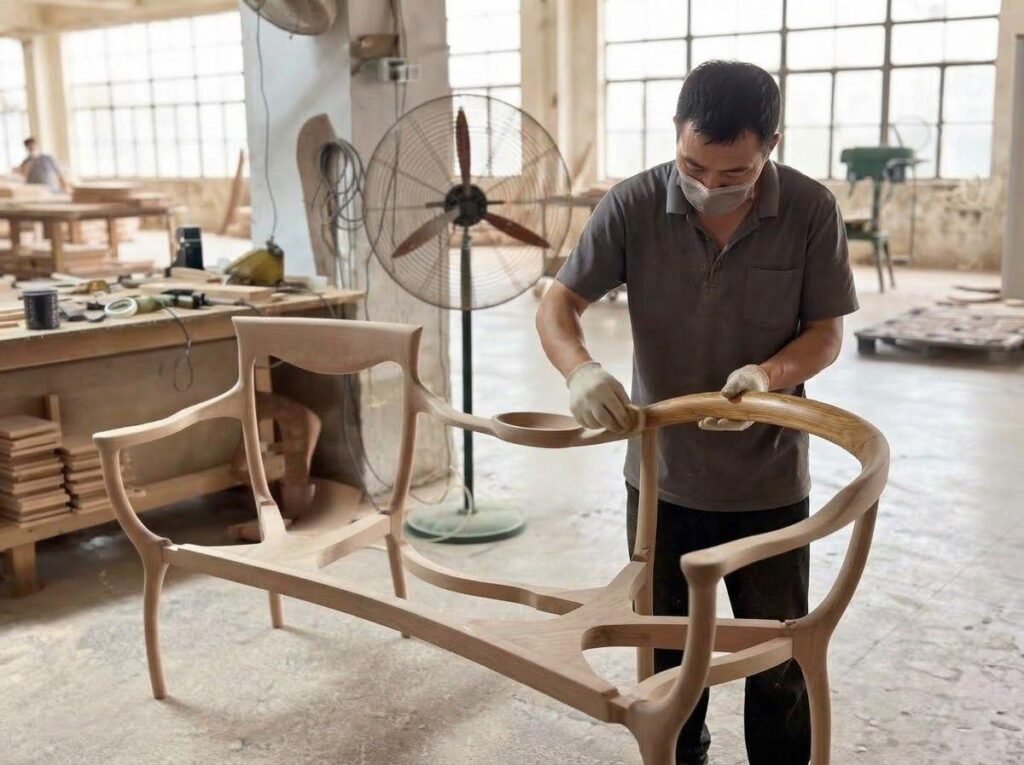
The Disconnect: Speaking CAD vs. Speaking ‘Chabuduo’
By definition, a China furniture prototype is the physical realization of a design concept manufactured in a Chinese facility. It is supposed to serve as the definitive, non-negotiable baseline for mass production quality, materials, and structural integrity.
But getting to that baseline requires speaking the exact same language. Reviewing a first sample without a hyper-localized, idiot-proof tech pack is like trying to bake a complex soufflé using a recipe written in a language you don’t speak, using substitute ingredients you found at a gas station. It is going to crash.
Western designers obsess over clean lines, hidden hardware, and gravity-defying floating cantilevers. It looks great on an iPad.
Chinese factory bosses? They care about structural stability. Standardized screws. Yield rates. And making absolutely sure nobody files a multi-million dollar warranty claim six months from now when an overweight hotel guest plops down on the chair too hard and breaks it.
When these two completely opposed mindsets collide in a dusty sample room in Foshan, the factory will invariably alter your design. They want to make it cheaper, faster, and safer for their assembly line to build.
Actually, let me walk that back a bit. That’s not totally fair. The crazy thing is, the factory usually thinks they are doing you a massive favor by “fixing” your overly complex, fragile blueprint.
They’ll jam in an ugly, thick crossbar between the chair legs because they simply do not trust your specified mortise and tenon joint to hold up over time. They’ll fatten up a delicate chair leg because their standard CNC router bits are already calibrated for a thicker diameter, and changing the tooling takes too much time. They look at the altered, bulkier piece, shrug, and say “chabuduo” (close enough).
Assuming a factory will blindly execute a drawing without filtering it through their own manufacturing habits is the most expensive mistake you can possibly make. Approve a sample based purely on its pretty exterior while ignoring how the skeleton was actually assembled? You’re buying smoke and mirrors.
The Classic Material Bait-and-Switch
Let’s talk foam, fabric, lumber, and lacquer. The four horsemen of the sample room apocalypse.
When a factory builds a mockup, they’re aggressively watching the clock. If your specified 34kg/m3 fire-retardant foam takes two weeks to arrive from their supplier in Hangzhou, they won’t wait. They will absolutely stuff that chair with standard 28kg/m3 junk they have sitting in the corner of the upholstery room. Just to get the visual shape dialed in for your visit.
Why does my premium velvet feel like cheap felt?
“We will use the correct material in mass production. Don’t worry, boss.”
Your sales rep will promise you this on WeChat at least a dozen times before your flight even lands at Baiyun Airport.
Never, ever accept this premise.
If you approve a prototype laden with substitute materials, you just nuked your own quality control baseline. When the mass production containers arrive at the port of Long Beach and the fabric starts pilling after six months in a busy hotel lobby, guess what? The factory will point straight back to that approved sample. They’ll pull up the signed document and claim they did exactly what you agreed to. And legally? They are right.
If the piece sitting in front of you does not feature the exact commercial-grade materials required for the final run, it is a mockup. Mockups absolutely do not get signed off under any circumstances.
And don’t even get me started on the wood finishing. Trying to get a mainland factory to match a tiny 2×2 inch physical wood chip you mailed them from New York is a nightmare. They will almost always default to a heavy, thick PU (polyurethane) lacquer that completely kills the natural grain of the wood, simply because it covers up imperfections and requires less sanding time than a proper NC (nitrocellulose) open-pore finish. You have to fight them tooth and nail to get the finish right on the prototype, or your final product will look like plastic.

The “Golden Sample” Trap
Here is a scenario that traps even seasoned procurement veterans. You go through the agonizing Chinese sample making process. You argue, you adjust, and finally, on round three, the factory presents you with the “Golden Sample.” It is perfect. The stitching is flawless. The joints are tight.
You sign the paperwork, wire the deposit, and fly home. Four months later, the containers arrive, and the mass production is utter garbage.
What happened?
The factory boss put his single best 60-year-old master carpenter on your prototype to win the contract. But that guy isn’t building your 500 chairs. A team of twenty-something migrant workers on a rapid assembly line are building your 500 chairs. The prototype was a handmade piece of art; the mass production is a factory churn.
This is why you must evaluate not just the sample, but the factory’s actual capability to scale that specific sample.
Navigating the Ecosystem: Finding the Right Size
Not all manufacturers handle prototyping with the same level of chaotic energy. The ecosystem is massive, and you need to know exactly who you are getting into bed with. We are talking everything from sprawling, million-square-foot campuses with their own dormitories to highly specialized boutique shops hidden in alleyways.
Where you place your purchase orders dictates the kind of headache you’re going to have.
While some rookie buyers instinctively flock to massive OEM juggernauts that demand soul-crushing MOQs (Minimum Order Quantities), veterans realize that mid-sized specialists offer a completely different risk-reward setup. Take operations like Interi Furniture, for example, which focuses heavily on bespoke and project-based manufacturing.
These mid-tier players actually have the operational flexibility to iterate on a China furniture prototype without treating your design team like a massive nuisance. Why? Because their entire survival relies on engineering complex, lower-volume items. They aren’t trying to churn out 10,000 identical white dining chairs for a discount retailer; their business model is built around solving structural problems for hospitality and high-end residential buyers.
You need a factory that has a dedicated R&D sample room—a separate department that operates entirely independently of the main mass-production line. If they are building your prototype on the main line, you are already losing.
The Unforgiving Tear-Down Protocol
So you’ve landed. You survived the harrowing two-hour DiDi ride to the industrial park, dodging transport trucks and mopeds the whole way. The prototype is sitting right in front of you in the showroom.
Now what?
Don’t just sit in the chair, nod politely, drink their green tea, and say it looks nice. You need a brutal, unapologetic teardown routine.
- The Drop and Drag: Pick the piece up. Drop it from about six inches off the concrete. Listen for rattling. Drag it hard across the floor. If the frame twists even a fraction of an inch, the internals are garbage. The mortise joints are loose.
- Demand the Naked Frame: Never approve an upholstered piece without staring at an exposed, raw frame right next to it. Verify the wood species. Check the corner blocking. Inspect the glue wipe-off. If you skip this step, I guarantee they will hide cheap MDF inside your “solid wood” sofa.
- The Hardware Audit: Grab a screwdriver from the factory floor. Back a screw out. Are they using cheap drywall screws instead of proper wood screws? (I watched a $2,000 sofa literally fold in half during a hotel installation because the factory saved maybe four cents on fasteners. True story).
- Moisture Content Check: Bring your own moisture meter. Jam it into the raw wood. If it reads over 12% in that humid sample room, that wood is going to warp, split, and crack the minute it hits a heated, dry apartment in Chicago or a desert climate in Arizona.
The Ultimate Red Flag: The factory nails it perfectly on the very first try, zero pushback, in record time.
If this happens, your alarm bells should be ringing. It almost certainly means they outsourced the sample making to a highly skilled local master craftsman down the street just to win your business. They have absolutely zero capability to actually replicate that handmade quality on their own messy mass production line.

Trenches FAQ: What Buyers Actually Ask Me
Q: Seriously, how much should a proper prototype cost?
A: Expect to pay 200% to 300% of your target mass-production unit price. If they offer to do it for free, they are burying the cost in your future unit price. Or worse, they are going to put absolutely zero engineering effort into it. Pick your poison, but understand that you pay either way.
Q: Is it okay to let them use local market equivalent materials just for the first round?
A: No. If your spec demands a specific rub-count commercial fabric or genuine American walnut, the prototype needs to use it. The only exception? If you’re strictly doing a rough “white-wood” test just to check scale, pitch, and ergonomics before doing a final aesthetic pass. But once you move to the final sample, it must be the real deal.
Q: What’s a realistic timeline for a sample iteration?
A: A genuine, built-from-scratch prototype takes 15 to 25 days. Period. If a factory promises a custom sofa prototype in a week, you’re getting an off-the-shelf white-label frame they already had lying around, with your requested fabric hastily stapled over the top of it.
Q: If the sample is awful, do I walk away or give them another shot?
A: Give them a second chance if the errors were just dumb aesthetic misses or genuine misunderstandings of a weirdly drawn CAD file. Language barriers happen. But kill the project immediately if the errors involve deliberate deception—like hiding cheap MDF under a wood veneer when you explicitly paid for solid ash. Deception in the sample room means deception in the container.
Q: Can I approve a first sample off high-res photos and a Zoom call?
A: Absolutely, unequivocally no. It depends entirely on whether you like losing money and getting fired by your clients. (But seriously, no. Get on a plane).
The Final Polish
Sourcing over here isn’t for tourists. The sample room is where the real bleeding happens, where margins are won and lost before the cutting machine even turns on. A prototype isn’t just a chair; it is a binding physical contract made out of wood, foam, and fabric. Accept a flawed contract, and you have no one to blame but yourself when the shipping containers arrive full of unsellable trash.
Factories respect buyers who are a pain in the ass. Show up with a tape measure, a moisture meter, a flashlight, and the sheer audacity to rip a seam open just to check the stitching allowance. That’s when they stop treating you like a walking ATM and start treating you like a real partner. They realize they can’t slip anything past you.
But seriously, I have to ask: if you aren’t willing to spend the cash and endure the grueling jet lag to tear down a prototype in person, do you really have any business importing this stuff at all? Keep your standards ruthless. Make your tech packs bulletproof. And never, ever trust a factory boss who taps a cigarette and tells you it’s “close enough.”