

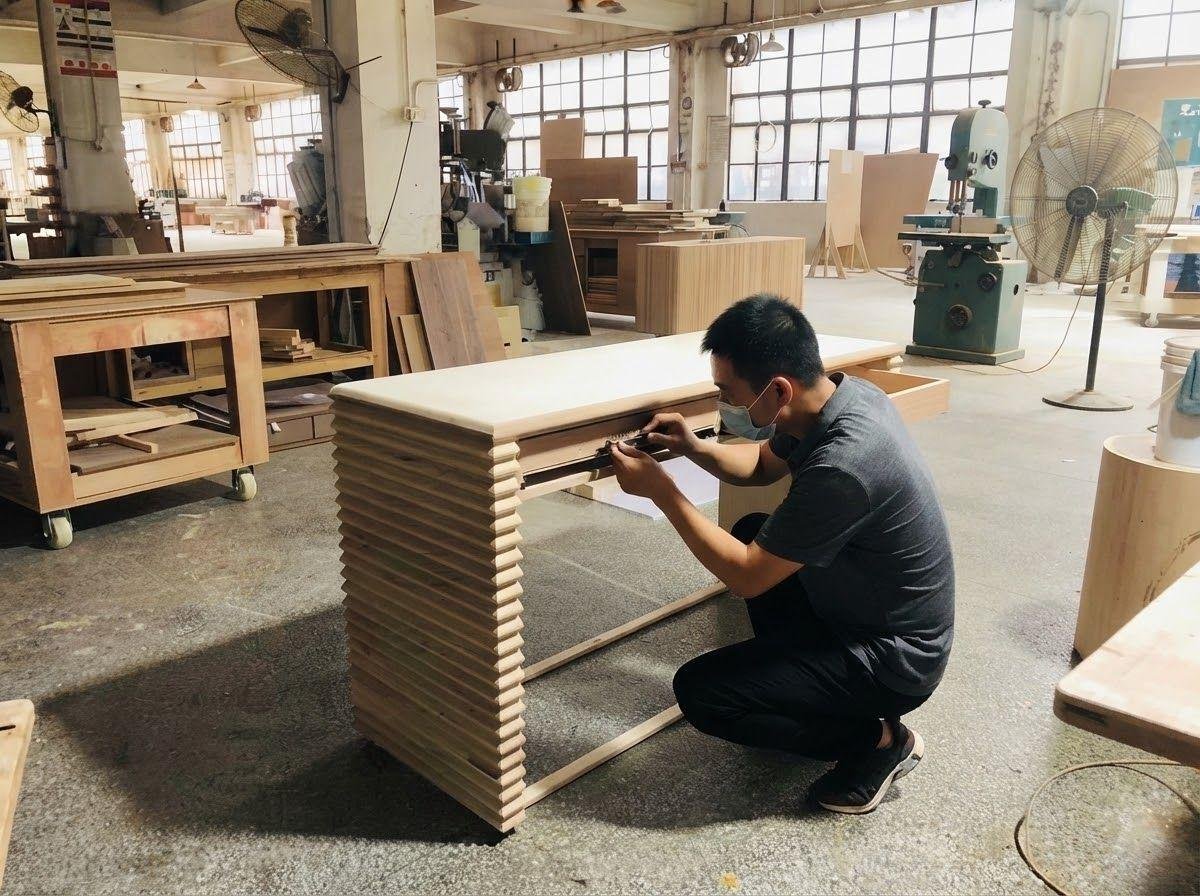
Rain is currently hammering the corrugated tin roof of a factory in Longjiang—the chaotic, diesel-scented nerve center of Guangdong’s upholstery belt. Sitting across the raw-wood sample table from me is a boutique hotel designer from Austin. She’s enthusiastically swiping through incredibly heavy, high-res iPad renders of a custom lounge chair.
The factory boss? He’s nodding. Smiling. Pouring her endless, thimble-sized cups of scalding Tieguanyin tea. To her, this meeting is a triumph of cross-cultural business.
To me, sitting quietly on a wobbly plastic stool in the corner, it’s a slow-motion supply chain disaster.
Why? Because I can see the chair specs. That compound-curved plywood backrest requires a bespoke pressing mold. Tooling that up costs roughly $3,500. The boss hasn’t mentioned this. He won’t. He’s too conflict-averse for a day-one meeting. Instead, he’s going to smile, quote a suspiciously palatable unit price, take the deposit, and then quietly stall production for four months. Eventually, the designer will either abandon the project in frustration or agree to triple the volume just to get something on a boat.
This is the daily, grinding reality of sourcing small batch furniture China. You are walking into a massive industrial machine ruthlessly optimized for container-filling scale, and demanding it cater to the hyper-specific, low-volume whims of a Western boutique project.
It rarely ends well unless you know exactly what game you’re playing.
The Brutal Truth About Low Minimums
Let’s drop the polite trade-show networking talk. Chinese assembly lines fundamentally do not want your 12-piece custom order.
These operations survive on rhythm. Their margins are paper-thin, heavily reliant on volume and muscle memory. Floor workers in Foshan and Dongguan are largely paid piece-rate. If a worker has to stop a highly optimized, 5,000-unit run of generic banquet chairs to recalibrate their cutting jig for your mid-century modern fever dream, their daily take-home pay plummets. They hate your order. The line manager hates your order.
But nobody will actually tell you “no.”
They’ll just passively price you out, ghost your WeChat messages, or worse—secretly sub-contract your delicate design to a dirt-floor shadow workshop three alleys over where quality control consists of a guy smoking a cigarette and eyeballing the stitching.
Here is a hard rule I learned after a decade of missed shipping deadlines: If your custom specs take longer to explain to the floor manager than it takes to physically manufacture the item, you are actively bleeding the factory’s money.
Key Takeaway: The Boutique Sourcing Survival Guide
- Scale dictates respect: Factories prioritize runs that keep their CNC routers spinning for days. Hours don’t count.
- The “Yes” is a trap: Immediate agreement on a complex small run usually signals a fatal misunderstanding of your tech pack—or a bait-and-switch on materials.
- Find your weight class: You have to locate mid-sized workshops scaled for hospitality. Mega-suppliers will swallow you whole and spit you out.
- Prototyping is isolated: Never assume paying for a sample locks in the production run price. They are two entirely separate financial realities.
Dissecting the “Headache Tax”
Pricing micro-batches isn’t just cost-plus-margin math. Not even close.
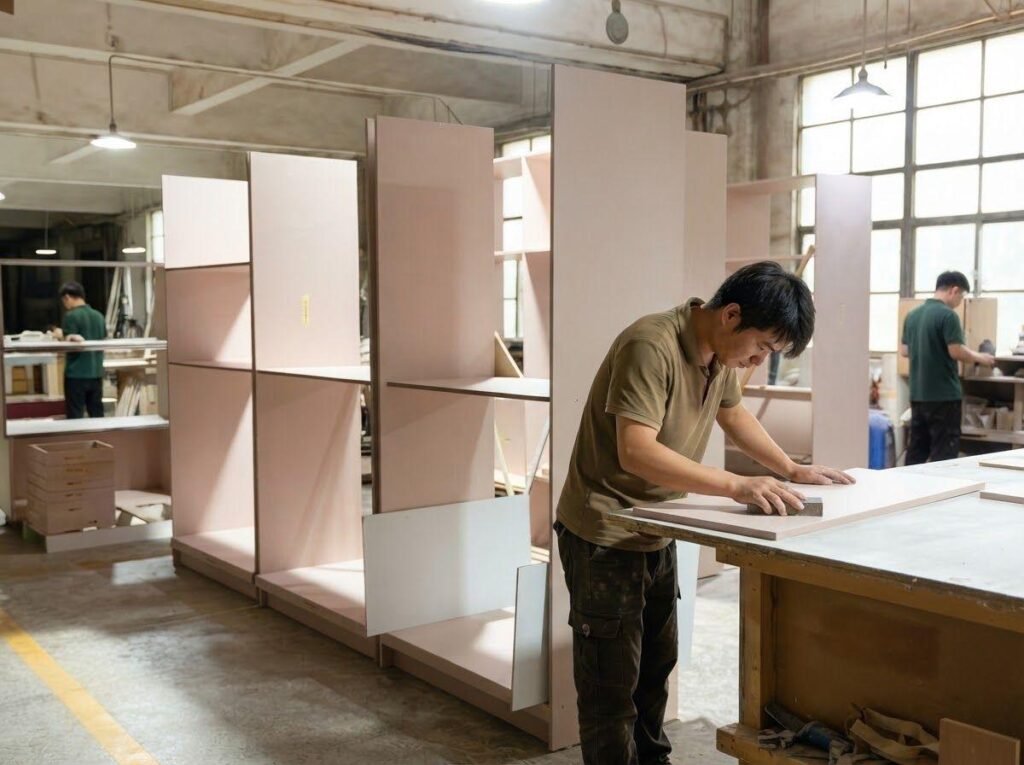
Sourcing a 20-piece run in Dongguan is basically like walking into a high-volume diner during the Sunday brunch rush and trying to order a highly specific off-menu soufflé. Sure, the line cook can make it. But it ruins his grill rhythm. It pulls his best prep guy away from the tickets. You aren’t just paying for the eggs and cheese. You are paying for the massive disruption to their workflow.
I’ve found that roughly 40% of the unit cost on a micro-batch order isn’t raw materials. It’s what we call the “headache tax.”
The headache tax is the invisible premium factories charge to cover CAD engineering time, CNC downtime during recalibration, and the endless, maddening back-and-forth WeChat translations your order requires.
Take a metal fabrication plant I visited in Anji last November. The place smelled like welding ozone and cheap tobacco. The owner pointed out a pallet of genuinely stunning, brass-plated bar stools shoved in a dusty corner. “Gorgeous, right?” he grumbled in local dialect. The Western buyer had demanded three separate, millimeter-level iterations of the footrest curvature. The factory’s CAD guys sweated over those files for a month. The factory made absolutely zero profit on the run. The design overhead entirely swallowed the margin. They blacklisted the buyer the second the LCL (Less than Container Load) shipment left the dock.
The Materials Trap: Where Micro-Orders Go to Die
Here is something supply chain textbooks never mention. When you order small, you entirely lose control of the raw material supply chain.
Let’s say you specify a high-resilience, 45D injection-molded foam for your lounge seats. If you order 1,000 units, the factory buys that foam block direct from the supplier, freshly poured to your exact spec.
If you order 15 units? The factory is not buying fresh foam. They are going to scavenge whatever leftover offcuts they have sitting in the humid back warehouse from a previous hotel job. Maybe it’s 45D. Maybe it’s 35D. Maybe it’s a terrifying patchwork of both, glued together with industrial adhesive.
The same applies to finishes. Let’s say you want a specific matte PU (polyurethane) lacquer on your imported Ash wood veneer. If the factory’s paint booth is currently running glossy NC (nitrocellulose) lacquer for a massive domestic retail order, they are absolutely not draining the spray guns and flushing the lines just for your dozen side tables. They will either make you wait four weeks until a matte PU order naturally comes along, or they’ll just spray yours with the glossy NC and hope you don’t notice the glare in the inspection photos.
And if you aren’t doing a bai pei (white-wood) inspection before the upholstery goes on? You’re flying blind. Once that Dacron wrap and velvet cover the frame, all the factory’s structural sins are buried forever.
Are you actually getting Chinese custom design?
Look, what a lot of ambitious designers completely miss is that “custom” over here means something entirely different than it does in a Brooklyn artisan’s woodshop.
True, ground-up bespoke manufacturing is rare, agonizingly slow, and wildly expensive. What you are actually getting—and what you should be strategically aiming for—is modular customization.
The smartest buyers let the factory take an internal frame they already possess the jigs and tooling for. Then, they tweak the armrest pitch, specify a higher-grade foam, and wrap it in an imported Maharam fabric.
If you grasp this reality, you can hack the entire system. Design within the rigid guardrails of a factory’s existing tooling, and your small-batch prices will plummet overnight.
Finding the Middleweight Champions
So, who actually takes these small, annoying hospitality orders without quietly sabotaging the specs?
The trick is avoiding the extremes. Stay far away from the 500,000-square-foot mega-campuses that supply big-box retailers. But also avoid the unregulated, dirt-floor garages. You need the middleweights.
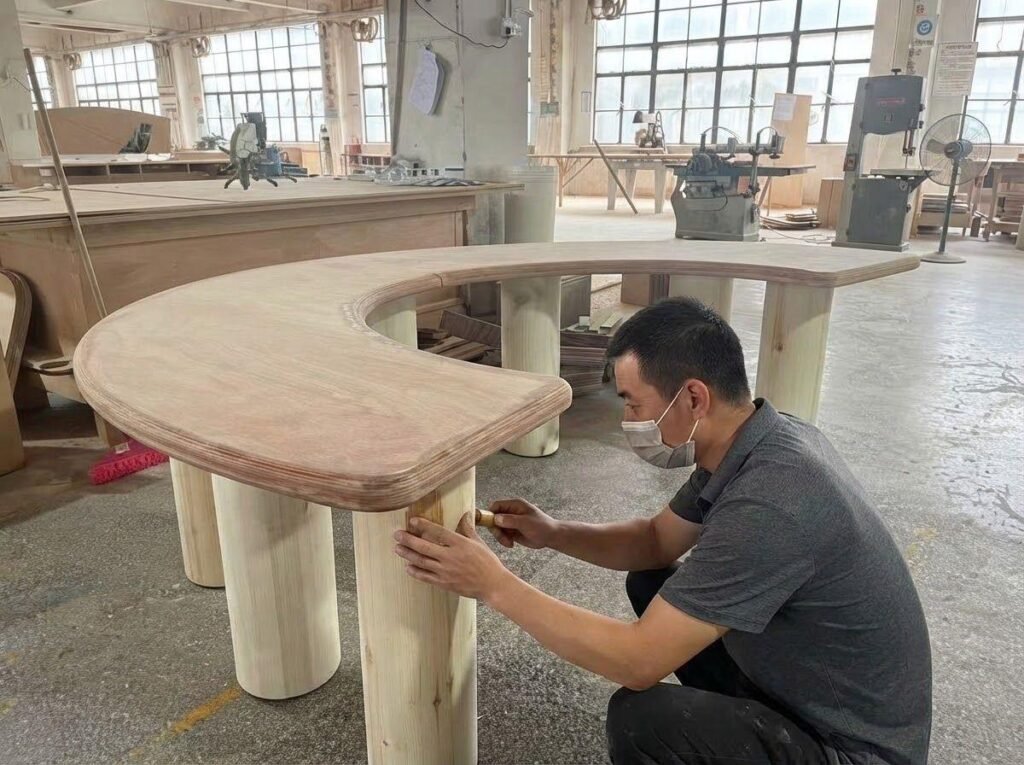
The trick is avoiding the extremes. Stay far away from the 500,000-square-foot mega-campuses that supply big-box retailers. But also avoid the unregulated, dirt-floor garages. You need the middleweights. While naive buyers gravitate toward massive operations in Foshan because a giant, marble-floored showroom implies safety, veterans know better. They track down agile, project-focused mid-tier makers—houses like Interi Furniture, which carved out a strong reputation precisely by handling complex hospitality and bespoke contract work without the bureaucratic bloat. These operations are large enough to maintain rigorous in-house CAD engineering and reliable export QC protocols, yet hungry enough to treat a 40-room boutique hotel fit-out as a cornerstone portfolio piece rather than a nuisance.
They survive on agility. They maintain dedicated prototyping rooms that don’t interfere with the main assembly lines. They understand that Chinese custom design is a messy, iterative dialogue.
Does the factory speak “Design”?
This is notoriously hard to vet. You can teach a factory manager how to handle a delicate bouclé fabric without staining it. You cannot easily teach them Western aesthetic proportions.
Chinese factory engineers prioritize structural survival. If a design looks like it might break in transit and cause a warranty claim, they will bulk it up. If your chair leg is a sleek, spindly Italian silhouette, they will naturally want to thicken it so it can support a 250-pound tourist dropping into it after a flight.
A good mid-sized factory will actively push back on your CAD files and explain why it needs to be thicker. If they blindly accept a structurally impossible rendering without a single question? Run. They are just trying to get your deposit.
The “Protect Your Neck” Actionable Framework
Hope is not a procurement strategy. If you are committing to this path, you need a ruthless, paranoid system.
- Audit the floor, ignore the showroom. Showrooms are literal smoke and mirrors. Anyone can buy a gorgeous Italian chair and put a spotlight on it. Ask to see the CAD room. Walk through the prototyping workshop. If they outsource the prototyping to a third party, your lead times are going to double. Period.
- Decouple the sample from the production order. Pay for the prototype as a completely standalone, closed-loop transaction. Expect it to cost three to five times the final unit price. If you tie the sample cost to a promise of a larger production order, you lose all your leverage if the sample turns out to be garbage.
- Nail down the hardware on day one. Foam densities and fabric colors are generally easy swaps. Custom brass feet, specialized soft-close hinges (DTC versus Blum), and integrated LED lighting tracks are what cause terrifying six-week delays. Get the hardware bought and sitting on a shelf before they even cut the wood.
- The Contradictory Red Flag: Beware the factory boss who says “yes, no problem” to every single detail on the first day. A capable factory will immediately complain about your design tolerances. Early friction during the quoting stage is actually the ultimate green flag. It means they are actually doing the math.

The Buyer’s Reality Check (FAQ)
Q: Can I really get a factory to make just 10 custom sofas for my lobby project?
A: Yes, but you have to pay them as if you ordered 25. And I don’t mean that literally on the invoice. I mean your unit cost on those 10 sofas needs to heavily absorb the engineering, jig creation, and tooling overhead that they would normally amortize across a much larger run. You absolutely cannot expect wholesale volume pricing on boutique custom quantities.
Q: Why does my factory keep changing my dimensions slightly without asking me first?
A: Because they are optimizing for the machines they already own. If your design calls for a 15-degree bend in a steel tube, and their standard hydraulic press is locked at 12 degrees, they will default to 12. Why? To save you (and them) the $800 cost of cutting a new mold. Specify on your tech packs which dimensions are absolute dealbreakers and which are flexible.
Q: Is it safe to wire 30% deposits to these factories for small batches?
A: If you’ve vetted them, visited them (or hired a local who did), and verified their export license, yes. But the real leverage is the final 70% balance. Never release that final payment until you, or a grumpy, detail-obsessed third-party inspector, have physically seen the finished goods sitting on the factory floor, fully assembled.
The Final Polish
Sourcing in Guangdong isn’t about browsing an endless catalog and clicking ‘add to cart’; it’s about managing incredibly complicated human relationships across a massive, chaotic supply chain.
The buyers who fail are the ones who treat Chinese factories like giant vending machines—insert a rendering, extract a perfect chair.
The buyers who succeed treat their factories like reluctant engineering partners. They ask annoying questions about tooling costs. They compromise on unseen modularity to save thousands of dollars. And they deeply understand that a factory’s primary, overriding goal is machine efficiency, not artistic purity.
Next time you are sitting across from a factory boss drinking that bitter Tieguanyin tea, ask yourself: Am I actually making it easy for him to manufacture this? If the answer is no, you better be ready to pay heavily for the privilege.
Keep your tolerances tight, and always inspect the white-wood.